integrated metrology community.

News
EMPIR project research is highlighted in Finland’s largest newspaper
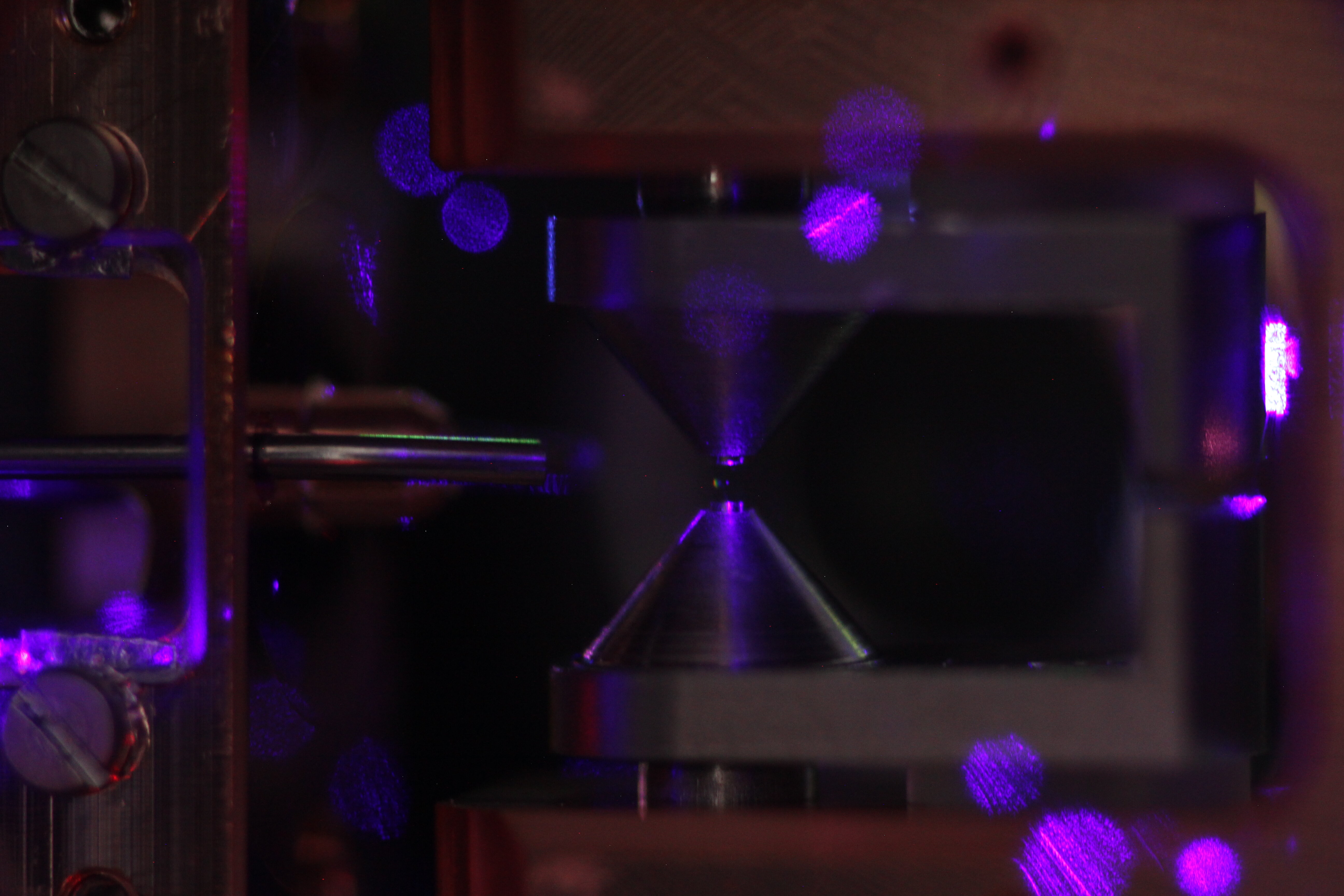
Single Sr+ ion in VTT ion trap
Newspaper article on optical clocks highlights the potential for even greater precision with international time-keeping
The project
Around the world, we are able to measure time to an extraordinary level of accuracy. In fact, atomic clocks, which form the basis of international timekeeping, are the most precise measurement devices available today. Despite this, there is still scope to increase their measurement accuracy and stability, bringing us to the next-generation of atomic clocks that use optical frequencies – optical clocks.
Most optical clocks today are formed from laser-cooled single ions, that are cooled down to near absolute zero temperatures, and then confined using electromagnetic fields. However, EMPIR project ‘Coulomb Crystals for Clocks’ (17FUN07, CC4C) is investigating an alternative, multi-ion approach and a more advanced form of laser-cooling for building optical clocks. The project will enable new research opportunities concerning new ion species, ion collisions, and also overarchingly improve the stability and precision of optical clocks to meet demands for accurate time – in sectors like telecommunications, and energy networks, and in research on fundamental physics.
Article on optical clocks published in Finland’s largest newspaper
Within the project, researchers have successfully developed innovative experimental equipment that has drawn attention from several journals. A number of peer-reviewed scientific papers that outline project findings have been published – including those that explain the development of apparatus for hybrid quantum system experiments, a cryogenic radio-frequency ion trap for quantum spectroscopy, and a cryostat for ion traps. These findings will be critical in pushing the boundaries of fundamental measurement science.
In addition to this, significant interest from the scientific community has also led to the publication of a 2-page feature article in Finland’s largest newspaper, Helsingin Sanomat. The article, published in July 2019, showcases the optical trapped-ion clocks developed at VTT Mikes, Finland’s centre for measurement science. The article brings light to the extreme sensitivity and precision of these newer optical clocks, and their potential to revolutionise communications, satellite navigation, and aerospace fields. This feature in a popular, daily Finnish newspaper will additionally help to disseminate project outcomes to a broader audience outside of the scientific community.
The project consortium continues to study new methods for building optical clocks. Their research is centred around clouds of ions that are cooled down to the point of crystallisation – otherwise known as Coulomb crystals. Through their research, the consortium is striving to not only improve the operational reliability of optical clocks, but also to foster links between metrology and other disciplines where optical clocks could have new applications - like nuclear physics. In the longer term, the project group envisions a future redefinition of the fundamental unit of time; the SI second.
This EMPIR project is co-funded by the European Union's Horizon 2020 research and innovation programme and the EMPIR Participating States.
Want to hear more about EURAMET?
Sign up for EURAMET newsletters and other information
Follow us on LinkedIn and Twitter
Information
- EMPIR,
- Fundamental,

Developing a metrologically-based field assessment of glare and obtrusive light more

Standardising industrial procedures for the magnetic properties of devices leading to the improved quality of a wide variety of products more
Implementing quantum-based pressure measurement techniques in European industries more

Developing reference materials for mass spectroscopy to monitor radioactive and stable isotope pollution in the environment more

Development of the metrological network needed to realise and implement 6G technology more