Case Studies

Page 1 of 44.
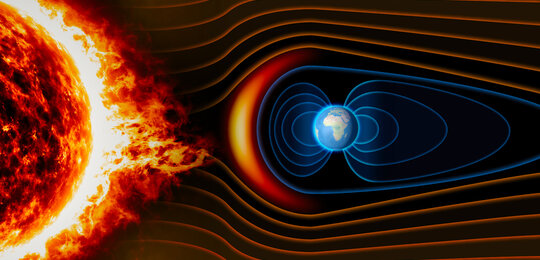
On the left-hand side of the image is the sun with fiery solar flares extending across the picture to the Earth on the right-hand side. Here the Earth’s magnetic field is acting like a “shield” diverting the fire around the planet

Understanding and predicting the effects of solar storms with a new AI model

One of the first discoveries of the space age in 1958 was the existence of two doughnut-shaped radiation zones around the Earth, the “Van Allen Belts”. Formed from energetic particles generated by distant cosmic events or from the solar wind, these follow the Earth’s magnetic field lines. The inner belt, composed mostly of ener...

read more
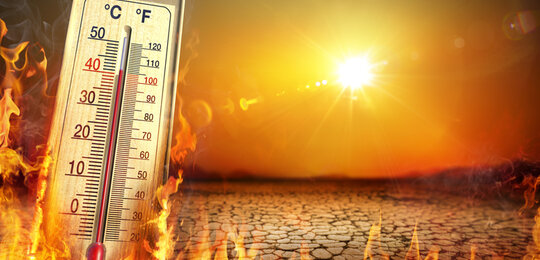
In an orange sky the sun beats down onto cracked dry earth with a burning thermometer on the left of the image reading over 40 degrees centigrade

Using outer space as a limitless, energy efficient heat sink

The vast majority of sunlight reaching the Earth’s surface is composed of UV and visible shortwave radiation (≤3 μm). This energy is absorbed by the oceans and landmasses and reemitted as longwave thermal radiation (4 μm - 100 μm). Although some escapes into space, certain wavelengths are absorbed by atmospheric gases such as c...

read more
In the foreground of the image is a virtual screen with an image of a brain with “AI” in the centre and the words “Neuromorphic computing” underneath

Developing the neuromorphic computer chips of the future

The EU targets reducing greenhouse gas emissions by at least 55% by 2030, compared to 1990 levels. The International Energy Agency, however, has highlighted that, data centres alone consumed 1.5% of the world’s electricity in 2024 and, partly due to energy-intensive computing such as AI, this will more than double by 2030. One ...

read more

In the background are white clouds and a blue sky and set against these are the words “CO₂” with the “O” represented by the planet Earth

Reducing cost and improving the accuracy of radiometric sensor calibrations: Terrestrial and space

Over the last few centuries, carbon trapped by millions of years of plant and animal deposition has been released into the environment as carbon dioxide (CO2) through the burning of fossil fuels. In 1958 the measured level of this greenhouse gas in the atmosphere was 315 parts per million (ppm), in 2024 it reached 423.9 ppm and...

read more
A close-up of a microfluidic device. Image courtesy of Elsa Batista (IPQ)

New standards for easy to use, cost-effective microfluidic devices

Many highly sensitive processes in biomedicine or chemical analysis rely on the accurate measurement of nano-to-millilitre amounts of liquid. This can range from delivering precise drug doses to premature babies in hospital, to detecting trace amounts of pollutants in the environment. In the healthcare sector in particular, org...

read more
View of Parque Nacional Patagonia, Chile, rendered using Eradiate Credit: Rayference

Modelling the interaction of sunlight with the Earth

The Earth’s energy budget describes how much radiation from the sun reaches the Earth’s surface and how much escapes back into space. Knowledge of how this is changing is not only important in understanding and predicting climate changes, but also essential in areas including weather forecasting, air quality monitoring, vegetat...

read more
Page 1 of 44.
Element 1 Element 2 Element 3 Element 1 Element 1 Element 1 Element 1 Element 1 Logo-Footer