integrated metrology community.

News
EMPIR project leads to development of two new facilities for improved MRI device measurements
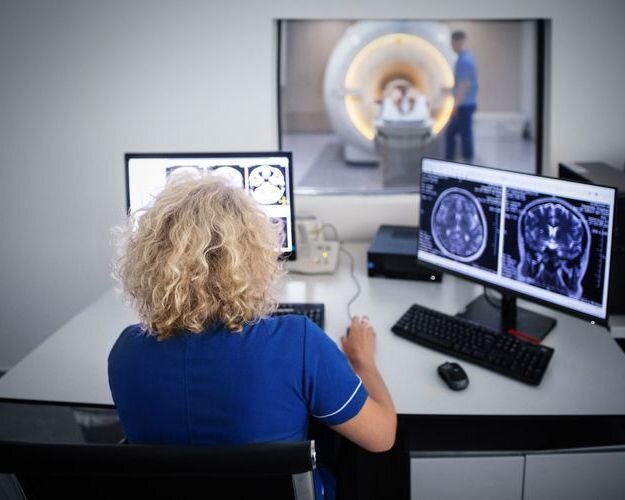
MRI scanning procedure
Enhancing comparability for diagnosing and monitoring medical conditions
The project
Magnetic resonance imaging (MRI) used in routine clinical practice produces images designed for single use, to be looked at by individual human experts. Cancers, heart disease, dementia and stroke can all be detected and monitored using MRI. European health services maintain thousands of MRI scanners from different manufacturers, with various ages, field strengths and pulse sequence implementations. Although a powerful tool, it lacks consistency when comparing images acquired on different scanners or at different times.
MRI scanners can also produce images known as quantitative MRI (qMRI), which measure actual physical properties of tissue, and which can provide additional consistency and specificity, but these measures need metrological support.
Completed EMPIR project Improved metrology for quantitative MRI (20NRM05, iMET-MRI) developed test objects, procedures, analysis tools, and best practice guidance for various qMRI techniques and demonstrated them in an international multi-site trial.
Phantoms
The consortium created simple fat phantoms supported by primary standard metrology and traceable using a benzoic acid reference material as an internal standard. More complex fat mimics were also investigated, particularly regarding limitations of the current metrological capability.
Iron content mimics were also developed and are currently going through testing for long term stability alongside the other test materials.
The work was described in the paper A standard SI traceable phantom suitable for qMRI: design, manufacture and characterisation which was published in the journal Metrologia.
Good Practice Guide
This project developed a new Good Practice Guide for assessing scanner performance in qMRI, which included test objects and testing procedures for relaxometry, proton density fat fraction, diffusion, and iron content imaging. The guide also forms the basis for further development of international standards and additional qMRI measurands.
Software
The project also led to a software tool called GAMS (general algebraic modelling system) software which was designed to reproduce the entire MRI image acquisition pipeline, including the definition of the MRI pulse sequence in a standard, open format (Pulseq), a detailed, physically-derived digital model of the phantom and its 3D spatial structure, a detailed model of the physics of the MR acquisition process via Bloch equations, and the processing of the simulated k-space data for MRI image synthesis. This software enables measurement uncertainty to be calculated in ways that were not previously possible.
New NPL primary standards facility
The work of this project has led to a new SI-traceable primary standards facility being built at NPL. Companies making MRI phantoms will be the first users of this facility. This facility includes a viable-field NMR spectrometer with time, field strength, and temperature all traceable to UK primary standards and able to measure T1, T2, and Apparent Diffusion Coefficient. This lab will act as a UK primary standard for qMRI, with additional measurands and capabilities added over time.
New INRiM facility
A new laboratory at INRiM, to be opened in the first half of 2026, will be equipped with a nuclear magnetic resonance spectrometer that will be used to measure the T1 and T2 relaxation times of magnetisation of the tissues mimicking materials. These relaxation times are crucial for understanding tissue properties in MRI and can vary depending on the type of tissue and the magnetic field strength used.
The system will later be extended to perform measurements of apparent diffusion coefficient. In the long term, the system will become a real primary standard for qMRI.
The laboratories will both offer a materials characterisation measurement services to hospitals and companies. In addition, customers will be able to request materials with target properties, which will then be certified in the laboratory. This has a number of applications, including periodic monitoring of the performance of a clinical lab over time.
Work at the two centres will be carried out in close collaboration between the two centres as well as with similar facilities at NIST to ensure international consistency.
Project coordinator Matt Hall from NPL said
‘This is an exciting time for MRI metrology. We’re seeing new capabilities at the European level and a real momentum developing in quantitative approaches. This was crucial to support the clinical application of qMRI, and realise the full benefit of decades of research work by the MRI community. The iMet-MRI project allowed Europe to develop world-class MRI metrology capability. We’re all very excited to see where this leads.’
This EMPIR project is co-funded by the European Union's Horizon 2020 research and innovation programme and the EMPIR Participating States.
Want to hear more about EURAMET?
Information
- EMPIR,
- Standardisation,

Enabling production of more reliable data and more rigorous assessments of climate change and variability more
The Spanish National Metrology Institute is an active member of the European Metrology Network (EMN) for Energy Gases more

Advancing the large-scale energy storage which is required for a shift to renewable energy supply more

Lowering measurement uncertainty and improving SI-traceability more

Stage 1 of the 2026 Call under the European Partnership on Metrology is open to submit potential research ideas more