integrated metrology community.

News
EMPIR project develops good practice guide to improve metrology for quantitative MRI
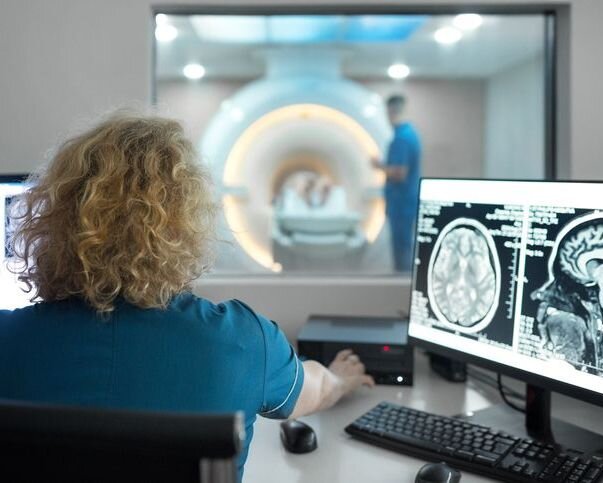
MRI scanning and images
Laying the groundwork for qMRI device comparability
Magnetic Resonance Imaging (MRI) is used in routine clinical practice and produces images designed for single use, to be looked at by experts. Although a powerful tool, MRI lacks consistency when comparing images acquired on different scanners or at different times. MRI scanners are capable of producing images known as quantitative MRI (qMRI), which can provide additional consistency and specificity, but these measures need metrological support. Quantitative medical resonance imaging produces images by making measurements of physical or chemical properties making these images useful for diagnosing cancer, heart failure and dementia.
Completed EMPIR project ‘Improved metrology for quantitative MRI’ (20NRM05, iMET-MRI) developed test objects, procedures, analysis tools, and best practice guidance for various qMRI techniques and demonstrated them in an international multi-site trial. The project has led to significant new investment in primary standard metrology in the UK and Italy.
The project developed phantoms with metrologically robust MRI-observable properties allowing assessment of this type of medical imaging, increasing the reliability and providing SI-traceability of each scan. Five types of measurement were considered in the project: two on magnetic relaxation, one measuring diffusion, iron content, and fat fraction.
Guidance for various techniques, procedures and test objects were developed, and then successfully demonstrated in an international multi-site trial.
Good Practice Guide
Much of the work from the project has been used in a draft good practice guide on qMRI calibration which includes the deployment of phantoms important for the assessment and comparison on MR image quality. The new guide also contains a proposal for a new qMRI normative standard.
This project established traceable and metrologically quantified measurements of clinically applied quantitative MR contrasts and will allow the independent assessment and calibration of different scanners, products, and services.
This would place these services on a similar metrological footing to other medical imaging modalities such as CT or PET, where the use of ionising radiation led to more developed metrological infrastructure than in MRI.
The project has helped to demonstrate traceability to the International System of Units (the SI) for this new medical technique. In the long-term this will allow better healthcare for millions of European citizens.
Project coordinator Matt G Hall from NPL said
‘iMet-MRI was successful in establishing a European capability in metrology for quantitative MRI. The project demonstrated how useful traceable references can be and has led to a lot of interest in the community, including from standards bodies where there are now ongoing discuissions around the need for improved international standards. We’ve also seen a huge gain in momentum in the area, with new primary standards facilities currently being built in both the UK and Italy.’
This EMPIR project is co-funded by the European Union's Horizon 2020 research and innovation programme and the EMPIR Participating States
Want to hear more about EURAMET?
Information
- EMPIR,
- Standardisation,

Developing a metrologically-based field assessment of glare and obtrusive light more
Standardising industrial procedures for the magnetic properties of devices leading to the improved quality of a wide variety of products more
Implementing quantum-based pressure measurement techniques in European industries more

Developing reference materials for mass spectroscopy to monitor radioactive and stable isotope pollution in the environment more

Development of the metrological network needed to realise and implement 6G technology more