integrated metrology community.

News
EMPIR project developed tools to allow objective detection of heart disease from electrocardiography
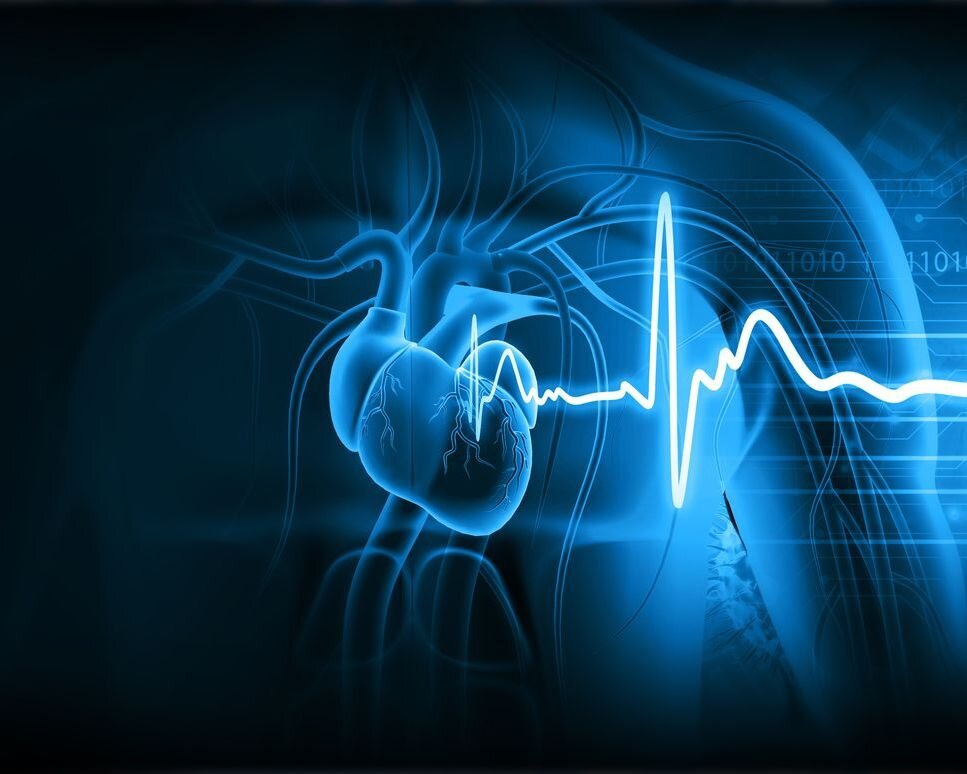
Artist’s impression of a beating heart
Three large databases to aid detection of cardiovascular disease available for cardiology community
Cardiovascular diseases (CVDs), which affect the heart and blood vessels, cause an estimated 10, 000 premature deaths per day in Europe. Essential to the correct detection of underlying heart problems, such as ischemia, or arrhythmia that can lead to stroke, is the use of electrocardiography (ECG) data obtained using non-invasive leads to record electrical signals from the heart.
Recently the advent of Machine Learning has enabled automatic detection of such events with high accuracy in a non-subjective way. However, to train software, and allow the direct comparison of algorithms with defined, metrics (known as “benchmarking”) large databases of ECG signals are required, which were not readily available before 2018.
This has been addressed by the now completed EMPIR project Metrology of automated data analysis for cardiac arrhythmia management (18HLT07, MedalCare).
ECG databases
To address the lack the project developed a number of ECG databases and released these to the cardiology community:
PTB-XL
An early output from the project was the streamlining publication of a large ECG database PTB-XL along with an accompanying paper: “PTB-XL, a large publicly available electrocardiography dataset.” Collected by PTB, the National Metrology Institute (NMI) of Germany, it is a comprehensive collection of 21,799 clinical 12-lead ECGs from 18,869 patients with many different co-occurring pathologies and from a large proportion of healthy control samples.
PTB-XL+
Clinical features were extracted from PTB-XL using two commercial ECG analysis software packages and an open-source software package “ECGDeli” developed within the project and released as PTB-XL+. Non-standard ECG features have also been considered using the PTB-XL+ and used for benchmarking, and supported with the paper: “PTB-XL+, a comprehensive electrocardiographic feature dataset”
MedalCare-XL
The project also established, for the first time ever, a “virtual population” of ECG-data with digital ground truth reference values. This synthetic database, MedalCare-XL, contains 16,900 lead ECGs based on multi-scale mechanistic electrophysiological simulations equally distributed into 1 healthy control and 7 pathology classes. A paper: “MedalCare-XL: 16,900 healthy and pathological 12 lead ECGs obtained through electrophysiological simulations” was published to support its use. The database is divided into training, validation, and test folds for development and objective assessment of novel Machine Learning algorithms. The synthetic data was validated against the PTB-XL database which demonstrated that the synthetic signals represent clinical ECGs for healthy and pathological subpopulations with high fidelity. It was cross-validated by applying a neural network-based Machine Learning algorithm and a subsection examined by experts within the framework of a clinical Turing test.
Other project results
Clinical Turing test
To check if the synthetic ECGs within the MedalCare-XL database would pass as clinical signals under diagnostic conditions a clinical Turing test was performed: Medically trained cardiologists were asked to determine if ECG traces were from real patients or from the synthetic MedalCare-X database. The clinical Turing test indicated some methods generally performed well and others performed poorly and provided valuable feedback for improving modelling of electrophysiology and its diagnostic capabilities.
ECGDeli software
During MedalCare the Karlsruher Institute for Technology (KIT) developed an open access-tool for the extraction of ECG features from clinical and virtual datasets, ECGDeli along with the supporting publication: “ECGdeli - An open source ECG delineation toolbox for MATLAB”. In addition to contributing to the diagnosis of specific cardiac diseases by analysing ECG signals this software can also be used to extend existing algorithms or as a benchmark for new algorithms.
Cardiology challenge
Towards the end of the project the PTB-XL database was successfully used to test new ECG algorithms in PhysioNet’s Computing in Cardiology Challenge 2020 for the classification of 12-lead ECGs as well as in the PhysioNet Computing in Cardiology Challenge 2021 on varying dimensions in electrocardiography.
In the long-term project results will bring a greater clarity to ECG traces, allowing automated detection of pathologies such as cardiac ischemia and arrhythmias in a clear, unbiased way.
Markus Bär (PTB) who coordinated the project said about the work: “The project has been quite successful due to its unusual combination of expertise – modelling experts for implementation of realistic cardiac models, metrologists for uncertainty quantification in simulations and machine learning applications as well as cardiologists who reviewed, guided and helped to improve the underlying models in an exercise best described as a clinical Turing test. Altogether the MedalCare project produced the first example of a database of synthetic ECGs (virtual cohort) and suggested ways to validate and improve it. At the same time, it provided a new extensive data base for ECG features based on clinical recordings and suggestions for benchmark protocols and uncertainty assessment for diagnostic machine learning algorithms. Apart from many well received publications from the project, its success is probably best demonstrated by the facts that the outputs are being used in new project consortia such as the EU TEF project (testing facility) for medical applications and that the databases are further expanded by individual partners and used in a considerable number of studies by other researchers. ”
This EMPIR project is co-funded by the European Union's Horizon 2020 research and innovation programme and the EMPIR Participating States.
Want to hear more about EURAMET?
Information
- EMN Mathematics and Statistics,
- EMPIR,
- Health,

Developing a metrologically-based field assessment of glare and obtrusive light more

Standardising industrial procedures for the magnetic properties of devices leading to the improved quality of a wide variety of products more
Implementing quantum-based pressure measurement techniques in European industries more

Developing reference materials for mass spectroscopy to monitor radioactive and stable isotope pollution in the environment more

Development of the metrological network needed to realise and implement 6G technology more