
Comparisons as continuously evolving bilateral comparisons
Project Description
The project will explore the feasibility of a network-based scheme for key comparisons (KCs). In contrast to a few top-down designed comparisons with many participants, the scheme would comprise many bilateral comparisons with relatively few participants in each. The diagram illustrates and contrasts bilateral networks to a traditional design using a graphical representation of a possible network of bilateral comparisons. The links represent direct comparisons between pairs of laboratories. The network would be allowed to grow by adding links when laboratories decide to undertake new bilateral comparisons.
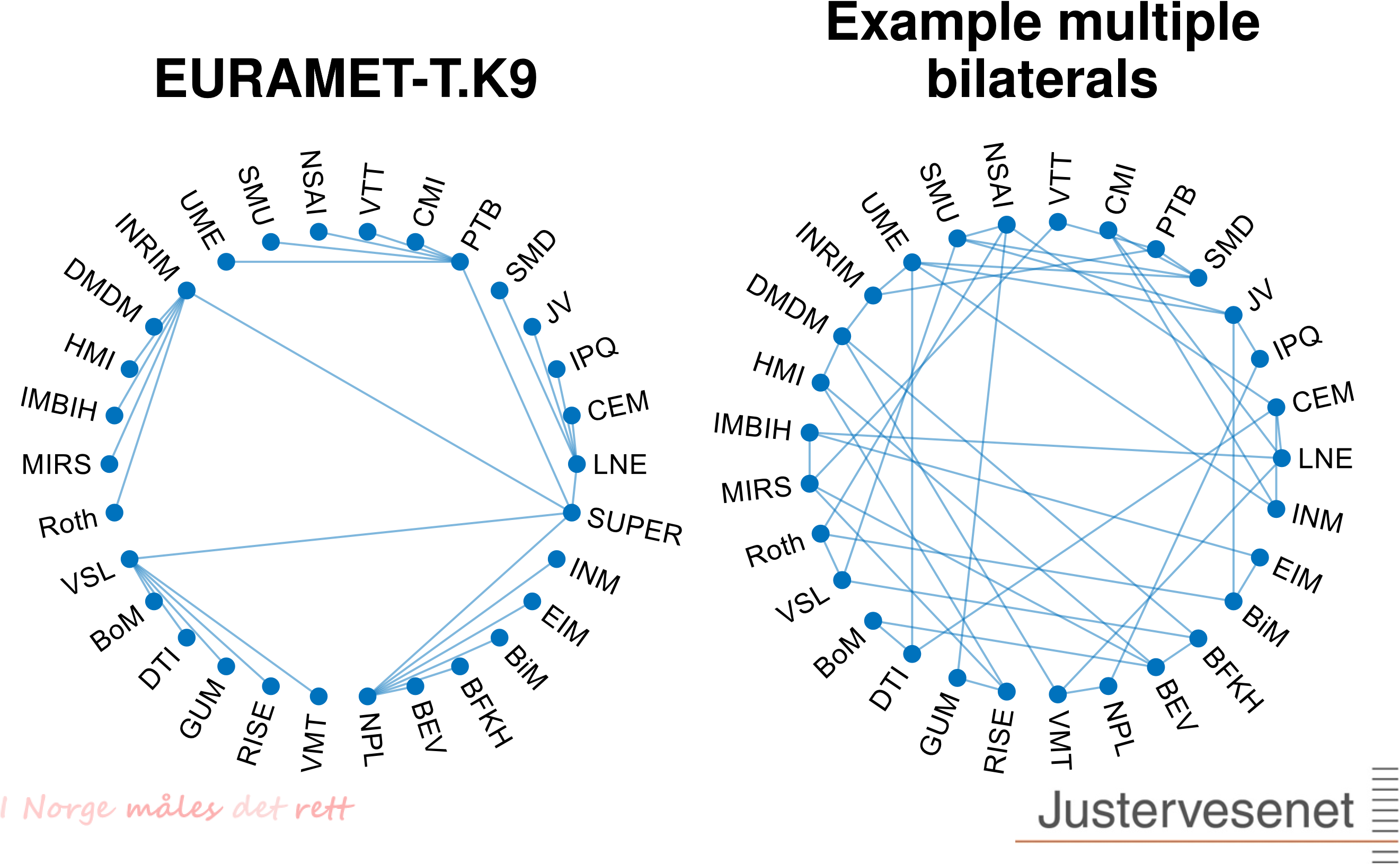
At each stage of the evolution, the consensus value, associated uncertainty and degrees of equivalence would be updated and compared with those at previous stages. The project aims to establish a basic theoretical description of the network KC structure and identify aspects to be analysed more deeply. Concentration will be on the economies in resources and time to be realised by such a scheme. This work would serve as the foundation for a project proposal within the EPM programme, or other suitable funding programmes.
The research will be conducted in combination with an EMN Mathmet activity.
Progress Report 2026-03-27
The project has mostly been dormant in 2025.
However, project partners supported the development of an EPM application under the Research Potential call scope.
The main activity in that proposal was development of digital tools to help in management, reporting and analysis of comparison data. But there were also some time and budget allocated to theoretical work: partly to compile a library of current methods in relevant data analysis, to provide best practice or guidance, to further develop the MCS and linked, networked bilateral concepts, and then to support the programmers with implementations of actual analysis tools. NPL and JV participated in the preparations, with the bulk of that work carried out by NPL.
The coordinator will propose to the TC-IM plenary that the project is ended in October with a report describing the networked bilateral comparisons idea. Instead, a new project will be proposed to deal with comparisons in general.
Progress Report 2025-03-21
PRT 2025 under Integrated European Metrology was prepared and submitted.
The PRT had 9 coauthors from NPL, PTB, AIST (Japan), LNE, SMD, VTT, LGC Limited and Random Red d.o.o.
The partners considered the original scope to be too narrow, and the PRT objectives goes beyond just bilateral comparisons. The objectives include a thorough, AI-assisted dive into the KCDB, expanding methods of analysis in traditional designs, and developing software tools. The PRT has some overlap with a proposal submitted under the RPOT call, APP46.
A paper is in progress on the MCS method. Part of the work in 2024 dealt with aspects of that method. It has been applied to new examples taken from the KCDB.A working document was written on the bilateral comparison idea, and some simple results deduced on the calculation of uncertainty for long link chains, with suggestions for how correlations may be handled under the GUM framework. There remains some open questions in the linkage procedure:
- One could compute explicit links along redundant paths in the network, between any two laboratories. Some work has explored how link uncertainty can be computed if there are correlations in the paths: (i) if each lab has some systematic, non-random effects that lead to correlations between different bilaterals, and (ii) if there are correlations between paths. The third, that there are correlations between laboratories, is not yet considered.
- One could compute a consensus value among the intermediate linking laboratories, and compute the bilateral DoE as is traditionally done using unilateral DoEs. The consensus value is then essentially a computational tool and may have to be updated when any of the intermediate labs are performing a new comparison.