
Pilot Study: Comparison of Phase Noise Measurements
Project Description
A variety of measurement problems have been pointed out in the literature in the last 10 years, like inconsistencies and gross errors, chiefly related to low-noise oscillators. Such warnings come in large part from NIST (Boulder site) and from LNE-LTFB (FEMTO-ST Institute). This indicates that the current knowledge in the assessment of type B uncertainty and zero uncertainty (VIM terms) is insufficient. No traceability chain has been implemented yet, and no international comparison of phase noise has ever been made in the EURAMET community.
The proposed comparison
- A set of traveling oscillators (tentatively 4-5, from HF (10 MHz) to SHF (20 GHz)) is prepared by the French team, and installed in a rugged case.
- All participant NMIs are welcome to technical and organisational discussions:
- Choice of oscillator types and frequencies
- Choice of Fourier (analysis) frequency span
- Choice of the comparison scheme (polygonal, star or hybrid)
- Agree on experimental procedures
- Option to invite 1-2 experts to review our procedures
- How to exchange data
- Data analysis
- Propose guest participants, and rules which apply (see below)
- Use of the results, and future actions
- Each participant does all the proposed measurements or a subset of, depending on the available equipment. For example, some instruments may not be able to measure microwave oscillators, or have a limited span of analysis frequency.
- At the end of the measurements, each participant shares the results and sends the oscillator set back (or forward, in a polygonal scheme), at its expenses.
- The French team takes most of the burden of analysis, but all contributions are welcome.
Guest participants
Rather restricting ourselves to the EURAMET NMIs, we should invite qualified guests to join the comparison. Typical guests should be the manufacturers of phase noise analysers and of low-noise oscillators and some research institutions, but we may identify other cases. Because metrology and research must be kept free from the pressure of other interests, guest participants may be subject to restrictions.
Main targets
- Agree on the identification of experimental difficulties, and on the identification of common inconsistencies and errors.
- Progress in the assessment of type B uncertainty, zero uncertainty, and reproducibility.
- Pave the way to the implementation of national traceability chains. European traceability may be considered too.
- Publication:
Depending on the knowledge acquired and on the results- An article in Metrologia.
- A more detailed report on methods and results (supplemental material of the above, or standalone).
- A EURAMET Technical Guide on good practice.
Side targets – subject to redefinition at the issue of the comparison
- Promote the dialogue between the parties: NMIs and research institutions, manufacturers of oscillators and instruments, system integrators, and more generally users of phase noise.
- Promote a discussion about the right place of phase noise in the context of metrology. In fact, while phase noise is with Electricity and Magnetism, the bulk of scientific knowledge is with Time and Frequency (together with the Allan variances).
- Stimulate the NMIs to publish their own CMCs.
- Educate users and manufacturers to good practices and to the adoption of SI units.
The project coordination is in the campus of Besançon, where the LNE-LTFB and the FEMTO-ST Institute are located. The FEMTO-ST Institute is a laboratory affiliated to CNRS and to the local universities. The LNE-LTFB is a French DI for time and frequency, including phase noise. The activity related to the phase noise measurements of LNE-LTFB is carried out in the premises of FEMTO-ST.
Phase noise measurements are part of a research project funded by LNE, which allows LNE-LTFB, with the support of FEMTO-ST, to coordinate and pilot the TC-TF comparison project as well as to provide the traveling oscillators in order to characterise them in the framework of this project, in terms of phase noise.
Progress Report 2026-10-07
Please find an illustration of the project progress here>>
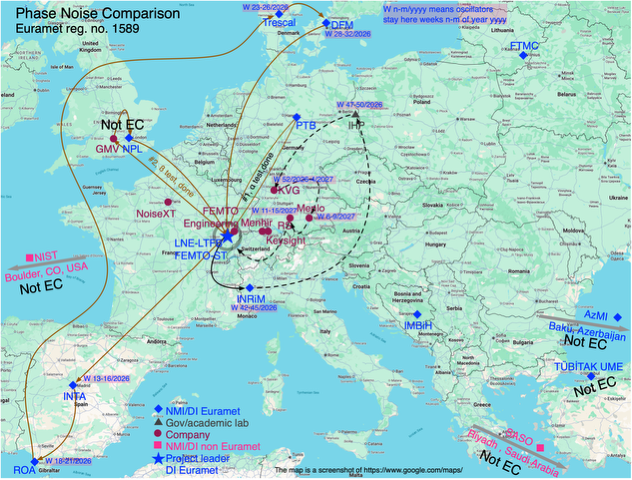
Spherea/NoiseXT (France) is now participating in this project.
Progress Report 2025-10-07
7.1 First meeting with all participants
We had an online meeting with the participants, December 12, 2023. We decided the configuration of the traveling package and the oscillators to circulate, and we started the discussion about the measurement campaign.
7.1.1 Choice of the oscillators
There will be 4 oscillators, each chosen as a significant example of a relevant category
- 10 MHz OCXO. This kind of oscillator is usen as the internal reference of high-end instruments (synthesizers, spectrum analyzers, etc.). Oven-controlled Bulk Acoustic Wave resonator is the one and only practical technology. Instability σy≈2×10-13, and low white phase noise, limited by the dissipation in the resonator.
- 100 MHz OCXO. This kind of oscillator is chosen for low white-PM noise for telecom, frequency multiplication etc. Oven-controlled BAW resonator is the preferred technology. These oscillators also feature low flicker FM, without scarifying white PM. Odd behavior of phase noise analyzers has been reported with this type of oscillators.
- 1 GHz SAW. This type of oscillators is used as the low-noise clock for digital metrology. Surface Acoustic Wave resonator is a good technology option. Low white PM noise is a priority, while lower noise phenomena (white & flicker FM) are not considered important because in applications such processes can be rejected or removed with PLL.
- 10 GHz DRO. This type of oscillator is used as the low-noise reference for most microwave applications. Dielectric resonator is the preferred technology (for comparison, YIGs require tight PLL). Low white PM and low white FM are the relevant features.
7.1.2 Roundtrip strategy
Given the number of participants (≈15 at the start of the project, but 21 as in 2025), a multiple-polygonal scheme seems the one and only practical option. It could be 4-5 travels across 4-5 labs with return at LNE Besancon for verification and data analysis.
7.2 Implementation of the travelling package of oscillators
We realized that starting with no artifact to circulate was a huge mistake. However, this permitted to discuss the choice of oscillators and to gen an agreement of the partner labs.Purchasing the oscillators and implementing the travelling package of oscillators took a long time for a series of practical difficulties, the main of which was electromagnetic interferences from the power supply.
The implementation is finished, the traveling package has been tested in Besancon, and it is ready to use. It goes with a flight case filled with foam, which protects the package from shocks and moisture.
7.3 Alpha test at PTB
The travelling package was sent to PTB for alpha test at the end of July, and it came back to Besancon in September. The oscillators have been tested with three phase noise analyzers
- Rohde Schwarz FSWP (all oscillators)
- Holzworth (all oscillators)
- Microchip PhaseStation (only 10 and 100 MHz, the other frequencies are out of range)
No problem has been detected.
7.4 Next steps
- Revision of the procedures, with the lessons learned from the alpha test at PTB
- Meeting to plan the travels (October 2025)
- Start the travels (November 2025)
Trescal (Denmark), Femto Engineering (France), IHP - Leibniz Institute for High Performance Microelectronics (Germany), Keysight Technologies Switzerland SA (Switzerland), Rohde & Schwarz Messgerätebau GmbH (Germany) are now participating in this project.
Anapico AG (Switzerland) and IZM (Germany) are no longer participating. Anapico was acquired by Keysight, and replaced with Keysight CH, while the key person from IZM moved to IHP (Germany)