integrated metrology community.

News
Revised EURAMET calibration guideline ‘Evaluation of Vector Network Analysers’
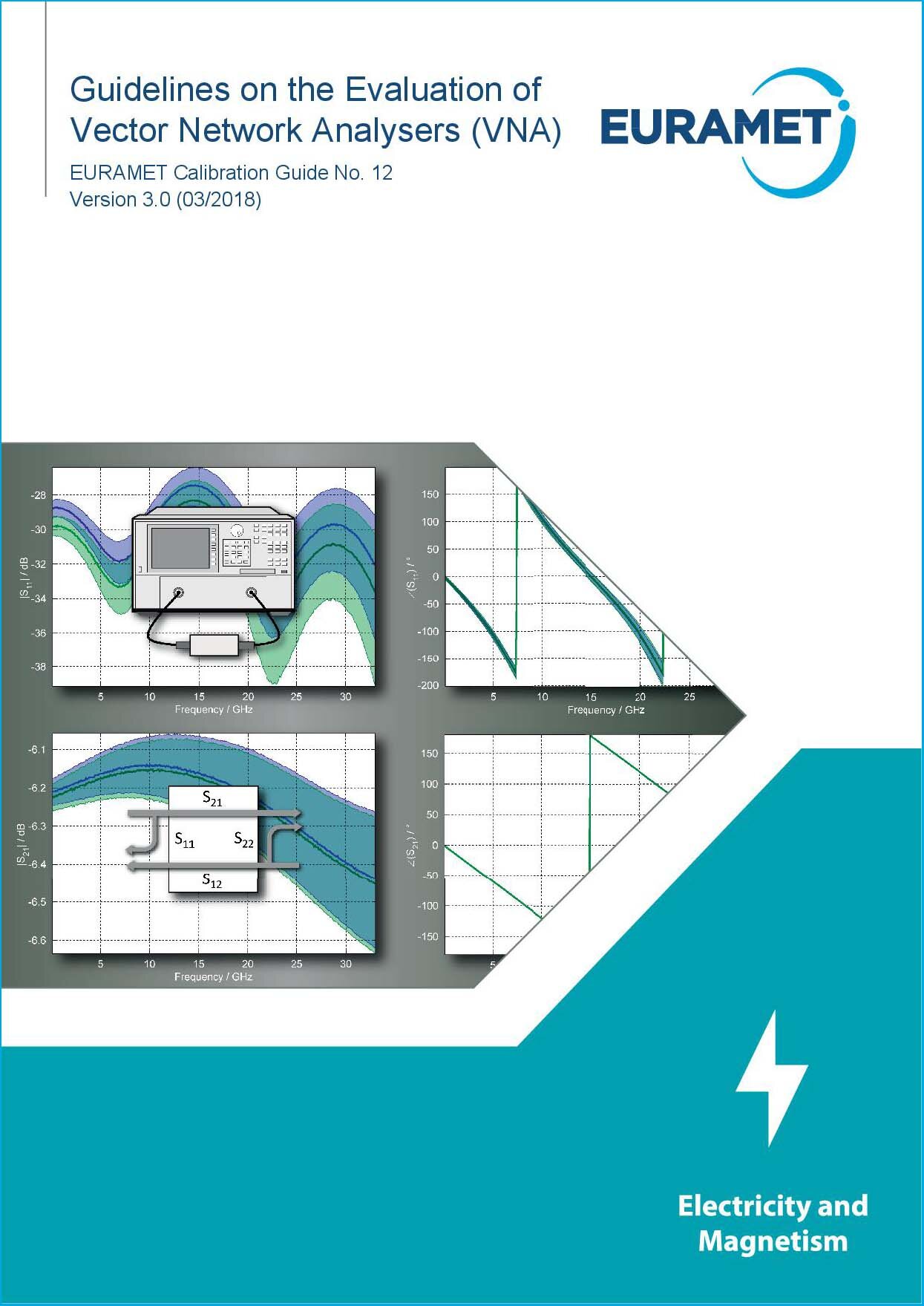
Revised guide for Electricity and Magnetism now available
As the speed of digital communications increases, radiofrequency and microwave components must perform at ever higher data transmission rates. Achieving increased speeds relies on the reliable characterisation of new component configurations during design development and prototype testing. Vector Network Analysers are used for this purpose.
The newly revised EURAMET calibration guideline no. 12 on the 'Evaluation of Vector Network Analysers (VNA)' gives advice on how to measure the reflection and transmission of guided electromagnetic waves with a vector network analyser in accordance with best measurement practices.
"Advances in VNA measurements over the last years prompted the need for a revision of this important calibration guide," says Luca Callegaro (INRIM, Italy), chair of EURAMET's Technical Committee for Electricity and Magnetism. "This guide is intended to become a reference for all users aiming at traceable and accurate measurements with vector network analysers: National Metrology Institutes, calibration laboratories and scientific and industrial research centres."
What are vector network analysers?
Vector network analysers measure reflection and transmission of electromagnetic signals in amplitude and phase. These are fundamental quantities in radiofrequency and microwave measurements.
"Translated into simple words, a VNA determines how smoothly a high frequency electric signal travels through a component, for example a cable. At high frequencies the transmission of signals can be influenced by all sorts of effects, for example by deviations from ideal geometry: The impedance of a transmission line is determined to a large part by the geometry of the line and a change in the geometry leads to a change in impedance. This leads to a reflection of the signal travelling along the transmission line," explains Markus Zeier from METAS in Switzerland, one of the authors of 'Evaluation of Vector Network Analysers (VNA)'.
"It is important to characterise this behaviour, because many modern communication technologies depend on the reliable transmission of fast electromagnetic signals."
Content of the calibration guideline
The EURAMET calibration guideline 'Evaluation of Vector Network Analysers (VNA)' provides:
- information on establishing measurement traceability to the International System of Units using reference standards,
- advice on VNA calibration and verification schemes,
- an instruction for the evaluation of measurement uncertainties and
- focusses on best measurement practice.
This calibration guideline concentrates on linear VNA measurements in the coaxial line system up to 110 GHz and although it is limited to one-port or two-port VNA measurements, extension of the measurement principles to higher numbers of ports is generally straightforward. Many of the guides principles can be adopted to other line types such as waveguide or on-wafer.
Appendices contain further details and examples are given to illustrate measurement concepts. A glossary is provided and references are cited for further reading.
The EURAMET guide is published to increase calibration result equivalence and enhance the mutual recognition between measurement laboratories certifying the performance of vector network analysers.
Authors
The revision of calibration guideline 'Evaluation of Vector Network Analysers (VNA)' has been developed by EURAMET's Technical Committee for Electricity and Magnetism. Authors are Markus Zeier (METAS, Switzerland), Djamel Allal (LNE, France) and Rolf Judaschke (PTB, Germany).
EURAMET has published more than 20 calibration guidelines to date, these are aimed at improving harmonisation for measurement instrument calibrations.
All EURAMET calibration guidelines are available on EURAMET's website: https://www.euramet.org/calibration-guidelines
Information
- TC-EM,
Smart meters are being installed throughout Europe but have been hindered by a lack of trust in the new technology more

The European Metrology Network for Quantum Technologies paved the way for possible future research projects more

An EMPIR project has reduced uncertainty in standards for photovoltaic cells through an interlaboratory comparison more
EMPIR project publishes several technical reports and contributes to the development of five standards in the field of microfluidics more

Supporting robust measurement of thermophysical properties in solid materials more