integrated metrology community.

News
Metrology Partnership project develops world first traceable calibrations for hydrogen gas networks
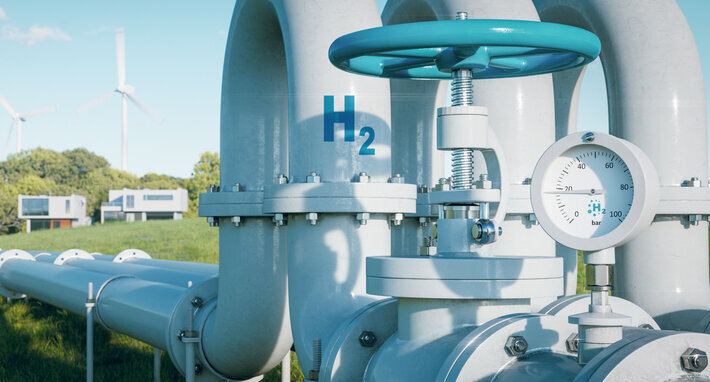
Hydrogen is a sustainable alternative to fossil fuels which can be stored underground, transported through existing gas networks and used to rapidly meet fluctuating energy demands. However, there is a need for verified metrology for traceable pure hydrogen flow calibration to allow the safe transport and fair custody transfer for hydrogen and hydrogen enriched natural gas (HENG).
Metrology Partnership project Flow measurement traceability for hydrogen in gas networks (23IND05, H2FlowTrace) will help to establish a robust metrology infrastructure for the transport, transfer and use of hydrogen and HENG, supporting the transition towards green energy and a carbon neutral future.
World first
Transfer skids are mobile calibration systems that carry the reference instruments, pipework, controls and safety systems needed to transfer flow measurement traceability for pure hydrogen from national metrology institutes to industrial sites. This project delivered the world’s first SI‑traceable chain for calibrations with hydrogen of sonic nozzles and flowmeters using both transfer skids, which were defined, designed and validated by the consortium.
A small-scale transfer skid (SSTS) is now being validated, and it will become a secondary reference for the calibration of flowmeters with hydrogen and blends for flow rates up to 720 kg/h. For higher flow rates, a large-scale transfer skid (LSTS) is being built and will use two master meters as references. These master meters were calibrated with pure hydrogen using the SSTS.
The data collected during a test campaign, involving 16 partners (NMIs, calibration laboratories, flow meters manufacturers) will benefit the metrology and scientific communities by providing a large, meaningful dataset of calibrations with hydrogen and HENG. Using this dataset, the achievable measurement uncertainty of various flow meter technologies will be determined, and guidance will be provided on calibration with alternative fluids.
This achievement is significant because it delivers the world’s first SI‑traceable calibration chain for hydrogen applications, establishing a robust measurement foundation for this crucial and rapidly growing sector. It also proves that high‑integrity, portable traceability is now feasible using the new large-scale transfer skid with purpose‑designed sonic nozzles, demonstrating both technical innovation and the value of strong collaboration in accelerating hydrogen metrology.
Project coordinator, Rémy Maury from LNE-LADG said:
“The outcomes of this project will help gas flow metrology to prepare for the increase of hydrogen use in the future. The creation of the world first traceability chain for hydrogen applications allows the calibration of flowmeters across a large flowrate range up to 1000 m3/h. In addition, the large test campaign results will help NMIs and calibration laboratories to reduce the costs of calibrating flowmeters for hydrogen applications and then encourage the use of hydrogen as a new energy source. Every H2FlowTrace partner’s effort permitted the validation of two transfer skids which will conduct to the creation of new services for hydrogen calibrations in the future with a targeted measurement uncertainty of 0.30 % (k=2).”
This Metrology Partnership project has received funding from the European Partnership on Metrology, co-financed by the European Union Horizon Europe Research and Innovation Programme and from the Participating States.
Want to hear more about EURAMET?
Information
- EMN Energy Gases,
- European Partnership on Metrology,
- Industry,

The world’s cybersecurity currently uses cryptographic keys which may become ineffectual with the advent of quantum computers more
This allows national metrology institutes to perform SI-traceable calibration of stylus instruments without special material standards more

Developing a measurement framework for performance and safe radio exposure in wireless networks more
Across Europe, there are now four installations of the primary standard for hydrogen flow meters that are used in hydrogen refuelling stations more
Developing calibration methods for ‘substations of the future’ in digitised energy networks more