integrated metrology community.

News
Partnership project develops technology of interest to Norwegian Space Agency for use on satellite
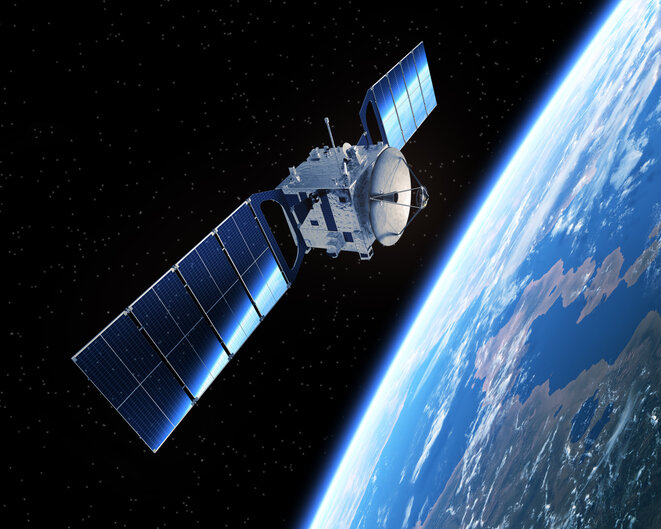
Satellite in space
Newly developed self-calibrating photodiode standards have a broad range of applications
The project
Photonics and optics are exciting, rapidly evolving technologies of great value (over 100 billion € in the EU) and of importance across industry, environment, health, medicine, energy, lighting and science.
The photonic industry and standardisation organisations request miniaturised, cost-effective, integrated and self-calibrating measurement systems that cannot be provided by traditional methods. Recent developments exploiting predictable photodiodes have demonstrated improved uncertainty of responsivity to 10 parts per million and the proof-of-concept of an NMI-on-a-chip suitable for miniaturisation.
Metrology Partnership project Self-calibrating photodiodes for UV and exploitation of induced junction technology (S-CALe Up, 22IEM06) will demonstrate exploitation of the new photodiodes as built-in standards in various applications and develop improved standard detectors for the UV range by exploiting new methods.
Possible application in space
The Norwegian Space Agency is defining an IOD (in orbit demonstration) mission to qualify a hyperspectral camera. The dual-mode self-calibration technology developed in this Metrology Partnership project is interesting for the Norwegian Space Agency and they are now evaluating the possibility to integrate and test the dual-mode self-calibration technology from the project in a satellite environment. The dual-mode self-calibration is an experimental technique that calibrate the responsivity of a photodiode by measuring its photocurrent and comparing the heat produced by the optical radiation and an electrical heater attached to the photodiode. The improvements made in the 22IEM06 S-CALe Up project have demonstrated a performance at room temperature with similar uncertainty as the well-established primary radiometric standard at cryogenic temperatures. The new packaging technology developed in the project is ready to be implemented and tested on other types of photodiodes covering a much broader spectral range than the extended visible validated in the project.
The dual-mode self-calibrating detector is particularly interesting for space applications because of the small footprint, best performance in vacuum, room temperature operation and is a purely experimental technique. In normal operation, the detector will use its very fast and low noise photocurrent signal to quantify the power and when needed (for instance every six months) can perform a more time-consuming self-calibrating procedure over some hours to define its photocurrent calibration accuracy and hence ensure that the detector is always well-calibrated.
Project coordinator Jarle Gran from JV said
‘We are very proud of the progress we’ve made in all aspects of the dual-mode technology within the S-CALe Up project from robust packaging, read-out electrical circuits and improved data analysis. The access to metrological standards is very limited in space and we are happy that we have a suitable candidate. Especially interesting for those missions is when we have an infrared sensitive photodiode calibrated with our technology. The technical aspects enabling the technique to be used in a wider spectral range in the future are already solved in the project.’
This Metrology Partnership project has received funding from the European Partnership on Metrology, co-financed by the European Union Horizon Europe Research and Innovation Programme and from the Participating States
Want to hear more about EURAMET?
Information
- European Partnership on Metrology,
- SI Broader Scope / Integrated European Metrology,
- EMN Climate and Ocean Observation,
Laying the groundwork for qMRI device comparability more

Newly developed self-calibrating photodiode standards have a broad range of applications more


New methodology enables better tracking of atmospheric trends more