integrated metrology community.

News
New software verification services launched
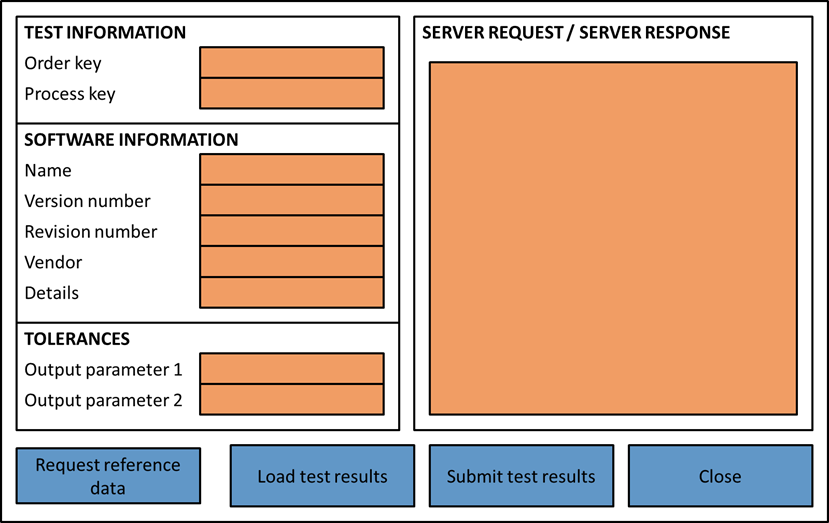
Layout of a (standalone) TraCIM client required to undertake communication between a user of a TraCIM software verification service and the TraCIM server.
NPL, the UK National Measurement Institute (NMI), has made available a number of software verification services as a result of work carried out in the EMPIR Support for Impact Project ‘Validation of software development and analysis tools using TraCIM’ (15SIP06 ValTraC).
Increasingly, developers and users of mathematical software, i.e., software that implements mathematical calculations, are looking to organisations such as NMIs to provide independent verification of that software. Such verification helps to increase confidence in the accuracy of results returned by the software.
The TraCIM system (developed under the previous EMRP Joint Research Project 'Traceability for computationally-intensive metrology', NEW06 TraCIM) allows verification of software to be undertaken via the internet. The user of a TraCIM software verification service is required to implement a TraCIM client to undertake the necessary communication with the TraCIM server running at NPL. On request, the TraCIM server provides users with multiple sets of reference data. The data is processed by the software under test to obtain test results that are submitted to the TraCIM server. The test results are then compared with corresponding reference results stored on the TraCIM server, allowing a software evaluation report to be generated and provided to the user.
Within the ValTraC project, NPL worked with National Instruments to demonstrate the application of the TraCIM approach to the verification of mathematical functions implemented within its products, including the widely used systems engineering tool LabVIEW®. The project considered the use of both standalone TraCIM clients, for cases where the software under test is unable to communicate via the internet, and integrated TraCIM clients, for cases where such communication is possible.
Ian Smith from NPL, Project Coordinator, said “Previously, verification services for mathematical software were somewhat ad hoc in nature, with their speed and efficiency dictated by how much information was required to be transferred between service provider and service user, as well as the means of that transfer. The TraCIM system implements a more standardised approach, and takes advantage of modern internet communication services, to provide the means for NPL to undertake verification in an efficient and swift manner.”
The main outputs of the project, including guidelines on the use of the TraCIM system to undertake verification, are available on the project website (http://empir.npl.co.uk/valtrac).
The ValTraC project is part of EURAMET’s European Metrology Programme for Innovation and Research (EMPIR). EMPIR is co-funded by the European Union's Horizon 2020 research and innovation programme and the EMPIR Participating States.
The TraCIM project is part of EURAMET’s European Metrology Research Programme (EMRP). EMRP is jointly funded by the EMRP participating countries within EURAMET and the European Union.
Information
- NEW06 TraCIM Project Website
- http://empir.npl.co.uk/valtrac/
- EMPIR,
- New Technologies,
- Support for Impact,

Validated, SI-traceable reference methods and materials to assess trace elements in discarded goods more

Enabling production of more reliable data and more rigorous assessments of climate change and variability more

The Spanish National Metrology Institute is an active member of the European Metrology Network (EMN) for Energy Gases more

Advancing the large-scale energy storage which is required for a shift to renewable energy supply more

Lowering measurement uncertainty and improving SI-traceability more