integrated metrology community.

News
New device developed by Metrology Partnership project measures low concentrations of ammonia
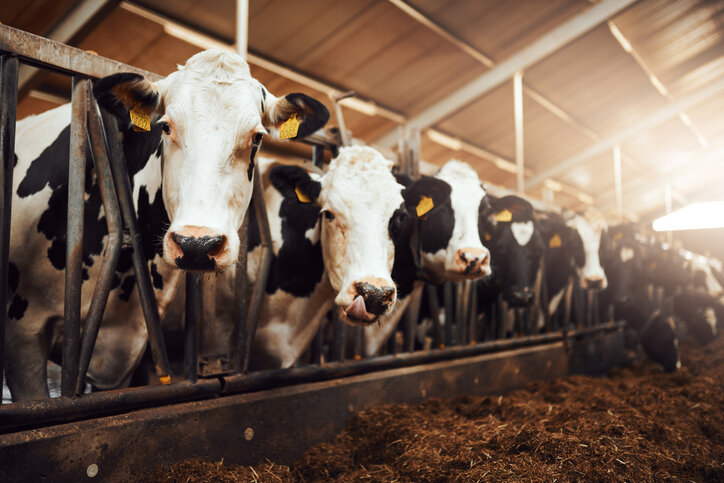
Domestic cattle on a dairy farm
Many current agricultural practices result in air, water and soil pollution, contributing to loss of biodiversity, climate change and poor air quality. Increasing global food demand drives ruminant livestock numbers, rapid land use change and nitrogen fertiliser use, accelerating greenhouse gas (GHG) emissions. The European ‘Farm to Fork’ strategy aims to reduce GHG emissions from agriculture and food production by 2030. To meet these targets and comply with policy, farmers need accurate emission inventories, however, these currently have an error range of 100 - 300 %. Therefore, a European metrology infrastructure must be developed to improve measurement uncertainty in this area.
Completed Metrology Partnership project On farm quantification of ammonia and greenhouse gas emissions from livestock production (21GRD10, quantiAGREMI) developed a SI-traceable field measurement infrastructure for the accurate determination of animal housing emissions as well as nitrogen footprints. The project successfully improved the quantification of ammonia and GHG from livestock housings, including well-defined uncertainty budgets.
Patent for device to measure ammonia
A French patent was submitted by project participant IMTelecom (n° FR2506805) and accepted in December 2025. The patent describes an innovative multi-element chemoresistive sensor for the selective detection of gaseous ammonia at very low concentrations, typically below 100 ppb. The device combines three complementary polyaniline-based sensing materials with an artificial neural network to improve measurement accuracy and compensate for humidity and gas interferences.
It is designed for applications in environmental monitoring, air quality assessment, healthcare and industrial processes. In addition, the patent covers a manufacturing process for the sensor, enabling the production of low-cost devices suitable for large-scale deployment while maintaining high sensitivity and selectivity.
Good practice guides
During the project three good practice guides were generated to allow more accurate, SI-traceable, emission inventories for GHG and air quality. They will help scientists and end-users improve measurements and modelling of GHG emission from livestock housings.
- Good Practice Guide on the developed traceable techniques for the quantification of NH3 and CH4 emissions from selected livestock housings for target applications (e.g., animal category, housing systems) with a target uncertainty of 10 % (CH4) to 20 % (NH3) for mechanically ventilated and 30 %(CH4) to 40 % (NH3) for naturally ventilated housing
- Good Practice Guide on the developed emission monitoring techniques for the CO2, NH3 and CH4 characterisation, considering atmospheric conditions and for enhanced spatial and temporal coverage as well as target applications
- Good Practice Guide on quantification methods and uncertainty for NH3 deposition from livestock housing and tracing nitrogen deposition (e.g.15N) in managed soils
The work from this project will allow farmers and policymakers to develop clear mitigation policies, help meet EU targets, and reduce the effects of agriculture on the environment.
Project coordinator Paola Fisicaro from LNE said:
”This project put together a large variety of scientists from different areas such as metrology, agriculture, modelling and sensor manufacturing. Is has been a real pleasure to coordinate this fantastic team and to learn from them. The project will bring new tools to improve the quality of the data on GHG emission from livestock housings.”
This Metrology Partnership project has received funding from the European Partnership on Metrology, co-financed by the European Union Horizon Europe Research and Innovation Programme and from the Participating States.
Want to hear more about EURAMET?
Information
- EMN Pollution Monitoring,
- European Partnership on Metrology,
- Green Deal,

Improving the measurement of radon levels to protect people from exposure to harmful radiation more
Developing the metrological network to allow for accurate measurements using the primary resistance standard more

Developing the metrology framework to facilitate non-invasive ‘virtual’ biopsies more