integrated metrology community.
News
Leader in global lighting market takes over development of LED measuring device
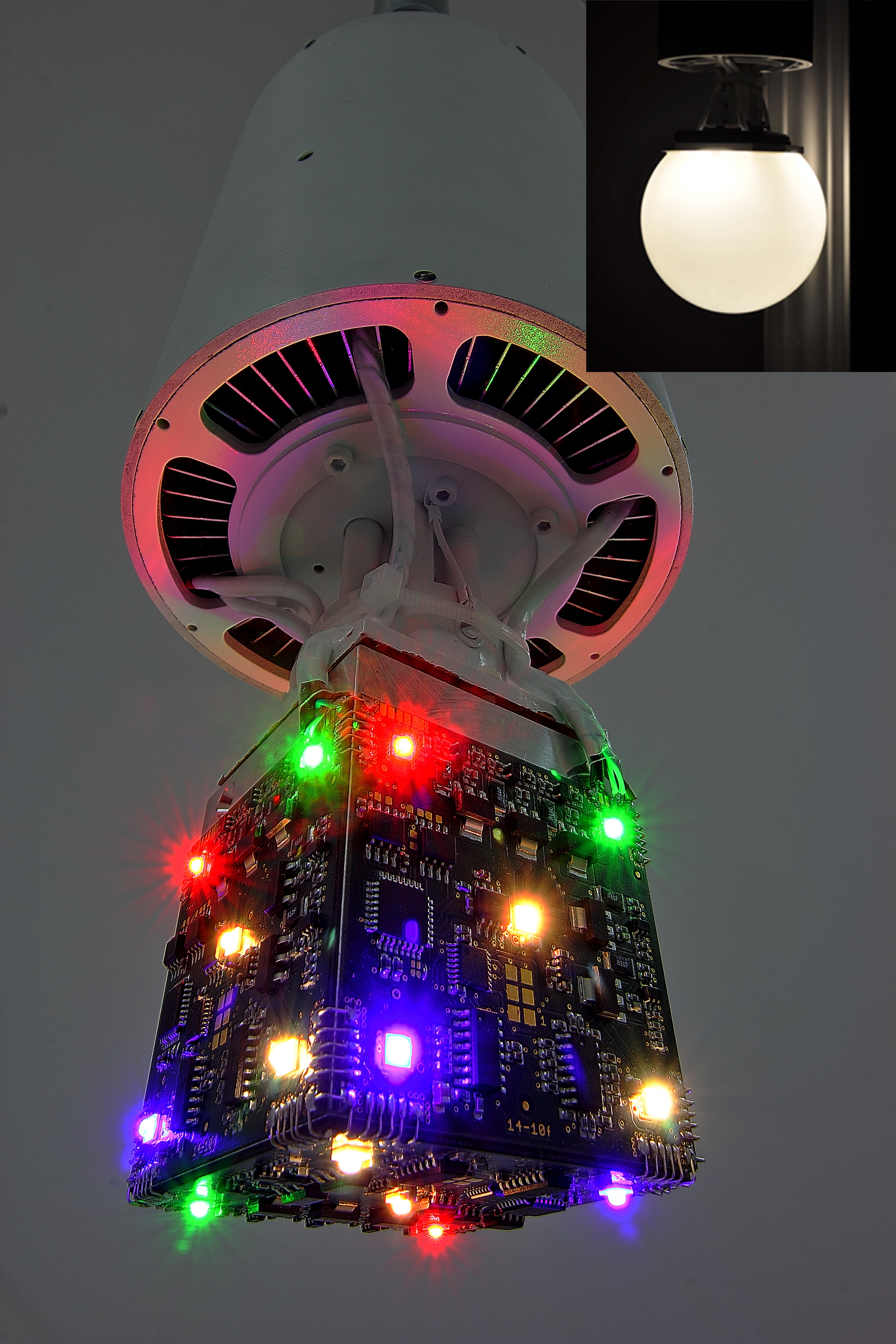
A Multiple Transfer Standard prototype in a sphere and its version with the globe accessory attached
EMRP project engages with CIE through uptake of new CIE standard and final stakeholder workshop
The International Commission on Illumination - also known as the CIE from its French title, the Commission Internationale de l´Eclairage - is devoted to worldwide cooperation and the exchange of information on all matters relating to the science and art of light and lighting. In 2015 a new standard CIE S 025 was published on the requirements to perform reproducible and traceable photometric and colorimetric measurements on LED lamps, modules, and luminaires. The uncertainty of the measurements is an important part of the standard, and is proving to be a major barrier for testing laboratories.
To facilitate uptake of the new standard, EMRP project Metrology for efficient and safe innovative lighting (ENG62 MESail) developed a prototype, LED-based calibration source. It allows testing laboratories to calibrate measurement setups, and also get additional information about the sensitivity necessary to estimate uncertainties. OSRAM, a leader in the global lighting market, has shown a great interest in taking over further development of the device as it offers key features for the end user including ease of use and affordability.
To ensure effective and successful completion of the project two final activities were organised. The first one was the joint JRP-CIE training course for stakeholders with supported by the European National Committees of CIE, the collaborator TechnoTeam and all project partners. The aim of the training was to disseminate the results of the project to the user community. The training course took place on 9 - 10 May 2017 in METAS, Switzerland. There were four sessions prepared in four laboratories, including goniophotometry, integrating sphere, spectroradiometry and electrical parameters measurements. The new LED-based calibration source MTS (Multiple Transfer Standard), the ISN (Impedance stabilisation network) and <link publications-media-centre news>the uncertainty evaluation tool for the electrical parameters measurements developed in this project were used in the tutorial and practical workshop. The final stakeholder workshop was then organised on 11 May after the practical workshop in the same venue. The workshop facilitated engagement between testing laboratories, industry and public bodies. Research results obtained in the project were presented and the workshop consisted of 6 oral presentations delivered by 8 speakers.
Information

Metrology Partnership project helps demonstrate the reliability and trustworthiness of virtual experiments and digital twins more

Advancing Europe’s aim to be a global leader in quantum technologies by 2030 more
During the European Radiation Protection Week 2026, a Memorandum of Understanding was signed between the NERIS platform and the European Metrology Net... more

The FunSNM project has established a coherent foundation and metrological tools to support Europe’s capabilities in sensor networks. more

Establishing the measurement infrastructure required to support the transition towards low-carbon maritime fuels and next-generation engines more