integrated metrology community.
News
EURAMET publish calibration guidelines for automatic weighing instruments
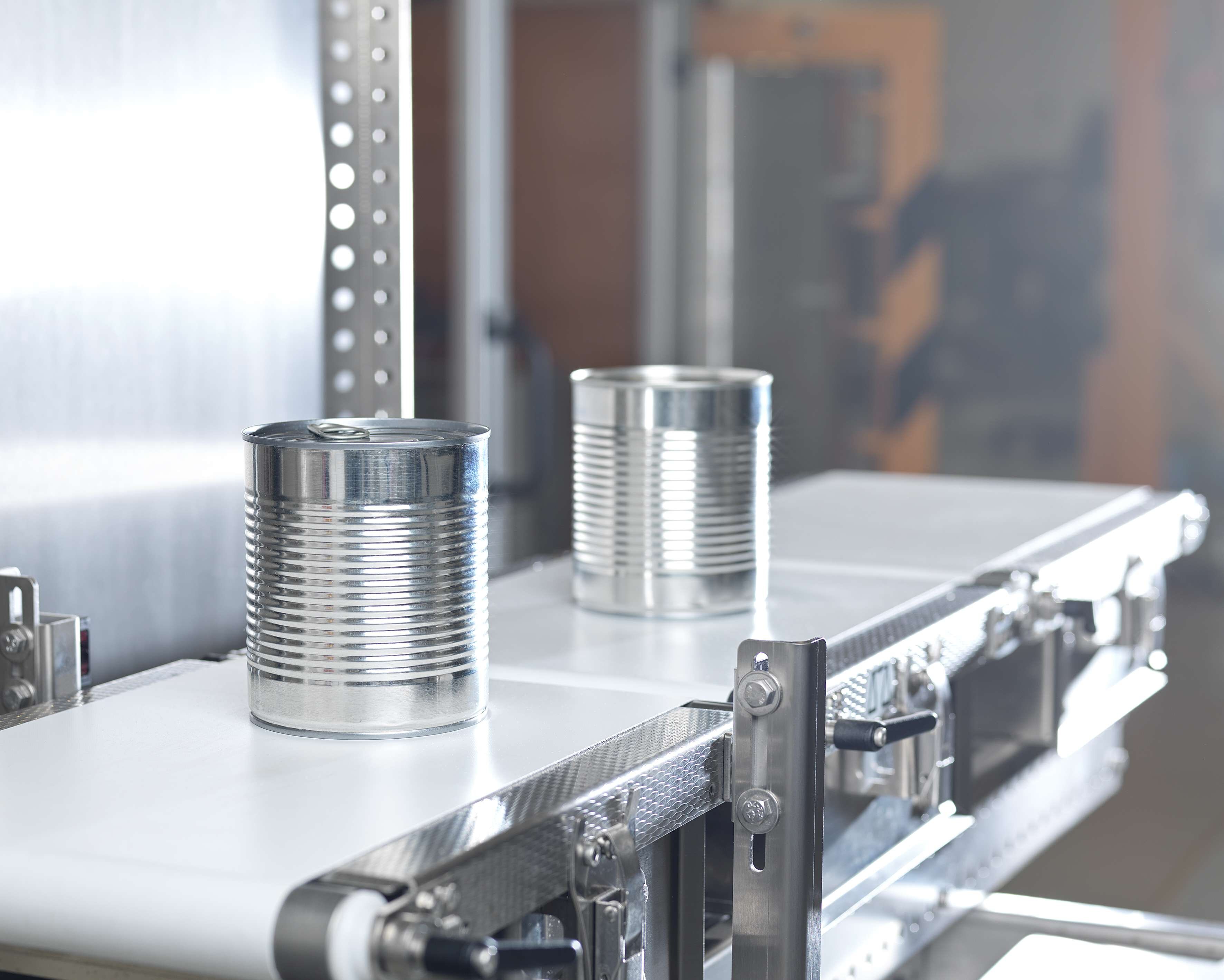
Metal cans being moved across an automatic weighting instrument; Copyright: PTB
The new guide provides a consistent approach to improve mass measurements
Automatic catchweighing instruments (or “catchweighers”) are a type of automatic weighing instrument (AWI) used to quickly determine the mass of individual items, such as packages, without the intervention of a human operator. As the standard EN ISO 9001 lays out calibration requirements for measuring instruments, guidelines in this area are needed to help industry users become compliant with the standard.
This year, EURAMET published a new guide on the ‘Calibration of Automatic Weighing Instruments’ (No. 26, Version 1.0), which is available to download for free. EURAMET’s calibration guidelines provide guidance to help harmonise calibrations across the European metrology community, covering procedures across a range of areas, from mass and hardness to electricity and magnetism.
As part of its work developing methods for AWIs, completed EMPIR project “Traceable calibration of automatic weighing instruments operating in the dynamic mode” (AWICal, 14RPT02) produced a draft version of Calibration Guideline No. 26. This draft was then finalised as a EURAMET calibration guide by the EURAMET Technical Committee for Mass and Related Quantities (TC-M). The guide covers key aspects for the calibration process including determining test load reference values, evaluating uncertainty and the contents of the associated calibration certificate, and is applicable to both dynamic and static (“start-stop”) weighing systems.
“The guide is the first internationally harmonised document for the calibration of automatic catchweighing instruments,” says Matej Grum (MIRS), coordinator of the AWICal project, “It represents excellent basis for accreditation of calibration services in this field. Metrologically traceable results of calibration will enable users, such as food and pharmaceutical manufacturers, to improve the quality of their production and easily meet customers’ demands.”
This EMPIR project is co-funded by the European Union's Horizon 2020 research and innovation programme and the EMPIR Participating States.
Want to hear more about EURAMET?
Information
- EMPIR,
- TC-M,
- Research Potential,
Working to increase knowledge of radionuclide decay data and to develop a new primary method for activity determination more

The sources will improve atmospheric transport models which can be used to track both radon and greenhouse gases more
Supporting innovations in combined imaging and radiation cancer treatment by standardising dose measurements more
Between 2009 and 2013 EURAMET funded 119 research projects – many of which continue to benefit European citizens, businesses, and the environment more

Metrology Partnership project is developing the standardised measurements required to protect modern electronics from radio-interference more