integrated metrology community.
News
EURAMET Guideline on 'Calibration of Angular Encoders' now available
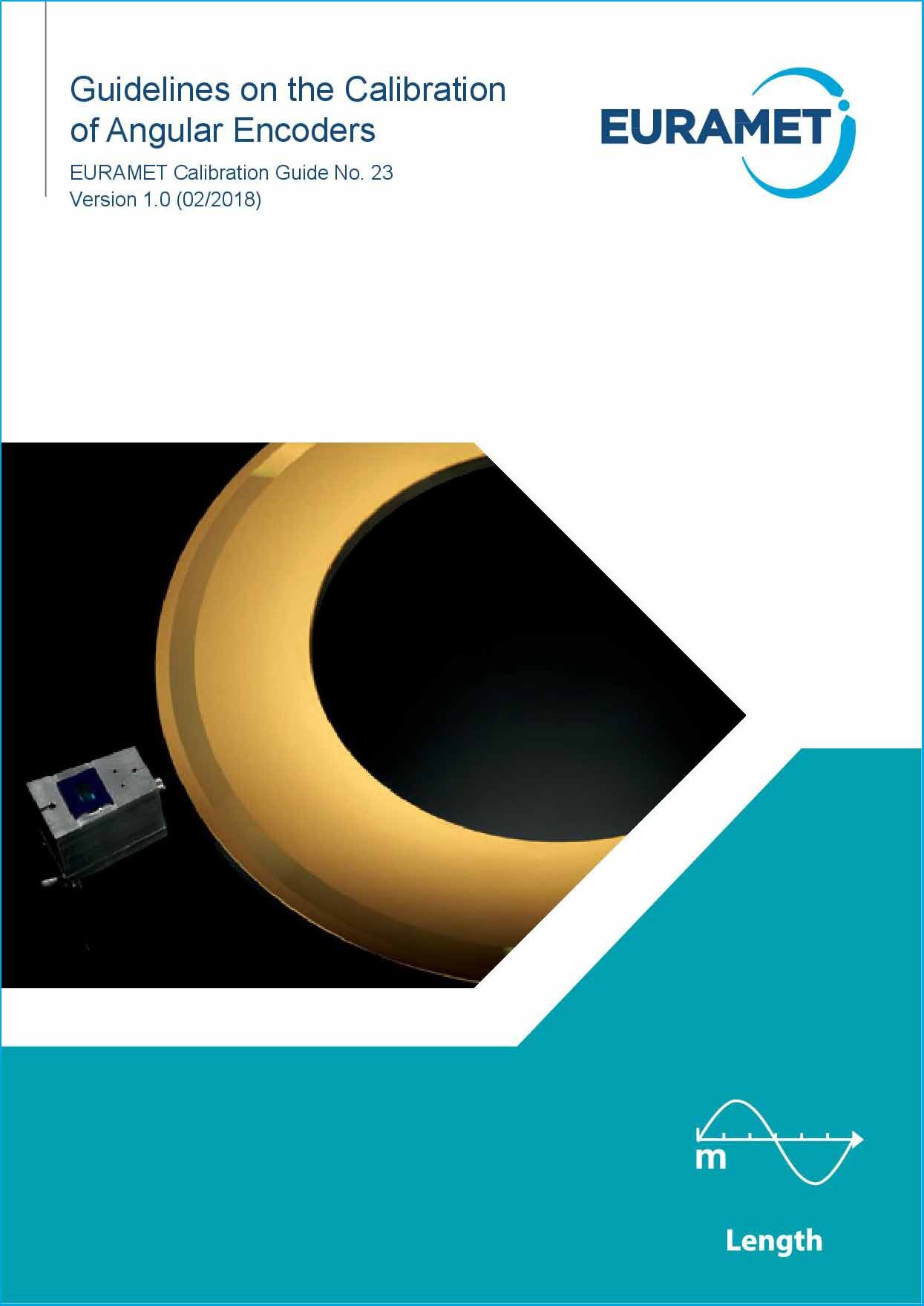
The aim of the newly published EURAMET guideline no. 23 is to improve harmonisation in the calibration of angular encoders. The document gives advice for calibration laboratories on establishing reliable practical procedures and aims to enhance the equivalence and comparability of calibration results obtained by independent laboratories.
The guideline 'Calibration of Angular Encoders' provides information on equipment, procedures, result evaluation and the determination of measurement uncertainties for instruments used to measure angular rotation in a wide range of applications.
What are angular encoders?
Angular encoders are devices used to convert the angular position of a rotating shaft intoan electrical signal. They are used in a wide range of applications where angular measurements to the uncertainty level of the order of arcseconds are required. For example, angular encoders are used in rotary tables on machine tools, high-performance robotics, servomotors, medical equipment, surveying instruments and angle comparators.
The term angle encoder is typically used to describe encoders that provide an accuracy of better than ± 5” with the number of graduation lines usually exceeding 10 000. The guide recommends precautions for setting up calibration systems and provides advice for achieving the required levels of calibration accuracy. It also gives information on how to investigate the performance of angle encoders.
Content of the guideline
The document provides general definitions and technical requirements for calibrating angular encoders. It is procedural in nature and gives practical advice for calibration laboratories. In addition, an example of a typical calibration procedure is presented.
It is noted that laboratories working according to ISO/IEC 17025 shall validate their calibration procedures. This may lead to modification of the principles and examples given in this document.
Authors
Guide no. 23 has been developed by EURAMET's Technical Committee for Length and within the EMRP project 'Angle Metrology' (SIB58 Angles). Authors are Emilio Prieto (CEM, Spain), Maria del Mar Pérez (CEM, Spain), Tanfer Yandayan (UME, Turkey), Joanna Przybylska (GUM, Poland), Andreas Just (PTB, Germany), and Ralf Geckeler (PTB, Germany).
The EMRP project 'Angle Metrology' focussed on improving angle measurements for science and industry.
EURAMET has published more than 20 calibration guidelines to date, these are aimed at improving harmonisation for measurement instrument calibrations.
All EURAMET calibration guidelines are available on EURAMET's website: https://www.euramet.org/calibration-guidelines
Information
- TC-L,
- EMRP,

Developing quantum electric current standards to underpin digital transformation more

Creating a metrological infrastructure to monitor biomethane for use in transportation and gas networks more

Memristive devices that can be used as resistance standard or can be used for computing applications more
Supporting the digital transformation in Europe by monitoring the detail detection sensitivity of iCT measurements more
Validated, SI-traceable reference methods and materials to assess trace elements in discarded goods more