integrated metrology community.

News
EMPIR project results have potential to improve competitiveness of the European microscopy industry
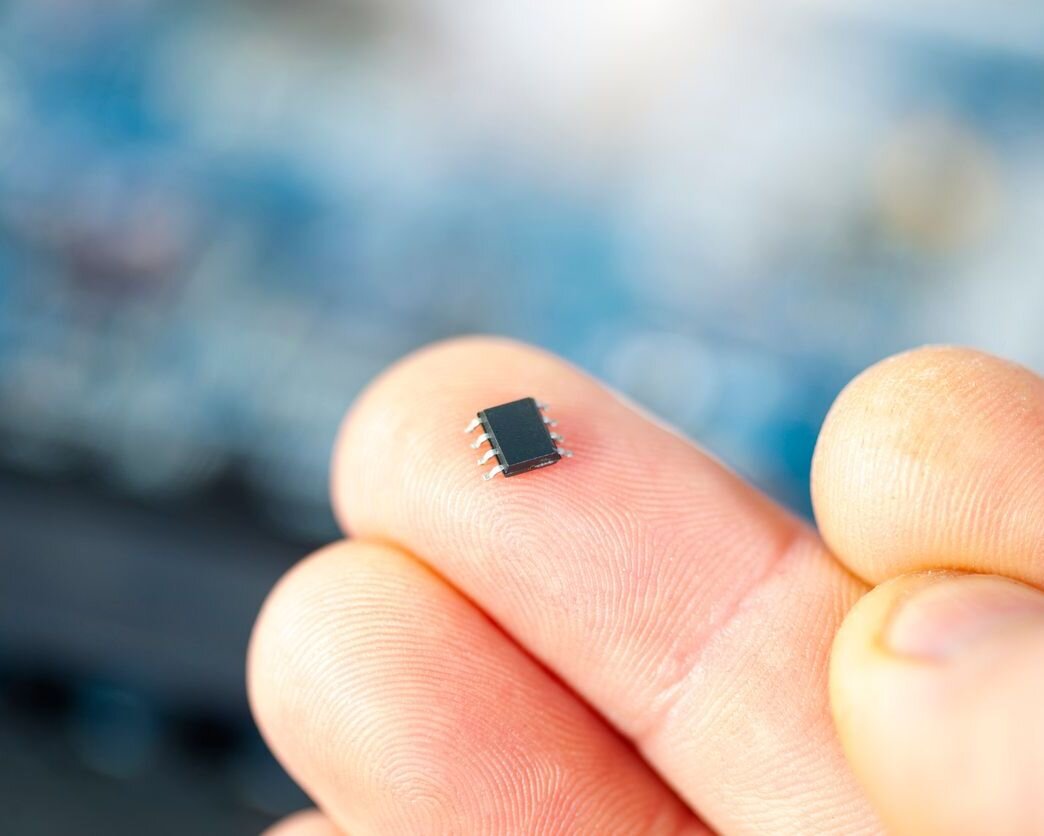
Electronic chip
Developing the instruments and software required to enable industrial use of high-speed scanning technology
The project
Complex nanostructures and nanodevices are used in photonics, quantum technology and nanoelectronics, and increasingly in healthcare and in novel materials research. Fast, accurate and traceable High-Speed Scanning Probe Microscopy has great potential for identifying faulty nanoproducts in manufacturing, boosting productivity and reducing waste. Conventional Scanning Probe Microscopy is either too slow to cover large areas, or if fast, it lacks positioning accuracy.
Completed EMPIR project Traceability of localised functional properties of nanostructures with high speed scanning probe microscopy (20IND08, MetExSPM) developed essential modules for High-Speed Scanning Probe Microscopy including self-sensing and self-actuating probes (where the sensing and actuating is integrated into the probe rather than externally), novel Scanning Probe Microscopy stages and open-source software for control and data processing. These outputs, some already commercially or freely available, have the potential to impact on several industry sectors such as semiconductor, optics and advanced manufacturing.
Impact
- The active probes developed in the project, consisting of an Atomic Force Microscope tip and an active cantilever, are available for customers and have been taken up by project collaborator Technische Universität Ilmenau, who is using the probes for a wide range of AFM measurements.
- The calibration methods developed in the project for the active probes are in use at Nano Analytik GmbH and improve the production reliability and customer satisfaction.
- The combination of piezo stages and a magnetic levitation (MagLev) stage with interferometric traceability to the metre, developed in the project, can be used in other applications requiring high speed and high accuracy.
- The Gwyscope, a digital signal processor suitable for SPM measurements, is also mentioned in Thorlabs website as an example of extended use of Thorlabs Educational AFM.
- ZEISS provided challenging samples (ultrafine optical surface, grating structures on silicon wafer, lateral standard and reticle on quartz glass) to the consortium partners. Measurement results achieved by the partners on these samples are in good agreement with the characterisation performed by ZEISS. This comparison shows a possible applicability of the measurement method in the production of lithography optics of ZEISS.
- The instruments developed or improved in the project have significantly improved the measurement capabilities for pitch and step-height calibration by AFMs at National Measurement Institutes VTT, CMI, GUM and PTB.
- Two patents relating to the active probes were disclosed, and one is in preparation.
The uptake of project results is anticipated to improve the competitiveness of the European microscopy industry and improve quality control in the semiconductor, nanomaterial, nano-bioscience and nano-photonics industries.
Project coordinator Virpi Korpelainen from VTT said
‘The project was both challenging and succesful. All the project developments can also be applied to other applications, and they are either commercially or freely available to end users.’
This EMPIR project is co-funded by the European Union's Horizon 2020 research and innovation programme and the EMPIR Participating States.
Want to hear more about EURAMET?
Information
- EMPIR,
- Industry,