integrated metrology community.

News
EMPIR project releases software and optical constants for the photonics industry
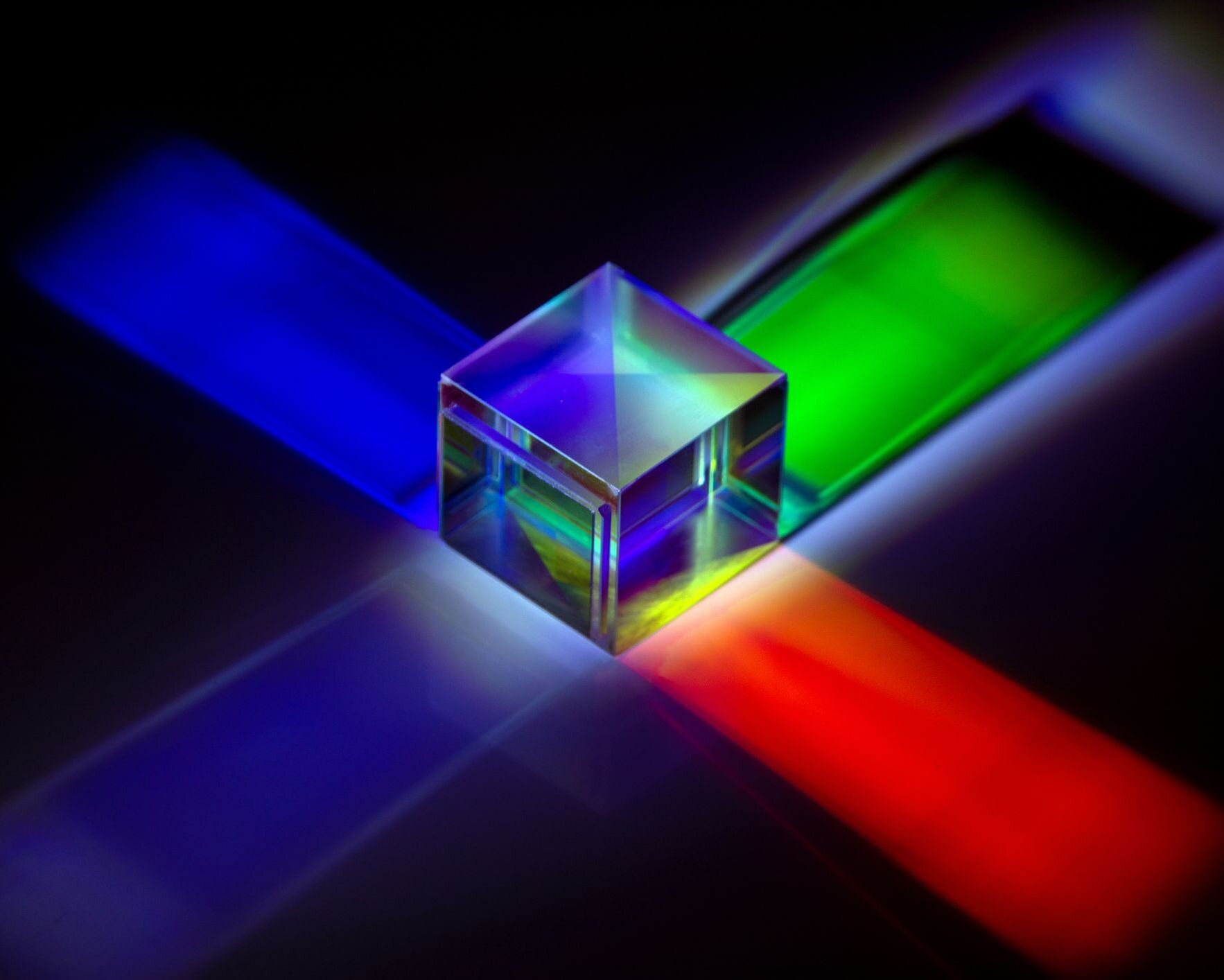
A glass cube reflecting different coloured light
For many of the 5000 photonics companies in Europe a precise knowledge of a material’s optical properties is vital for industrial competitiveness
Photonics, the science and technology of light, is used to characterise materials used in a wide range of industries and applications - including cyber and AI controlled physical systems, advanced manufacturing, miniaturisation, and new healthcare solutions.
In Europe the photonics industry generates a turnover of 60 billion euro a year and employs 300,000 highly skilled individuals. Innovations in this area are playing a key role in addressing European goals such as the Green Deal and the digitalisation strategy.
In photonics a precise knowledge of how a substance transmits, reflects, absorbs, refracts, or scatters light is vital. These properties are all influenced by a material’s refractive index which is itself determined by ‘optical constants’. Due to the importance of refractive index in optics, optical constant databases have been assembled and made publicly available. However, currently these are of often poor quality, contain estimated values, and lack measurement uncertainty.
This is especially the situation for methodology and instrumentation based upon indirect methods – where the characteristics of a material are determined by a mathematical reconstruction of how it has scattered or reflected the light falling on it. A common application of an indirect method is in the reconstruction of a patient’s scan following medical imaging, but the same approach it is used in any area using the principles of reflectometry, Mueller ellipsometry and scatterometry.
The EMPIR project Traceable metrology of soft X-ray to IR optical constants and nanofilms for advanced manufacturing (20IND04, ATMOC) has released the PyThia Uncertainty Quantification Toolbox to allow the quick determination of uncertainty for a wide range of photonics applications using computationally expensive indirect reconstruction methods.
Freely available and easy to install it relies on standard scientific packages such as NumPy and SciPy. The toolbox also contains four tutorials along with an example of its application in scatterometry:
- Tutorial 01 - Approximation of Functions with Polynomial Chaos
- Tutorial 02 - Approximation of n-D functions with Polynomial Chaos
- Tutorial 03 - Computation of Sobol Indices
- Tutorial 04 - Automatic choice of expansion terms
- Tutorial on Shape Reconstruction via Scatterometry
In addition to the software tool the project has also published its first datasets of optical constants of thin films in the extreme ultra violet (EUV). This includes metals, compound materials and alloys that are important in lithography, thermal and electric contacts and for novel absorber materials for semi-conductors or dyes. Access of these datasets is facilitated by the Python package ocdb following the FAIR principles and providing not only the data, but relevant metadata such as references as well.
The improved knowledge of optical properties of materials used will aid the development of novel nano-electronic devices, high-quality sensors and more effective photovoltaic elements, supporting industry and job creation in Europe.
This EMPIR project is co-funded by the European Union's Horizon 2020 research and innovation programme and the EMPIR Participating States.
Want to hear more about EURAMET?
Sign up for EURAMET newsletters and other information
Follow us on LinkedIn and X/Twitter
Information
- EMPIR,
- EMN Mathematics and Statistics,
- EMN Advanced Manufacturing,

Developing a metrologically-based field assessment of glare and obtrusive light more

Standardising industrial procedures for the magnetic properties of devices leading to the improved quality of a wide variety of products more
Implementing quantum-based pressure measurement techniques in European industries more

Developing reference materials for mass spectroscopy to monitor radioactive and stable isotope pollution in the environment more

Development of the metrological network needed to realise and implement 6G technology more