integrated metrology community.

News
EMPIR project identifies a reference material for the safe and efficient storage of hydrogen gas
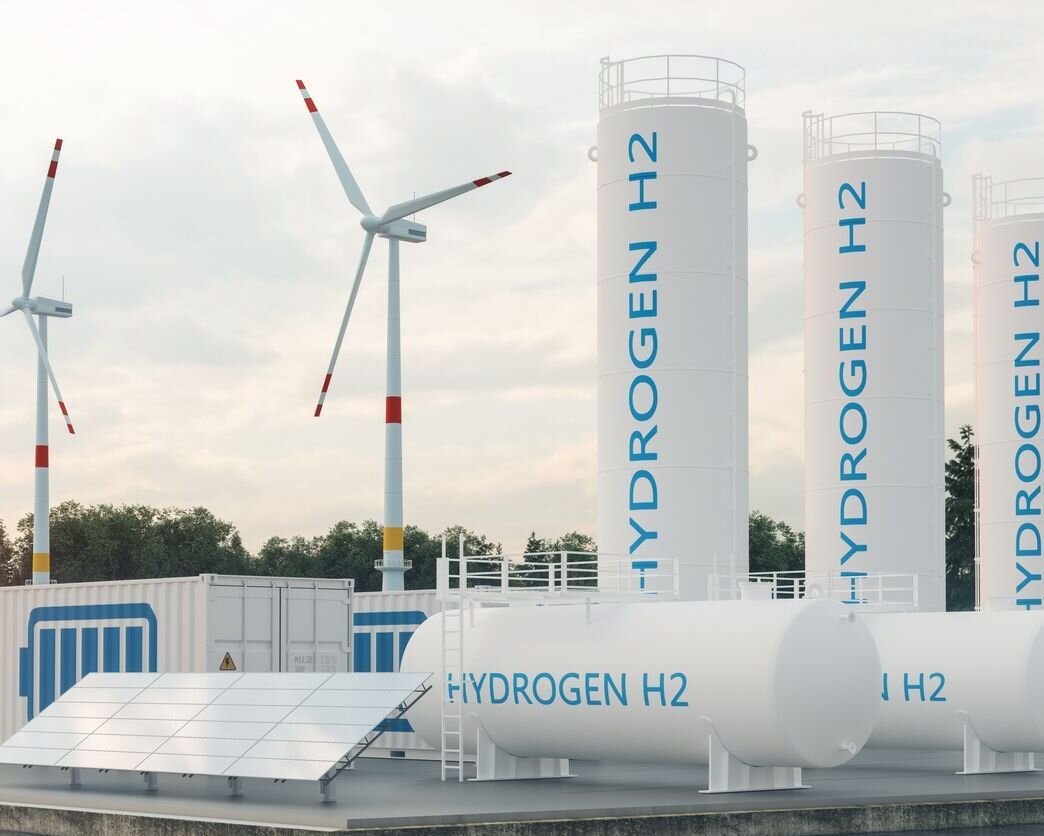
Energy Storage System With Hydrogen Storage Compartment
Hydrogen is an energy gas which can be stored, providing a backup for more fluctuating energy sources, but this area still lacks important metrology
The EU has a target that 42.5 % of all of Europe’s energy usage will come from renewable sources by 2030. Hydrogen (H2) is a clean energy gas that leaves a residue of just water when combusted. It can also be stored to help balance out energy supply and demand and provide backup to more intermittent sources of energy, such as wind or solar. However, the hydrogen storage market is not yet sustainable as important metrology still needs to be defined. These include energy conversion processes which lack traceability to standards for accurate billing and quality control, while potential safety issues remain unaddressed.
Currently hydrogen is mainly stored using compressed or liquified hydrogen systems. An attractive alternative is to physically store the gas in porous materials via cryoadsorption – as these methods provide fast, reversible storage at lower pressures. However, so far, no material has been established as a reference for hydrogen cryoadsorption measurements, making it difficult to compare measurements based on reliable standards.
The now completed EMPIR project Metrology for Advanced Hydrogen Storage Solutions (19ENG03, MefHySto) has addressed this problem.
Interlaboratory comparison of hydrogen storage ability
During the project the crystalline metal-organic material Zeolitic Imidazolate Framework-8 (ZIF-8) was identified as a possible H2 storage candidate which, due to its structural properties and mechanical stability, provides significant hydrogen uptake. It also allows a high degree of packing and excellent cyclability, which results in repeatable adsorption and desorption of large amounts of hydrogen during its lifetime.
The material is also hydrophobic which helps to reduce water adsorption during preparation and weighing, increasing the accuracy of measurements and facilitating an easy, reliable activation without using an inert or dry atmosphere.
To assess ZIF-8 the consortium produced a large batch of ZIF-8 pellets which was distributed to 9 different laboratories worldwide. These laboratories measured the gravimetric hydrogen uptake of the ZIF-8 at 77 K (−196.15 oC) and up to 100 bar utilising 15 different experimental setups. Results were evaluated taking into account the pressure range, type of analyser, control of the analysis temperature, and the procedure to correct or compensate for the presence of thermal gradients in the instruments.
The results of this large, interlaboratory comparison demonstrated a high reproducibility of H2 adsorption with a relative standard deviation of around 4 %, and clearly indicated the high stability, homogeneity and easiness of both the handling and activation process of the ZIF-8 pellets.
The underpinning metrology for hydrogen storage enabled by the project will encourage industry and investor confidence for supporting the roll out of the infrastructure required for a transition to the large-scale use of this clean gas as an energy source.
The coordinator of the project Dirk Tuma (BAM) said about the work performed:
“The project successfully addressed various important aspects of hydrogen storage solutions along the entire hydrogen supply chain with the individual work packages following a rigorously metrological approach. This started with hydrogen quality form electrolysis (power to hydrogen), was followed by state properties of both hydrogen and hydrogen-containing mixtures, then attended issues with fuel cells (hydrogen to power) and finally dealt with reversible as well as geological hydrogen storage”.
This EMPIR project was co-funded by the European Union's Horizon 2020 research and innovation programme and the EMPIR Participating States.
Want to hear more about EURAMET?
Information
- EMPIR,
- EMN Energy Gases,

Developing a metrologically-based field assessment of glare and obtrusive light more
Standardising industrial procedures for the magnetic properties of devices leading to the improved quality of a wide variety of products more
Implementing quantum-based pressure measurement techniques in European industries more

Developing reference materials for mass spectroscopy to monitor radioactive and stable isotope pollution in the environment more

Development of the metrological network needed to realise and implement 6G technology more