integrated metrology community.

News
EMPIR project develops DC power metrology for transition to green technology
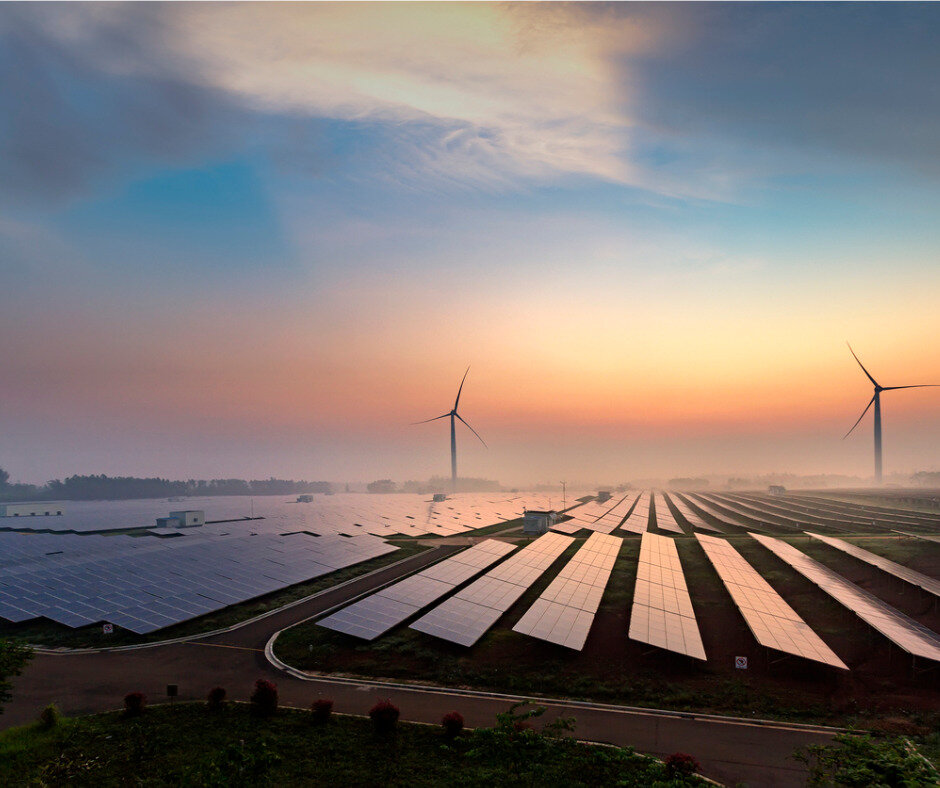
Solar panels and wind turbines at sunrise
The project’s work will help to implement new direct current grids which can better support renewable energy and high-efficiency technologies
Many of the sustainable technologies being taken up as a means to increase efficiency and reduce fossil-fuel dependency use direct current (DC) power. This includes LEDs lights, photovoltaic cells for generating solar energy and the batteries used inside electric vehicles.
However, current electricity grids are primarily AC and power conversion between the two is inefficient. As the shift towards renewable energy and sustainable technologies increases, new DC grids have become an attractive prospect. In order for DC systems to be successfully incorporated into the grid, metrology for DC power quality and accurate metering is required.
Building on the work of the MyRailS (16ENG04) project, EMPIR project “Standardisation of measurements for DC electricity grids” (20NRM03, DC Grids) has worked to develop metrology for DC grids. In particular, the project has developed on-site measurement equipment to measure voltage and current signals, as well as reference systems for measuring DC power quality (DCPQ) and DC electricity meter testing under distorted conditions. The project has also developed the metrological framework required to conduct surveys of DCPQ ‘compatibility level’ and ‘planning level’, which quantify the levels of electromagnetic disturbance from different sources that might affect the power system, and a related industry guide.
Further project achievements
- Measurement campaigns
Measurement campaigns were undertaken using onsite measurement equipment developed during the project at five low voltage DC (LVDC) grid locations: Malaga Smart City, Lelystad Airport, The Green Village in Delft, a parking garage in Utrecht and three public electric vehicle charging stations. Across these locations, DC-specific disturbances caused by devices like streetlights, wind turbines and electric vehicle chargers were measured. The data collected was then used to determine the nature of these disturbances and used to set proper DCPQ definitions and test conditions. A summary of the campaigns’ measurement results is available to read on the project’s website.
- Reference systems and transfer standards
Three reference systems for DC power quality and electricity meter testing were developed by the project. Two of these systems use separate conductors to generate distortions for high-magnitude DC currents and high-frequency AC currents, while the third merges DC and AC distortions into a single conductor. The two different methods allow varying transducer types to be calibrated. Alongside these systems, two transfer standards were developed and used to validate the reference systems as part of a round-robin comparison. An industry guide was developed on proposed test waveforms for DC electricity meter testing.
Final workshop
The final workshop of the DC Grids project, titled ‘Reliable Measurements for LVDC (Low Voltage DC) grids and DC metering’ was held in Delft, Netherlands, in collaboration with EURAMET’s European Metrology Network for Smart Electricity Grids and the Subcommittee ‘Power and Energy’ of the Technical Committee for Electricity and Magnetism.
The workshop included technical presentations by project partners and stakeholders, with over 135 attendees joining in person and online from around the world to learn about the work of the DC Grids project. Presentations from the project’s sessions, covering one-site LVDC grid measurements, measuring AC ripple in lab equipment, DCPQ standardisation and more, as well as a full copy of the workshop agenda, are available on the DC Grids website.
“In this new and largely unexplored field of application, the project consortium has realised the entire spectrum of developing DC broadband measurement instrumentation, carrying out on-site measurement campaigns, analysing the results, proposing new definitions and test conditions, and building and validating reference setups using real-world test signals,” says project coordinator, Helko E. van den Brom (VSL), “This has paved the way for new and improved standardisation of DC electricity meter testing and test methodologies for DC PQ level surveys, thus facilitating the further development and uptake of DC grids as a reliable extension to traditional AC distribution networks.”
This EMPIR project is co-funded by the European Union's Horizon 2020 research and innovation programme and the EMPIR Participating States.
Want to hear more about EURAMET?
Information
- EMPIR,
- Energy,
- EMN Smart Electricity Grids,
- TC-EM,
Validated, SI-traceable reference methods and materials to assess trace elements in discarded goods more

Enabling production of more reliable data and more rigorous assessments of climate change and variability more
The Spanish National Metrology Institute is an active member of the European Metrology Network (EMN) for Energy Gases more
Advancing the large-scale energy storage which is required for a shift to renewable energy supply more

Lowering measurement uncertainty and improving SI-traceability more