integrated metrology community.

News
EMPIR project contributes to committee revising LED lighting standards
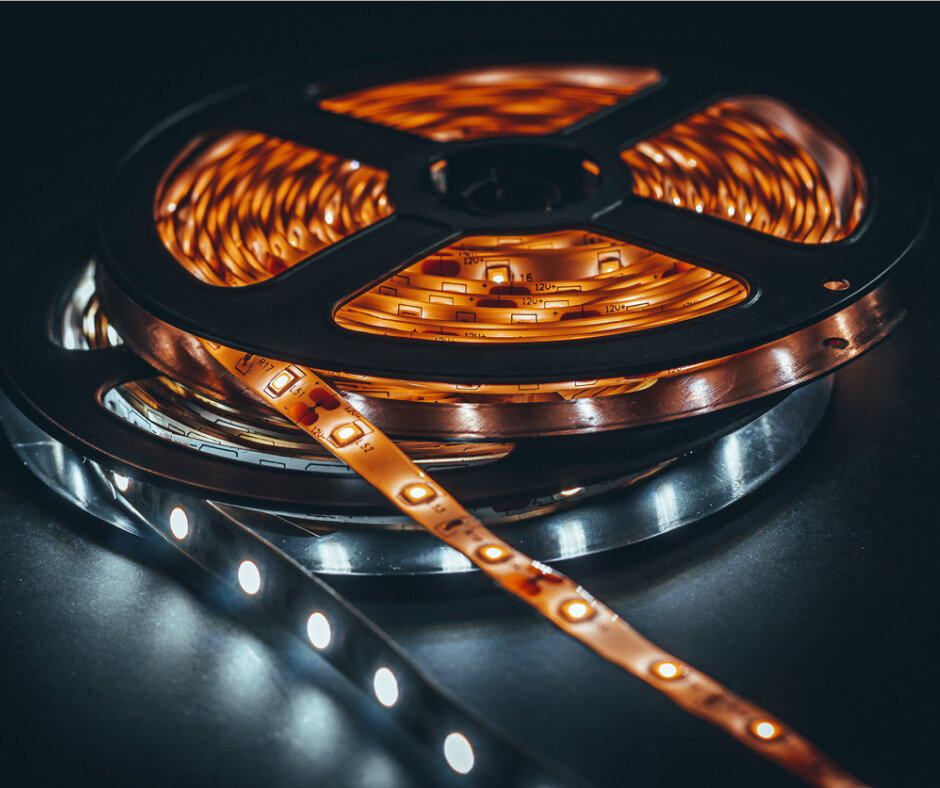
LED lighting strip
LED lighting expert from an EMPIR project consortium chairs a new technical committee approved to revise key standards
EMPIR project Revision and extension of standards for test methods for LED lamps, luminaires and modules (19NRM02, REVStdLED) is developing metrology for the characterisation of light sources using LEDs (light emitting diodes).
LED-based light sources are the fastest growing type of lighting technology on the market and are used for a multitude of applications. Domestically, LEDs can be found within many devices, such as television remotes, or in LED bulbs, which are replacing traditional tungsten-filament bulbs for the purposes of lighting rooms. These bulbs have the added benefit of being able to produce many colours or levels of brightness and are also becoming a common feature of ‘smart’ homes, able to connect to wireless networks and be controlled remotely. In urban settings, LED lights are replacing traditional bulbs in street lamps, providing more directed light to better illuminate pavements and roads, and to reduce light pollution.
Despite the wide-spread use of LED-based lights, traceability is still lacking for the technology. Although the laboratory tests that are required to assess the performance and characteristics of LEDs are detailed in international standards, there is a lack validated procedures for a number of the associated measurements. This is because existing standards and methods (for example, colour temperature, which characterises the hue of light) were designed for incandescent light sources and are only applicable to LEDs to a limited extent. Metrology is required to underpin suitable standards for the testing and characterisation of LED-based lighting, including the assessment of uncertainties and input/output tolerances, and methods to measure the light intensity distributions of different devices.
New technical committee
One of the key objectives of the REVStdLED project is to contribute to standards for LED-based lights. Specifically, the project is looking at revisions to CIE S 025 and EN 13032-4, two standards detailing requirements around photometric and colorimetric measurements for LED devices. These include measurements of light intensity distributions, total flux, and correlated colour temperature, a modified version of colour temperature made applicable for LED devices.
A new standardising technical committee, CIE TC 2-97, chaired by consortium partner Anders Thorseth (DTU), has been approved to revise CIE S 025, which will also be the basis for a revised EN 13032-4. The committee will identify essential test parameters, develop validated procedures, and produce best practice guidelines for laboratory testing, which will be used in these revised standards.
Project coordinator Armin Sperling (PTB) has said of the project:
“This project turned out to be much more challenging than expected, as the correct recording and evaluation of measurement uncertainties for measurements according to CIE S 025 and EN 13032-4 is often beyond the capabilities of testing laboratories. Therefore, suitable simplifications in the guidelines have to be found in order to be able to give trustworthy values under such limiting boundary conditions.”
The work of this project will enable high-quality laboratory testing of LED-based lights by validating methods and ensuring traceability for a number of important measurements. The improvement of these measurements will allow the performances of LED-based products to be better characterised and thus allow end-users to better fulfil their needs.
This EMPIR project is co-funded by the European Union's Horizon 2020 research and innovation programme and the EMPIR Participating States.
Want to hear more about EURAMET?
Information
- EMPIR,
- Standardisation,
- TC-PR,

Enabling production of more reliable data and more rigorous assessments of climate change and variability more
The Spanish National Metrology Institute is an active member of the European Metrology Network (EMN) for Energy Gases more
Advancing the large-scale energy storage which is required for a shift to renewable energy supply more

Lowering measurement uncertainty and improving SI-traceability more

Stage 1 of the 2026 Call under the European Partnership on Metrology is open to submit potential research ideas more