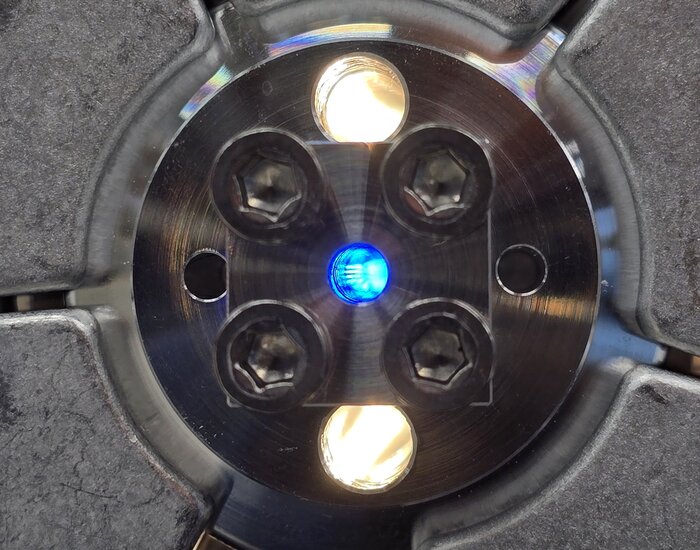
Metal-based FP-cavity for refractometry with mirrors optimised for two wavelengths - © Tom Rubin, PTB (2026) Metal-based FP-cavity for refractometry with mirrors optimised for two wavelengths - © Tom Rubin, PTB (2026)
Date
Link
  • 22IEM04 MQB-Pascal project website
Tags
  • European Partnership on Metrology,
  • SI Broader Scope / Integrated European Metrology,
  • EMN Quantum Technologies,

Gas pressure project uncovers novel phenomenon that will help to reduce measurement uncertainty

<p>Implementing quantum-based pressure measurement techniques in European industries</p>

Implementing quantum-based pressure measurement techniques in European industries

Background

Accurate pressure measurements are essential for key applications in climate, medicine, manufacturing, energy, science, safety and quality control. Examples are altitude determinations to prevent airplane collisions as well as frequent unnecessary flight manoeuvres, the operational safety of power plants, leak prevention in the storage of toxic or nuclear waste, and the assurance of medical sterility. Traditionally, primary pressure standards are measuring with a mercury column or using mechanical rotating parts that are very complex to manufacture and characterise and, of course, must not be damaged. Here pressure is defined as force over area. However, mercury poses health and environmental hazards, and piston gauges need to be handled with care and require time-consuming calibrations where weights need to be exchanged.

The pascal, the SI unit of pressure, can also be realised by measuring gas properties such as refractivity directly with laser-based technologies. This is especially useful in the vacuum range, where for a given gas temperature lowest uncertainties can be achieved and the efficiency of calibrations is improved.

While the completed EMPIR project QuantumPascal worked on establishing calibration-free quantum techniques to measure gas pressure using helium or argon, the successor project MQB-Pascal focusses on the use of nitrogen as a reference substance for refractometry measurements. Although most National Metrology Institutes and industries use nitrogen for calibrations, there is a lack particularly of dielectric metrological reference data.

The project

Metrology Partnership project  Metrology for quantum-based traceability of the pascal (22IEM04,  MQB-Pascal) is building on the work of the earlier project to establish an integrated metrological infrastructure for a SI-traceable quantum-based pascal between 1 Pa to 1 MPa, as no primary standard currently exists that covers the whole range. This project will further develop instruments and quantum-based methods, evaluate these in terms of practical applications, and will disseminate the novel technologies to stakeholders to allow for future products and services.

Novel phenomenon

Through a collaborative effort by PTB, UmU, and RISE, the project consortium have uncovered a novel phenomenon – the so-called laser-power effect, which has a dependency on the gas type and assessed pressure range. While the effect is subtle, it plays a critical role in ensuring consistent results in quantum-based pressure measurements for different gases, such as helium, argon, and nitrogen.

Although minor, this influence varies with pressure, gas type, and system design and must be accounted for to achieve the desired uncertainties. A simple but accurate model has been developed and experimentally validated, enabling corrections for discrepancies in pressures measured using helium, argon, and nitrogen. Additionally, UmU, RISE, and PTB have developed a methodology that enables the highly accurate assessment of resonance frequencies in evacuated measurement cavities.

Both findings are detailed in publications in Optics Express:

Effect of absorption of laser light in mirrors on Fabry-Pérot based refractometry

Procedure for automated low uncertainty assessment of empty cavity mode frequencies in Fabry-Pérot cavity based refractometry

Project coordinator Tom Moses Rubin from PTB said

‘For uncertainties in the single-digit ppm range in primary pressure measurement using refractometry, the gas-dependent “laser power effect” must be taken into account. This was independently confirmed as part of the MQB-Pascal project, and taking it into account also enabled consistency to be achieved for the measurement results with helium, argon, and nitrogen.'


This Metrology Partnership project has received funding from the European Partnership on Metrology, co-financed by the European Union Horizon Europe Research and Innovation Programme and from the Participating States.


Want to hear more about EURAMET?

Sign up for EURAMET newsletters and other information

Follow us on LinkedIn and X