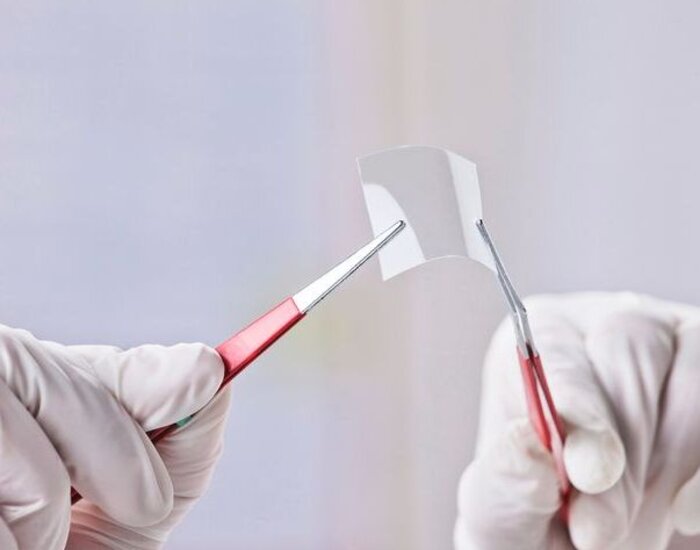
Image showing transparent piece of graphene Transparent piece of graphene
Date
Link
  • 23FUN07 QuAHMET project website
Tags
  • European Partnership on Metrology,
  • Fundamental,
  • EMN Quantum Technologies,
  • TC-EM,

Video describing quantum anomalous Hall effect materials and devices for metrology

<p><em>Developing the metrological network to allow for accurate measurements using the primary resistance standard</em></p>

Developing the metrological network to allow for accurate measurements using the primary resistance standard

In electric metrology, the Quantum Hall effect (QHE) is essential for realisation of the primary resistance standard, on which most basic measurands, including current, resistance, capacitance and electric power, depend. However, currently QHE devices only function at low temperatures and high magnetic fields, which hinders their widespread implementation. 

The Quantum Anomalous Hall effect (QAHE) provides an opportunity to overcome these limitations while maintaining the unsurpassed accuracy expected of primary resistance standards. Greater knowledge of QAHE devices is essential to accelerate the development of a ‘quantum electrical metrology toolbox’ for the universal adoption of quantum electrical SI (International System of Units) standards.

Metrology Partnership project Quantum anomalous Hall effect materials and devices for metrology (23FUN07, QuAHMET) is working to develop new materials for the QAHE, including magnetically doped topological insulators that could also be interfaced with anisotropic magnetic insulator layers to produce high structural quality materials that have optimised properties needed for QAHE at easily achievable temperatures. These materials will be tested for their electronic, structural, magnetic, and magneto-electronic properties with QAHE devices under different conditions, including temperature and applied magnetic fields to determine the limitations of QAHE.

Video

The rationale, objectives and progress of the project are described in this video of a 20-minute talk from an earlier workshop.

Topics covered include:

  • Need / motivation for the project
  • Quantum Hall effect
  • Introduction to the project – consortium, objectives, workflow, expected outcomes
  • Topological materials for QAHE
  • Current state-of-the-art in QAHE outside and within EU
  • Project setups

Project coordinator Susmit Kumar from JV, the Norwegian National Metrology Institute, said

‘One of QuAHMET’s most important results so far is the demonstration of resistance quantisation at zero external magnetic field at the 10⁻⁹ level in a magnetic topological insulator. This shows the real potential of the quantum anomalous Hall effect for electrical metrology.

Our next challenge is to make these devices work at higher temperatures and currents. If we succeed, quantum resistance standards could become easier and less costly to operate, bringing primary SI traceability closer to calibration laboratories and industry.’

This Metrology Partnership project has received funding from the European Partnership on Metrology, co-financed by the European Union Horizon Europe Research and Innovation Programme and from the Participating States.


Want to hear more about EURAMET?

Sign up for EURAMET newsletters and other information

Follow us on LinkedIn and X