Case Studies

Page 1 of 4.
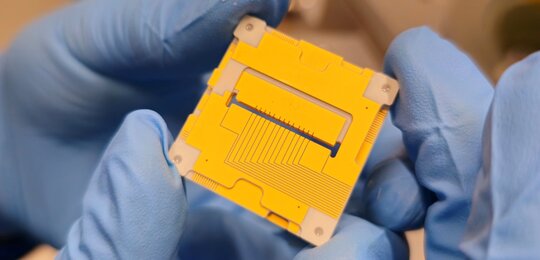
Image showing a pair of blue gloved hands holding the new 3D ion trap, which resembles a yellow square 3 cm by 3 cm

Developing the optical clocks of the future with a precision ion trap

Since 1967 the SI unit of time, the second, has been defined by caesium atomic clocks. In these, caesium atoms are probed with microwaves at frequencies that cause electrons to ‘jump’ into higher orbitals (~1010 Hz). When this occurs 9 192 631 770 times it defines one second. These clocks have enabled a wide range of modern tec...

read more
Against a black background is an image of the world showing European countries with cities connected with glowing gold lines to represent the electrical networks

Metrology and standardisation for components of European electrical grids

To prevent electrical failures in the grid, such as short circuits and breakdowns and resulting blackouts, it is essential that components of the electricity grid, including cabling, insulators, switchgears, and transformers, are tested to ensure suitability for their operating environments. As well as the high voltage alterna...

read more
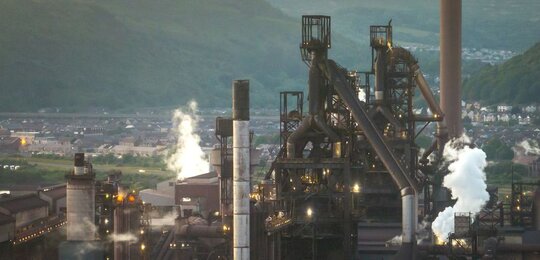
Against a hazy grey sky a large steel plant sits in a valley with white smoke plumes emitted from its large chimney stacks

Enabling better regulation of hydrogen chloride gas emissions

Waste incineration, steel production, chemical and cement plants all emit hydrogen chloride (HCl) gas which combines with water to produce hydrochloric acid, contributing to photochemical smog that damages health, buildings and ecosystems. The Industrial Emissions Directive (IED) limits maximum permissible HCl emissions from w...

read more
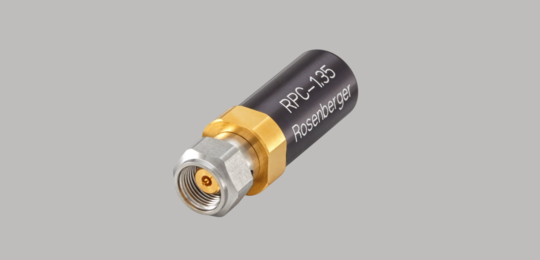
1.35 product image, courtesy of Rosenberger, used with permission

Providing the connectivity for current and emerging radiofrequency technologies

The radiofrequency (RF) part of the electromagnetic spectrum (between 3 kHz and 300 GHz) is used by many current communication systems – including mobile phone networks, TV broadcasting, public radio, and satellites. To reduce interference between these different applications they operate in separate RF “bands” at different fre...

read more
Artists impression of a “smart city” at night with vertical shafts of light rising from the buildings which are linked with glowing lines

Extending European access to high precision time and frequency information

Time and frequency (T&F) reference signals underpin electricity grids, global navigation and the internet. Most applications use signals from orbiting satellites, but their precision is insufficient for advanced research into such things as fundamental physics and quantum technologies. One alternative is to deliver clock signa...

read more
© Courtesy Conservatoire national des arts et métiers (CNAM

New high precision instruments for surveying and geodesy

The determination of distances with low measurement uncertainty, linked to the SI, is used in the surveillance of large-scale facilities during construction and the deformation monitoring of critical infrastructures. It is also important in observations of geological hazards, such as volcanoes or tectonic faults and can help ch...

read more
Page 1 of 4.
Element 1 Element 2 Element 3 Element 1 Element 1 Element 1 Element 1 Element 1 Logo-Footer