Providing the connectivity for current and emerging radiofrequency technologies
Challenge
The radiofrequency (RF) part of the electromagnetic spectrum (between 3 kHz and 300 GHz) is used by many current communication systems – including mobile phone networks, TV broadcasting, public radio, and satellites. To reduce interference between these different applications they operate in separate RF “bands” at different frequencies.
New technologies, such as autonomous cars and the “internet of things” are emerging that require large bandwidths to support high data rates. Many of these are now using a part of the RF spectrum called the E-Band (60 GHz – 90 GHz) which has more bandwidth available than that currently used by mobile phones. Signals in this frequency range also have short free-space wavelengths (3.33 mm to 5 mm) which allow for a small overall size for the system.
Receivers, cabling and antennas for vehicles and other applications all require robust connectors that can handle these higher frequencies. However, the first commercial 1.00 mm diameter connector for this range, released in 2010, was expensive, delicate, and often loosened - causing disruptions.
A new, more robust connector was required to allow for better exploitation of this promising area of the electromagnetic spectrum.
Solution
During the TEMMT project the company Rosenberger teamed up with two other German companies and PTB, the National Metrology Institute (NMI) of Germany, to address this problem.
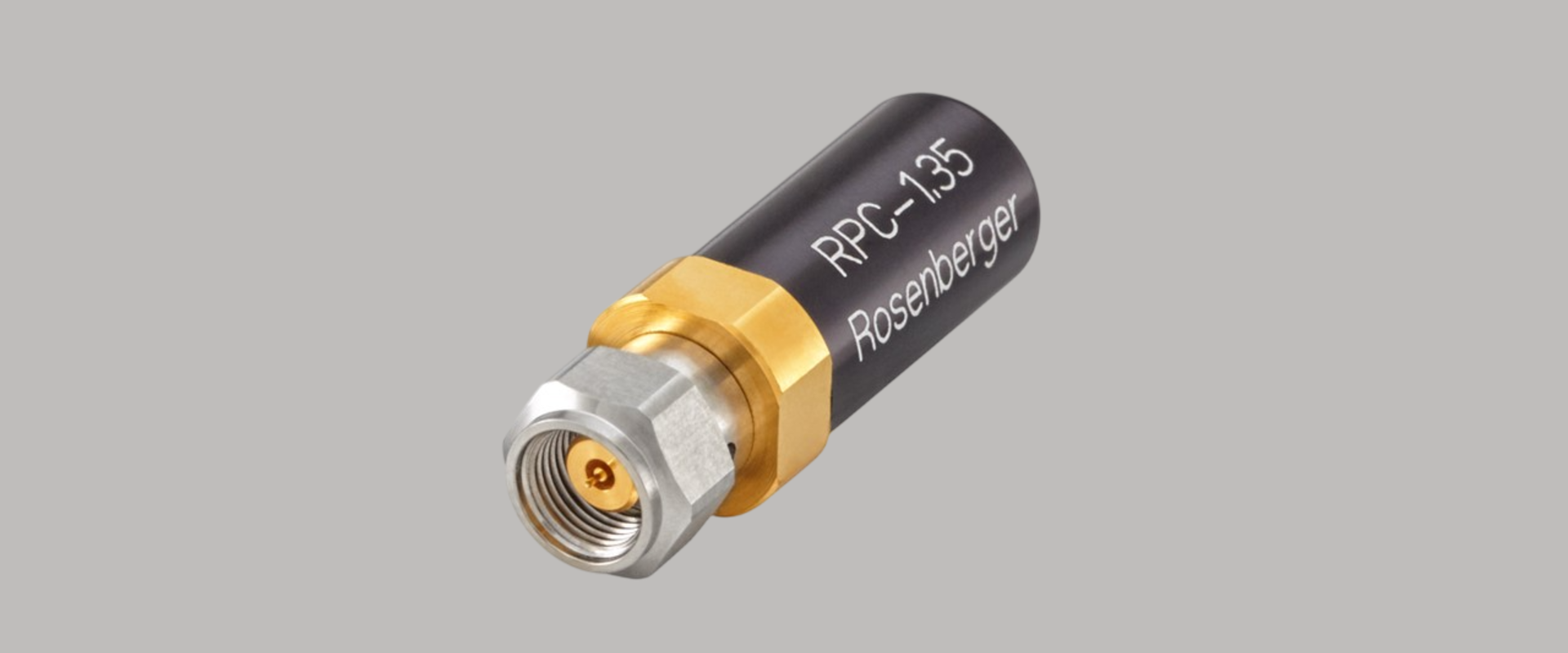
Working together the companies developed a highly robust design for a new 1.35 mm diameter connector for E-band applications. A fine-pitch thread with a larger diameter was added to achieve smooth coupling and allow a higher torque to be applied to prevent unintended loosening of the connector. With an improved interface design connector misalignment is prevented. The interface diameter was optimised to allow a cost-effective design of male type cable assemblies based on a standard cable type.
In agreement with PTB, Rosenberger machined a set of offset shorts which were characterised by PTB and now serve as national reference standards for the traceability of the 1.35 mm connector system.
Impact
Founded in 1958, Rosenberger provides high quality connectors and cable assemblies for companies in high-tech areas such as the automotive, industrial, medical, and test & measurement sectors.
The company now commercialises the new coaxial 1.35 mm connector for E-band measurements as part of the RPC-1.35 connector series, which includes cables, connectors and calibration kits. It is also included in the company’s patented LIGA technology for test probes for microwave wafers and printed circuit board test systems.
The 1.35 mm connector, made from commonly available materials, allows for precision, high performance RF-connections up to 90 GHz and is both more robust and less expensive compared to the 1.0 mm connector. With excellent return-loss values, reliability and repeatability it has recently started to support applications such as 5G and 77 GHz automotive radar sensors. In the latter, RF radars are cheaper than laser-based systems and are relatively more transparent to rain, dust, fog or snow that hinders the use of anti-collision cameras.
PTB has now launched the world’s first NMI level E-band service for traceable scattering parameters or S-parameters measurements, which describe the way a device modifies an electrical signal.
The 1.35 mm design has now been included into 3 IEEE standards - ensuring compatibility between instruments operating in this frequency range.
For the first time traceable measurements exist for the E and surrounding bands – allowing European industries a competitive edge in this emerging area.

- Category
- SI Broader Scope / Integrated European Metrology,
- New Technologies,
- Industry,