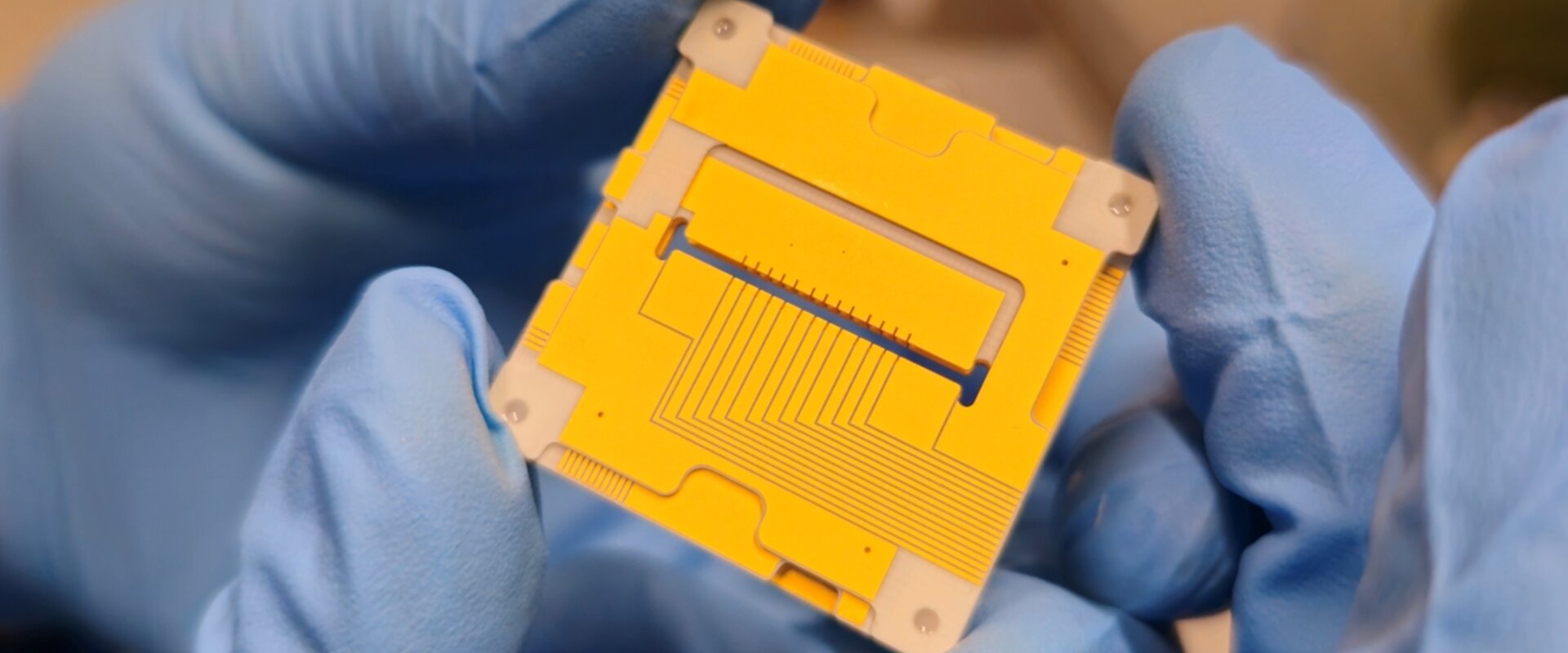
Developing the optical clocks of the future with a precision ion trap
Challenge
Since 1967 the SI unit of time, the second, has been defined by caesium atomic clocks. In these, caesium atoms are probed with microwaves at frequencies that cause electrons to ‘jump’ into higher orbitals (~1010 Hz). When this occurs 9 192 631 770 times it defines one second. These clocks have enabled a wide range of modern technologies, including financial transactions, telecommunications, and the internet. As the 21st century has progressed a requirement for a more precise knowledge of time has emerged in areas such as research into fundamental physics, the search for dark matter, and quantum communications.
An emerging solution is the use of ‘optical’ clocks. At the heart of these are ‘ion traps’ which utilise electrical fields to cage charged atoms such as indium ions (115In+). These ions are excited by precision lasers at frequencies (or ‘ticks’) 100 000 times higher than caesium (~1015 Hz) and are potentially accurate to 1x10-19, losing only one second every 317 billion years. Clocks containing single ions can take up to 3 years to reach this level however, and whilst using multiple charged atoms in the clock can reduce this time considerably, controlling these in ion traps has proven highly challenging.
Solution
During the CC4C project the Leibniz Universität Hannover (LUH) developed the first multi-ion optical clock in the world. An ion trap was developed with the capability to contain hundreds of 115In+ ions forming a ‘Coulomb crystal’. These were combined with ytterbium ions (172Yb+) which interacted with the 115In+, removing energy from these via ‘sympathetic cooling’. This reduced the motional energy of the 115In+, allowing more precise measurements of the optical transition frequency.
In the subsequent TSCAC project the prototype two-species optical multi-ion clock was further improved by LUH. The scalability was addressed and 115In+ ions co-trapped in a 3D ion trap chip with 172Yb+ ions for sympathetic cooling. To both control the clock’s frequency and reduce background noise caused by atoms swapping positions in the trap, a method was also developed to reproducibly restore their positions in the Coulomb crystal.
Impact
To translate these advances into usable technology for the wider community, Laser nanoFab took up the ion trap design for commercial development. Laser nanoFab are experts in novel systems and services in areas such as the laser-assisted production of complex 3D micro and nanostructures and nanoparticles. The company’s work is interdisciplinary in nature and encompasses both system development and application-oriented services. They now offer the developed ion trap at the clock’s heart, as a commercial product. Composed of a ceramic material with low dielectric loss and excellent thermal management it can effectively isolate multiple ions up to large Coulomb crystals. Based on experiments, with specifications backed by PTB, the National Measurement Institute of Germany, it can help others working in this area to save 10 – 15 years in producing an ion trap of their own.
Following TSCAC, in a world-first, the new clock was compared to two optical clocks and a caesium fountain clock at PTB demonstrating in its first operation an accuracy of 2.5 ×10⁻¹⁸ and in an optical frequency ratio measurement a record breaking accuracy of 4.4 ×10⁻¹⁸. With this achievement, it is also the first to demonstrate the measurement uncertainties required in the roadmap for the redefinition of the SI second in the near future.
The upcoming redefinition of the unit of time will support more precise measurements in global positioning and radioastronomy and will help ensure global synchronisation for digital communications in our fast-paced world.

- Category
- EMPIR,
- Fundamental,
- New Technologies,
- EMN Quantum Technologies,