European Metrology Network for Quantum Technologies
Provides European coordination of measurement science research to establish internationally-accepted and reliable measurement services for quantum technologies.
Case Studies
Please find below selected case studies from EURAMET's European Metrology Research Programmes (EMRP and EMPIR) that are related to Quantum Technologies:
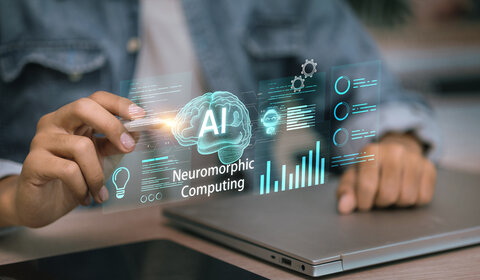
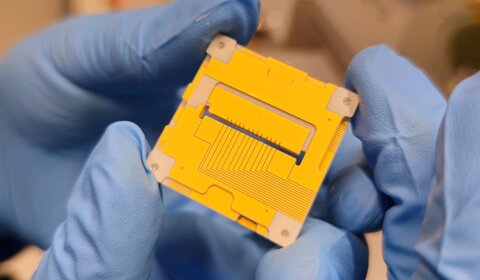
The EU targets reducing greenhouse gas emissions by at least 55% by 2030, compared to 1990 levels. The International Energy Agency, however, has highlighted that, data centres alone consumed 1.5% of the world’s electricity in 2024 and, partly due to energy-intensive computing such as AI, this will more than double by 2030. One answer may be ‘memris...
Since 1967 the SI unit of time, the second, has been defined by caesium atomic clocks. In these, caesium atoms are probed with microwaves at frequencies that cause electrons to ‘jump’ into higher orbitals (~1010 Hz). When this occurs 9 192 631 770 times it defines one second. These clocks have enabled a wide range of modern technologies, including ...
The first “quantum revolution” (Quantum 1.0) came about in the 20th century, when an understanding of fundamental particles led to the development of lasers, semiconductors and atomic clocks. We’re now in the second quantum revolution (Quantum 2.0), where physicists and engineers are controlling individual photons and sub-atomic particles. The impo...
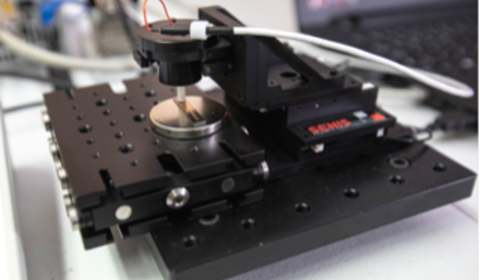
Technology based on the ‘Hall effect’, which determines magnetic field strength by measuring the voltages induced by electric current, accounted for more than 50% of the €1.7 billion global market for magnetic sensors in 2019. Magnetic measurements are important to ensure the correct placement of batteries or device performance in a range of modern...
Telecommunication systems mostly rely on ‘singlemode’ optical fibres that allow only one path or ‘mode’ for light to travel as it propagates through the fibre. However, in many important industrial applications, such as in avionics or the automotive industry, ‘multimode’ fibres are required.
In multimode fibres light can follow many different path...
Over the next decade or so, methods currently used to encrypt data may become ineffective in the face of advances in quantum computing, potentially leaving communication networks and services vulnerable to eavesdropping. Security could instead be assured by Quantum Key Distribution (QKD), a category of technologies that apply quantum theory, rather...
Resources are being invested globally in a race to develop practical quantum computing systems, driven by expected vastly superior problem-solving capabilities.
When realised, quantum computers would have very different characteristics to ‘classical’ computers. This presents a foreseeable threat to Europe’s digital economy, as the security and pri...
Current encryption methods would be easily defeated by algorithms running on a working quantum computer. In such a security environment, commercial sectors such as banking, communications and data storage will demand new encryption tools to ensure valued data can remain ‘quantum-safe’
In theory, Quantum Key Distribution (QKD) protocols could guara...
Europe is launching 22 satellites as its new global positioning system Galileo expands. This will provide robust, secure location and timing signals to European users, removing reliance on other countries, and opening new markets for high performance products that require precision time and frequency signals.
Satellite positioning systems rely on ...
Banks and internet companies need very accurate time and date stamps to send information and process high frequency transactions. As the technology used gets faster, greater timing precision is required. Atomic timekeeping, provided by National Measurement Institutes, supplies the highest timing accuracy, but these clocks are bulky and require very...