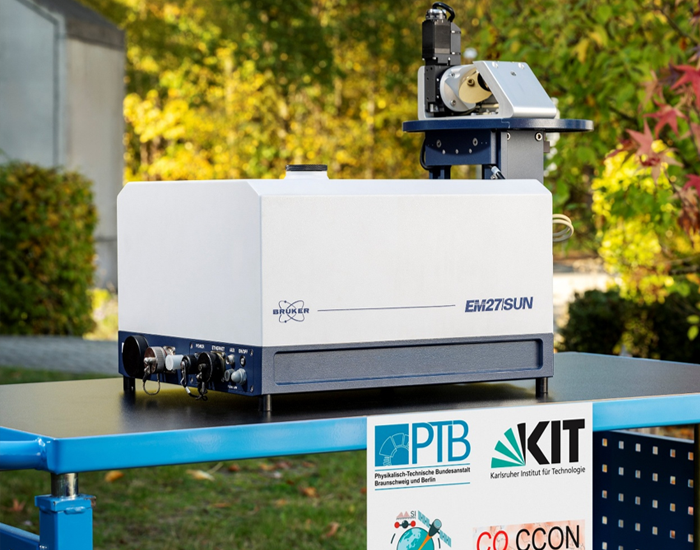
Arrival of EM27/SUN at PTB Braunschweig Arrival of EM27/SUN at PTB Braunschweig
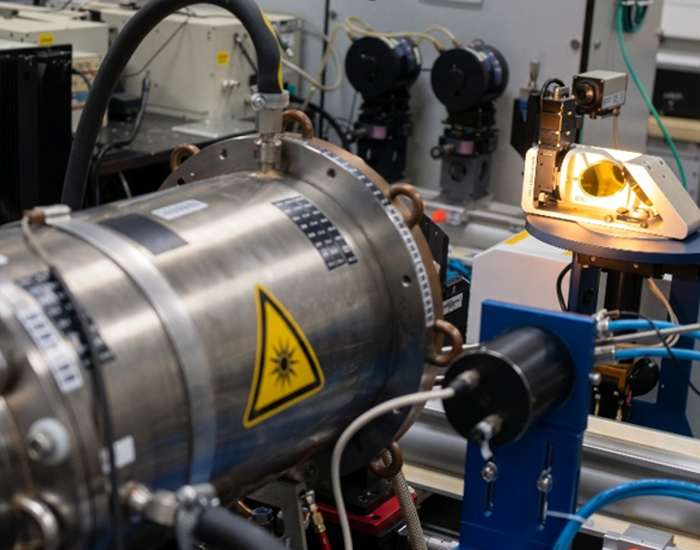
Characterising the detector non-linearity of a KIT EM27/SUN FTIR spectrometer at PTB Berlin. Characterising the detector non-linearity of a KIT EM27/SUN FTIR spectrometer at PTB Berlin.
Date
Author
  • Gang Li (PTB), Tom Gardiner (NPL), Marc Coleman (NPL), Kavitha Mottungan (NPL), Concong Qiao (KIT), Rainer Stosch (PTB)

Metrology in the Field: Anchoring Global Climate Data to SI Units

<p>Reliable global climate observation requires bridging laboratory metrology with field measurements.</p>

Reliable global climate observation requires bridging laboratory metrology with field measurements. To support this, the German National Metrology Institute PTB (Physikalisch-Technische Bundesanstalt) is establishing a new COCCON (Collaborative Carbon Column Observing Network) measurement station [Photo 1] operated by Working Group 3.14 (Spektrale Atmosphärensensorik/ Spectral Atmospheric Sensing).  The mobile COCCON station monitors  total columns of essential atmospheric gases XGas, including CO₂, N₂O, CH₄, H₂O and O₂. Operating these spectrometers directly in the field allows metrologists to assess the practical conditions of remote sensing, which is necessary for ensuring optical atmospheric measurements remain anchored to SI units.

The deployment of this station is supported by collaboration and in-person and online training sessions from COCCON Chair Prof. Frank Hase from the Karlsruhe Institute of Technology (KIT). As the network’s founding institute, KIT co-developed the portable EM27/SUN Fourier-transform infrared (FTIR) spectrometers used in COCCON.

COCCON vs. TCCON: The Total Carbon Column Observing Network (TCCON) serves as the primary reference for greenhouse gas satellite validation, operating approximately 26 large, stationary facilities worldwide.  In comparison, COCCON provides a complementary, high-density network. With over 160 compact spectrometers deployed globally, COCCON increases the spatial resolution of climate data and fills regional monitoring gaps. Every COCCON instrument is anchored to TCCON standards through centralised calibration at KIT and co-located cross-comparisons. The COCCON spectrometer is also useful for tracking local emissions. Because the instruments measure the total column of air above them, placing spectrometers upwind and downwind of a target area minimises the influence of local boundary-layer turbulence. This differential approach allows researchers to isolate and quantify emissions from specific locations, such as urban centres, industrial sites, and agricultural facilities, providing independent verification for bottom-up emission inventories.

SI-Traceable Calibration for Detector Non-Linearity:  In June 2026, PTB and KIT conducted a joint measurement campaign at PTB Berlin to characterise the detector non-linearity of an EM27/SUN FTIR spectrometer (serial number SN191) [Photo 2]. The instrument was exposed to stable, well-characterised radiation from a high-temperature cavity radiator operated by PTB’s Working Group 7.31 (led by Dr Richard Dieter Taubert). Measurements taken at source temperatures from approximately 1,400 to 3,000 K provided controlled signal levels for both detector channels. The analysis of the resulting interferograms and spectra is ongoing. The team expects these measurements to yield improved characterisation of the non-linear detector response and its correction parameters, supporting more accurate atmospheric gas measurements.

MetCTG: Metrology for Comparable and Trustworthy Greenhouse Gas Remote Sensing Datasets. These developments for COCCON are driven by the EURAMET joint research project 24GRD06 MetCTG. Climate monitoring bodies, including the World Meteorological Organization (WMO) and the Global Climate Observing System (GCOS), require measurement uncertainties as low as 0.1% to 0.24% for global GHG observations to better pinpoint sources and sinks.

The three-year project, which commenced in August 2025, aims to strengthen the accuracy, traceability and comparability of greenhouse gas remote sensing data. The project brings together national metrology institutes, universities and atmospheric science organisations across Europe through six interconnected work packages covering SI-traceable spectroscopic data, advanced theoretical modelling, validation using TCCON, COCCON, AirCore and satellite observations, uncertainty assessment and calibration of solar FTIR measurements, stakeholder engagement, and project coordination.  The Month 9 (M9) project meeting was held remotely on 23-24 April 2026 and provided an opportunity for partners to review progress across all work packages. Following the meeting, Frank Hase (KIT) delivered a dedicated training session on the PROFFIT retrieval software for colleagues from NPL and PTB, helping to strengthen project capabilities in greenhouse gas retrieval, processing and analysis. By linking metrology, spectroscopy, atmospheric observations and satellite retrievals, MetCTG will support major greenhouse gas monitoring networks and satellite missions, delivering more comparable and trustworthy datasets for climate science, emissions monitoring and Net Zero policy development.

 More about the project: https://www.metctg.ptb.de/home