Case Studies

Page 10 of 43.

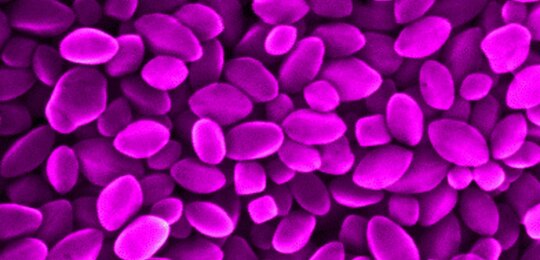
New reference material for light scatter-based sizing of extracellular vesicles

Extracellular vesicles (EVs) are biological nanoparticles actively released by cells, comprising of an outer lipid membrane, and containing markers indicative of the cell of origin, and housing an inner aqueous core. Most EVs are 100 nm in diameter or less but can range in size from 30 nm to a few micrometres. EVs are found in ...

read more
In the centre of the frame, an air monitoring station is attached to a pole. It consists of a grey metal box with a handle pointing towards the viewer and three covered pylons, carrying sampling equipment, protruding from the top, as well as a small silver cylinder. In the background there is the canopy of a full, green tree, and a blue sky filled with soft clouds

A new facility for ambient-like aerosols

Particulate matter (PM) in air – such as dust, soot, and smoke – poses risks to both human health and the environment. It is estimated that over 500,000 deaths in Europe every year are caused by PM exposure and areas of high PM concentration are associated with reduction in life expectancy of 12-36 months. PM is typically monit...

read more
In the early morning light a tractor in the foreground is spraying pesticide over rows of low plants in a large open field

Developing the technology to accurately measure ammonia

Ammonia (NH3), a colourless, reactive gas, can cause substantial health damage due to its adverse effects on air quality. Once released into the atmosphere, it can form fine particulate matter (PM2.5) that has been linked to tens of thousands of premature deaths annually. It can also be absorbed by soils and plants, damaging th...

read more
Consumer changing incandescent lamp with a new LED light bulb

New photometry standards for measurement of solid-state lighting products

Conventionally the calibration of photometric equipment was performed with tungsten filament standard lamps with the standard illuminant A spectrum, which was published by the International Commission on Illumination (CIE) in 1931 and was originally designed for use with incandescent lighting products. However, incandescent co...

read more

A new field test standard for hydrogen refuelling stations

Hydrogen refuelling stations (HRS) must meet measurement requirements set out by legislation. Standards such as SAE J2601 and OIML R139 are in place to ensure safety at HRS. The former establishes process limits for light duty vehicles (e.g., cars) to ensure that tanks do not overheat or overfill during fuelling, while the latt...

read more
The BTS-Solar array spectroradiometer deployed at the 19ENV04 EMPIR MAPP field campaign at Izaña, Tenerife, September 2022

Improving the measurements used to protect atmospheric ozone

Ozone, comprised of three linked oxygen atoms, is generated in the stratosphere by the action of solar radiation on oxygen gas, and absorbs 99% of the sun’s biologically harmful UV-B radiation (280 - 315 nm) that is a cause of skin cancers in humans. A rare molecule, it is concentrated in a band around 20-25 km above sea level...

read more
Page 10 of 43.
Element 1 Element 2 Element 3 Element 1 Element 1 Element 1 Element 1 Element 1 Logo-Footer