Understanding how natural and manmade atmospheric aerosols impact on climate
Challenge
Reducing the production of greenhouse gases is essential to keep global temperatures less than 1.5°C above pre-industrial levels. However, atmospheric aerosols also have a significant impact, contributing the largest uncertainty to estimates of climate change. Particles from manmade sources, such as waste incineration, tend to be dark, trapping heat and warming the Earth. With the exception of wildfires, natural aerosols, such as volcanic sulfuric particles, are generally whiter and reflect sunlight causing cooling.
Models suggest the latter have counteracted around half of all greenhouse gas effects since the 1880s. Thus they have been recognised as “Essential Climate Variables” by the Global Climate Observing System.
Information on how all particles in a column of atmosphere absorb or scatter light are provided by radiometers using remote sensing techniques. These measure the “Aerosol Optical Depth” (AOD) from the ground to the “Top of the Atmosphere” (ToA) where no aerosols exist. They are calibrated against a ToA value that is extrapolated from ground-based measurements, performed at high-altitude locations during clear weather, and then relocated to their operational monitoring sites, at which time metrological traceability is lost.
In 2021 a new reference spectrum was developed that provided ToA values based on satellite observations - the “Spectral Solar Irradiance Sensor-1 Hybrid Solar Reference Spectrum” (TSIS-1 HSRS) with very reduced uncertainties relative to previous satellite determined solar spectra. This removed the need for ground-based extrapolations, opening the possibility of calibrating instruments in the laboratory with measurements fully traceable to the SI.
Solution
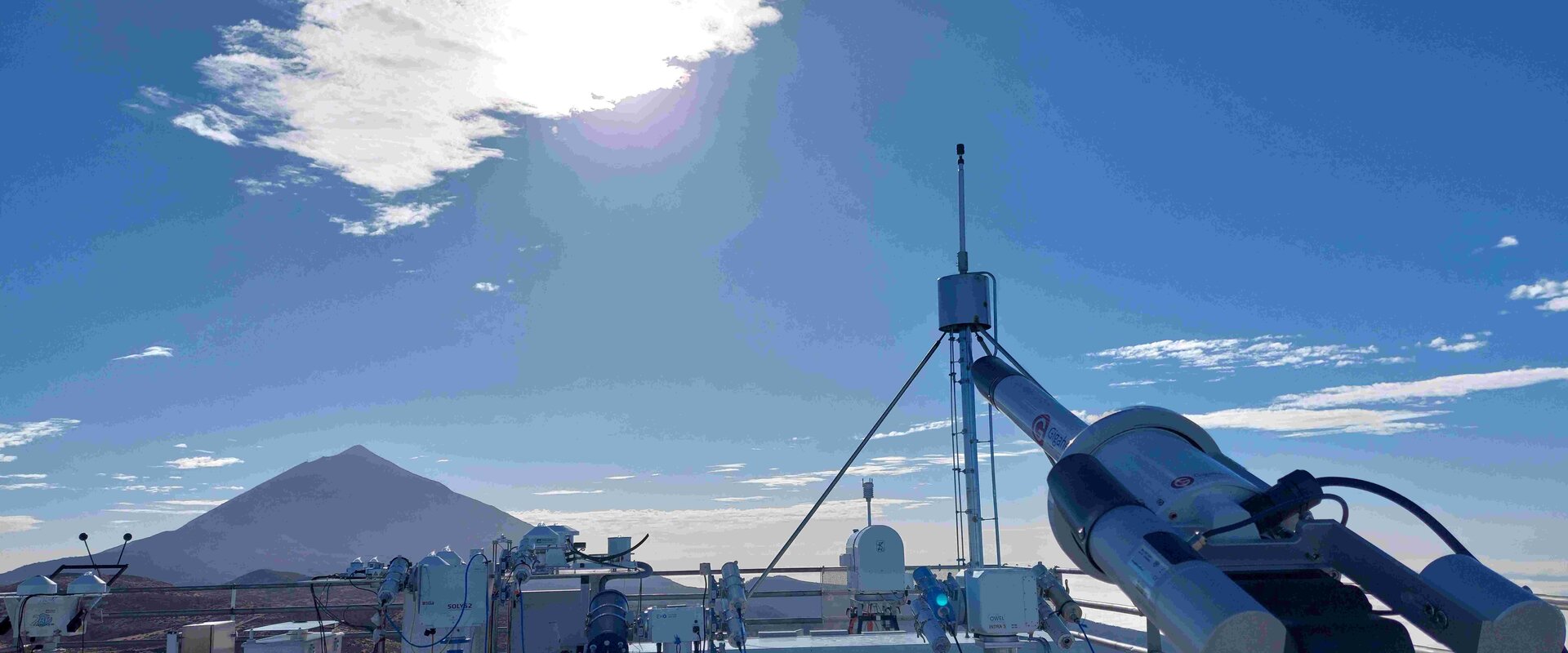
During the MAPP project a 3-week field campaign was carried out with five different types of spectroradiometers at the Izaña Atmospheric Observatory, a high altitude primary calibration site for extrapolating ToA values due to its stable atmospheric conditions.
All instruments had been laboratory calibrated, including a BiTec Sensor (BTS) from project collaborator Gigahertz Optik GmbH. This was calibrated in Gigahertz-Optik’s own ISO 17025 certified laboratory demonstrating a measurement uncertainty of 1% in AOD. During the campaign Gigahertz Optik applied a new developed algorithm from PMOW/WRC for AOD retrieval, verified at PTB the National Metrology Institute of Germany.
The retrieved ToA Data from all 5 instruments were compared to the TSIS-1 HSRS, showing 99% agreement and reduced the relative uncertainties of this reference spectrum in the ultraviolet region (308 nm to 400 nm) from 1.3 % to 0.8 %.
Impact
For forty years Gigahertz-Optik have supplied cutting edge instrumentation, software, knowledge and metrological solutions for optical measurements in LED manufacturing, lasers, photomedicine, imaging sensors, solar and ozone applications and many more.
The BTS sensor covering 300 nm – 1050 nm and 950 nm – 2150 nm allowed spectral measurements above 1700 nm to which it was limited before. Gigahertz-Optik have now integrated the new software into this spectroradiometer, and the company acknowledge the MAPP project, PMOD/WRC and PTB, in helping to calibrate and validate it for AOD measurements.
The AODs retrieved using laboratory calibrated instruments also showed excellent agreement with filter radiometers belonging to two atmospheric networks – with acceptance limits well within those defined by the World Meteorological Organization.
Instruments designed to measure atmospheric aerosols can now be calibrated in the laboratory and transported to the area of their operation. As well as the demonstration that SI traceability can be maintained for these, the knowledge gained will also help decouple the climate impacts of atmospheric aerosols from natural and anthropogenic sources.
In the long-term this could also help geoengineering proposals regarding injecting specific aerosols into the stratosphere to reduce the global warming currently underway, as the success of these will depend on the amount of solar dimming achievable, for which SI traceability and measurement uncertainty will be crucial factors.

- Category
- EMPIR,
- Environment,
- EMN Pollution Monitoring,
- EMN Climate and Ocean Observation,