Understanding and predicting the effects of solar storms with a new AI model
Challenge
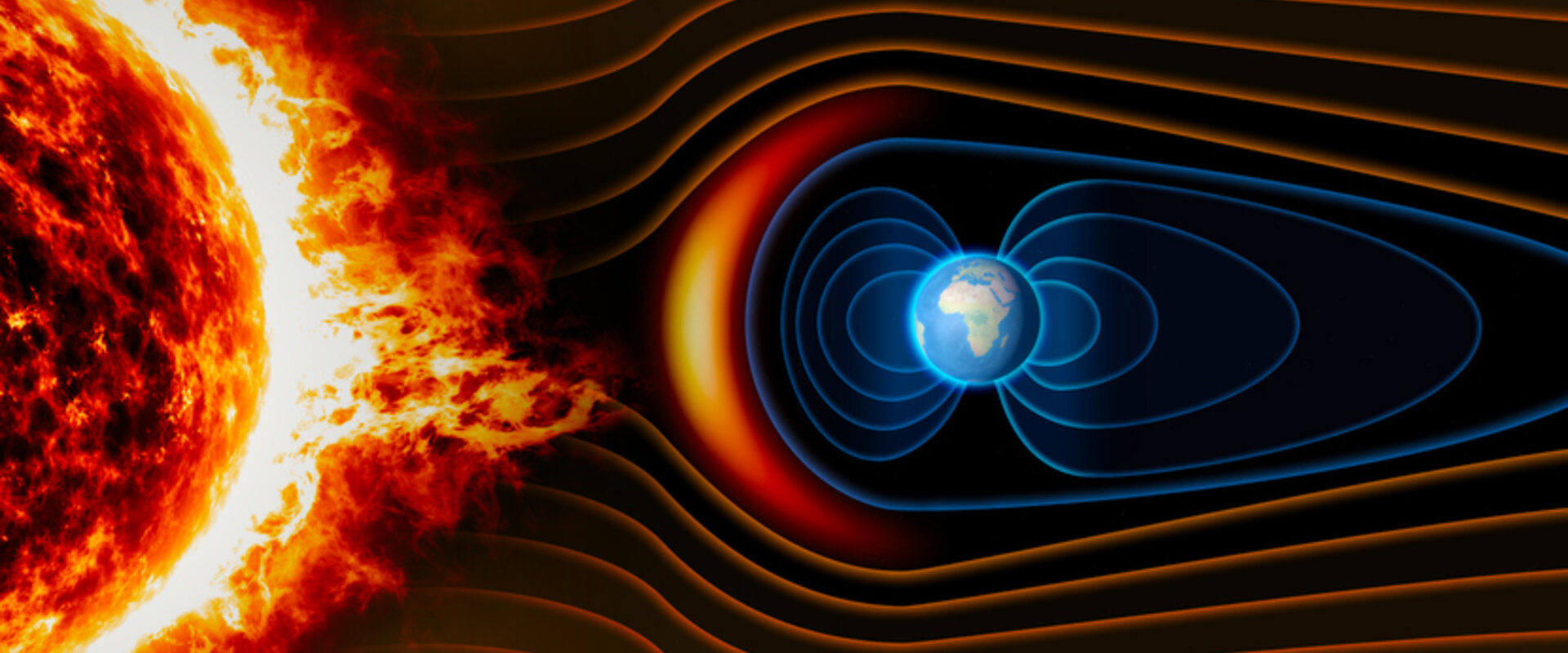
One of the first discoveries of the space age in 1958 was the existence of two doughnut-shaped radiation zones around the Earth, the “Van Allen Belts”. Formed from energetic particles generated by distant cosmic events or from the solar wind, these follow the Earth’s magnetic field lines. The inner belt, composed mostly of energetic protons (≤ 100 MeV) created by cosmic rays, is centered between 300 km and 1000 km above the Earth, extending to around 10 000 km. The outer belt, extending from 13,000 to around 60,000 km, is mainly populated by electrons from solar activity that range in energies up to 10 MeV.
During severe solar storms, energetic electrons and even protons can be injected into the ‘slot’ between the belts, or even into the inner belt. This can potentially cause problems to satellites and space missions, exposing aircraft cabin crew to high levels of radiation and disrupting radio and ground-based power systems.
Solar and geomagnetic activity has been monitored for many years, such as with the Energetic Particle Telescope (EPT) on the PROBA-V satellite, launched in 2013, but predicting when extreme solar events will occur has proven difficult.
Solution
During the BIOSPHERE project, the Royal Belgian Institute for Space Aeronomy (BIRA-IASB) developed a deep learning tool to help predict space weather effects. Eleven years of Van Allen radiation zone observations made by the EPT onboard the PROBA-V satellite, including the satellite’s coordinates at the time of observations, were compiled. These were combined with datasets of geomagnetic indices that describe the disturbances in the Earth’s magnetic field (indicating the onset of a solar storm and auroras), and with solar wind speed and pressure.
The EPT dataset was used to train a Long Short-Term Memory (LSTM) neural network, a recurrent architecture designed to capture long-term temporal dependencies in sequential data and to forget irrelevant information. The model successfully forecast radiation belt electron fluxes several hours in advance, achieving prediction efficiencies of approximately 90% for both relativistic (>0.5 MeV) and ultra-relativistic (>2 MeV) electron fluxes.
Impact
BIRA-IASB scientists are experts in space observation, having helped develop the EPT detector on board the PROBA-V satellite. As well as being responsible for analysing and simulating the space radiation observations in the LSTM model “ERB.AI”, the institute also coordinated four measurement campaigns assessing the relationship between cosmic radiation, solar activity and anthropogenic emissions. During these, on 11 May 2024, the strongest geomagnetic storm in over two decades was observed, generating auroras visible around the world (the “Mother’s Day” geomagnetic storm). For the first time, four electron radiation belts were observed lasting over a month, with unprecedented injections of ultra-relativistic electrons into the inner belt. This caused severe disruptions to high frequency radio communications and degraded Global Navigation Satellite Systems worldwide. The storm also strongly depleted the protective ozone layer at 80 km in the upper atmosphere (the mesosphere) by up to 60%.
BIRA-IASB is continuing to improve the ERB.AI model in the 2026 RAISEARTH project, integrating more physics-based data, and adding information on the intense solar storms observed in 2024-2026. It will also incorporate observations from the 3DEES detector, also contributed to by BIRA-IASB, launched on the PROBA-3 satellite in 2024.
The ability to predict extreme solar events and their effects on the terrestrial environment will help safeguard ground-based power electricity grids, allow satellites to be put in “safe-mode”, and protect astronauts from extreme radiation events.

- Category
- European Partnership on Metrology,
- Green Deal,
- EMN Radiation Protection,