Providing the confidence in instrumentation for measuring vehicle emissions
Challenge
Fine particulate matter with diameter ≤ 2.5 micrometres (PM2.5), is estimated to contribute to 238,000 premature deaths in Europe annually. To align with World Health Organisation (WHO) recommendations, the EU must halve its PM2.5 concentration limits - a goal the Air Quality Standards Directive seeks to achieve by 2030.
Before 2017, emission monitoring was performed using Type Approval (TA) tests in the laboratory which did not always reflect real world conditions. To supplement these, the EU introduced the ‘Real Driving Emissions’ (RDE) test where “Portable Emission Monitors” (PEMS) directly measure emissions at a vehicle’s tailpipe on the road, considering parameters such as acceleration, deceleration, ambient temperature, and payloads. To ensure measurement accuracy, particle counters for PEMS need to be calibrated with a stable particle generator and a reference counter.
However, commercial particle generators with a broad size range of 2-300 nm and a simple ease-of-use concept are not readily available and some, like “soot generators”, struggle to produce stable and reproducible aerosols in a comparable size range. In addition, they require skilled operators, take several hours to calibrate PEMS and are not fully harmonised leading to variations in instrument response.
In 2025, the new vehicle regulation Euro 7 was implemented, further reducing allowed emission llimits to meet WHO levels, creating a pressing need for a reliable and traceable way for size-certified nanoparticles with size down to 10 nm to calibrate PEMS.
Solution
During the MetroPEMS project, a new type of particle generator developed by Catalytic Instruments was characterised by METAS, the National Metrology Institute (NMI) of Switzerland.
Based on evaporation-condensation technology, solid silver is evaporated in a tube furnace, carried by a nitrogen gas stream, the silver vapor cools and condenses leading to particle formation. By adjusting the temperature and flow parameters, the size of the particles generated can be fine-tuned.
The “Silver Particle Generator” (SPG) was characterised in terms of size and number of particles generated as well as the stability and repeatability of the instrument. Results indicated that the SPG could produce high concentrations of uniform particles and aggregates in the size range between 2 and 300 nm, with less than a 2% variation over 15 hours of continuous operation and around 10% inter-day variability.
Impact
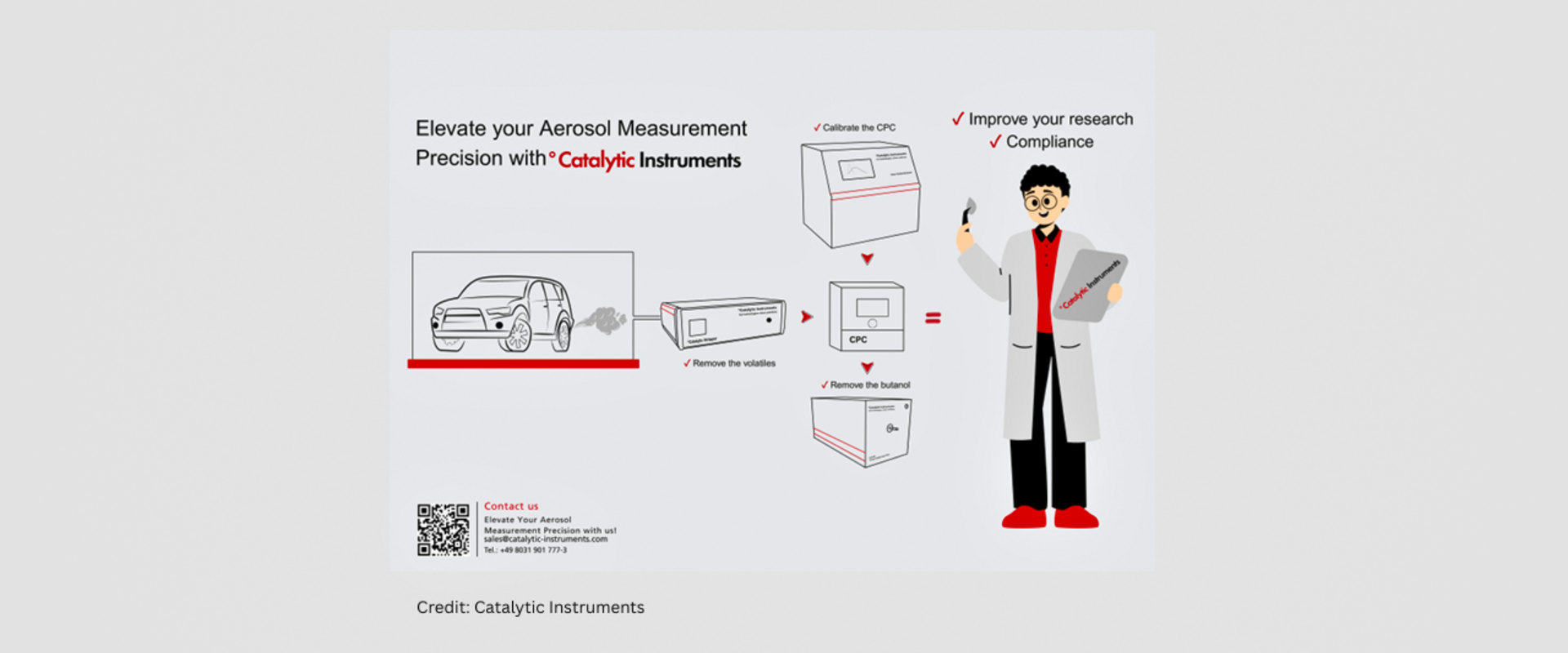
Catalytic Instruments, based in Germany, have produced cuttingedge instruments for the automotive industry for over a decade. This includes their Catalytic Stripper and Catalytic Vapor Filter, designed to remove volatile and semi-volatile compounds to enable more reliable emission monitoring from engines and combustion processes.
The company’s SPG is one of the first commercial, metrologically validated instruments in the world that can produce truly spherical particles in quantities sufficient for calibration purposes with a remarkable degree of long-term stability and reproducibility. This can be performed in line with ISO 27891:2015. The heat up time of the SPG is less than 15 minutes and can be operated by a service technician without any specific training.
Catalytic Instruments acknowledge the help from the project in allowing them to focus on the development of the SPG – especially by METAS, who’s characterisation in the MetroPEMS project has helped enhance trust in the device. A number of leading NMIs in Europe are now using the SPG and the company is also adapting its technology used in the instrument to other areas, like generating gold particles to coat anodes to decrease charging times of electric vehicle batteries.
The SPG and work of MetroPEMS will allow automotive industries to meet current and new regulations for vehicle emissions and help reduce the health burden caused by poor air quality.