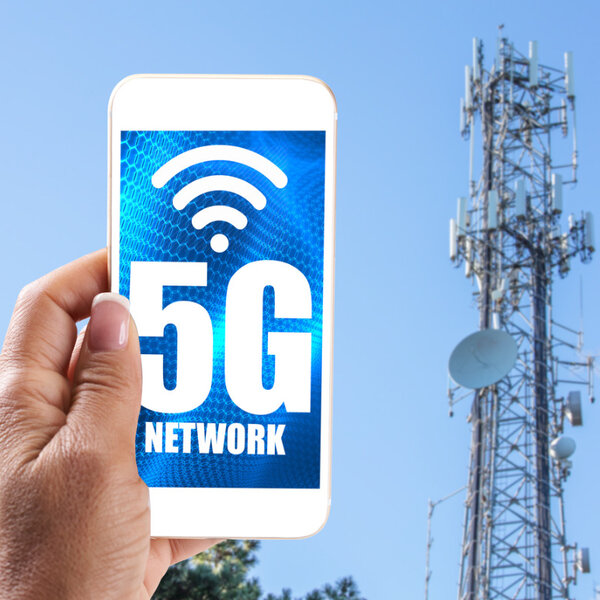
<p><em>The EU has targeted that all European households have access to 5G by 2030, an EMPIR project has produced guides to help the rollout of this network</em></p>
The EU has targeted that all European households have access to 5G by 2030, an EMPIR project has produced guides to help the rollout of this network
The fifth generation (5G) mobile network is currently being deployed across Europe. The increased connectivity it provides is set to become a basic requirement in the fields of eHealth, smart electricity grids, connected homes, and entertainment. It will also allow new digital applications, such as virtual and augmented reality, autonomous driving, artificial intelligence, smart manufacturing, and precision farming.
Unlike 3G and 4G networks, the 5G network generates radiofrequency electromagnetic fields (RF-EMF) using “focused” beaming to mobiles, and, to ensure public safety, the International Commission On Non-Ionizing Radiation Protection (ICNIRP) has published guidelines regarding RF-EMF exposure which are enshrined in the European Council Recommendation 1999/519/EC for general public. This sets an exposure limit of 61 volts per metre (61 V/m) but in some European countries much lower exposure limits have been applied (e.g. 4 V/m and 6 V/m). These stricter limits have had an impact on 5G network rollout and deployment.
To overcome this problem the telecommunications industry requires a credible verification methodology to assist the EU Commission to decide whether to harmonise policies on deploying mobile broadband and other wireless technologies.
The EMPIR project Metrology for RF exposure from massive MIMO 5G base station: Impact on 5G network deployment (18SIP02, 5GRFEX) has addressed this issue.
Building on the work of Metrology for 5G communications (14IND10, MET5G) which developed 5G Multiple-Input-Multiple-Output (MIMO) transmission testbeds, this project focused on the development of rigorous RF-EMF measurement techniques to establish a user-controllable massive MIMO (mMIMO) testbed.
Based on the experiment-based results from the mMIMO a good practice guide was produced for traceable RF-EMF measurements and data processing for 5G base station systems. In addition, a validation report was written, describing a rigorous capability for traceable RF-EMF measurements for 5G new radio mMIMO base stations.
Another key output from the project was an evaluation report describing how the stringent RF-EMF limits affect 5G wireless communication performance. This forms the baseline recommendations on how to robustly measure RF-EMF from 5G new radio mMIMO base stations.
Mobile network operators now have the evidence to inform the EC on the need for harmonisation RF-EMF exposure limit policies based on international guidelines. The new RF-EMF exposure measurement methods will also help industry assess 5G mMIMO base station performance and prove their safety to regulators. This will facilitate the adoption of evidence-based policies that will enable more effective deployment of mobile broadband and other wireless technologies.
Members of the 5GRFEX consortium are now participating in the European Metrology Partnership project Metrology for emerging wireless standards (21NRM03, MEWS) which is developing metrological methods for evaluating wireless system performance and uncertainty which will be submitted for consideration as contributions to documentary standards IEC 62232 and IEC 62669.
The coordinator of the project Tian Hong Loh (NPL) said about the project:
“By underpinning the state-of-the-art metrology for RF exposure from mMIMO 5G base station and performing rigorous evaluations based on the experimental-based evidence on the stochastic nature of mMIMO operation, this project has led to more informed debate and regulations, that balance performance and public safety. Sound evidence will also assist the EU Commission to decide whether to harmonise policies on deploying mobile broadband and other wireless technologies, which help satisfy the EU citizen’s demand for more and better data, providing huge societal benefit. ”
This EMPIR project was co-funded by the European Union's Horizon 2020 research and innovation programme and the EMPIR Participating States.
The Metrology Partnership project has received funding from the European Partnership on Metrology, co-financed by the European Union Horizon Europe Research and Innovation Programme and from the Participating States.
Want to hear more about EURAMET?
Sign up for EURAMET newsletters and other information
Follow us on LinkedIn and X/Twitter