
Developing the neuromorphic computer chips of the future
Challenge
The EU targets reducing greenhouse gas emissions by at least 55% by 2030, compared to 1990 levels. The International Energy Agency, however, has highlighted that, data centres alone consumed 1.5% of the world’s electricity in 2024 and, partly due to energy-intensive computing such as AI, this will more than double by 2030. One answer may be ‘memristors’, nano-sized devices that use less than 1/800th the power of conventional semiconductors and can be integrated in large numbers onto computer wafers.
A common form consists of a nanometre layer of an insulating material, such as a metal oxide, sandwiched between two nanoelectrodes. When a current is applied, nanofilaments form through the insulator, changing the memristor’s resistance. This state is reversible (by reversing the electrical field) and persists when the voltage is removed, meaning memristors effectively ‘remember’ past electrical experiences in a process analogous to human neurons.
However, memristors are sensitive and institutes using different instruments, materials or resolutions, have returned different results. In addition, only a few insulating (or ‘switching’) materials, such as hafnium oxide (HfOx) or tantalum oxide (TaOx), are compatible with current semiconductor technology. Validated techniques are therefore required to ensure both device performance and reliability.
Solution
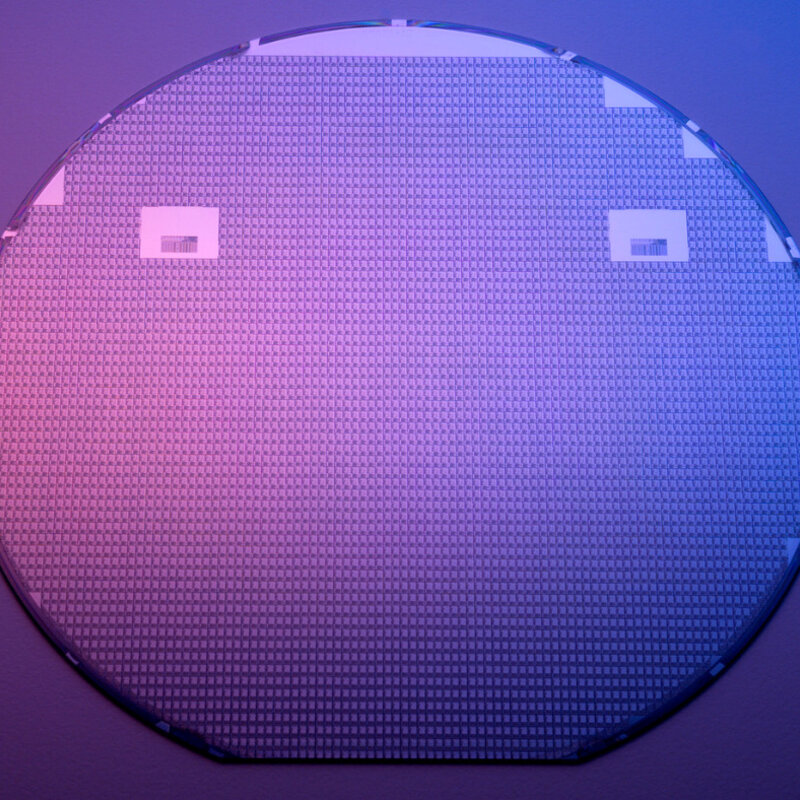
During MEMQuD, the Centre for Process Innovation (CPI) constructed memristors on 15 cm silicon wafers. The bottom electrode was formed using Physical Vapor Deposition (PVD) to coat the wafer with chromium (5 nm) and a platinum layer (20 nm). After confirmation with ellipsometry, CPI then photolithographically patterned the electrode via dry etching with an argon / carbon tetrafluoride plasma. Following coating with silicon oxide (200 nm) by a project partner INESC from Portugal, the wafers were photolithographically patterned and etched again before coating with either TaOx or HfOx insulating layers (5 nm). The top electrode was then constructed by PVD addition of titanium (5 nm) and titanium nitride (15 nm). Each wafer contained a total 6400 devices, 1600 devices per quadrant in 4 different sizes (5 μm, 7.5 μm, 10 μm and 15 μm) which were then singulated and sent to project partners for characterisation. This included response time to electrical stimulation, endurance, and reliability.
Impact
CPI is a Deep Tech innovation company who help organisations bring innovative technology (TRL1) to the market (TRL9). A founding member of the UK’s High Value Manufacturing Catapult, since 2004, CPI and its Enterprise arm have helped over 14 500 academic, R&D, and private projects, and 3500 SMEs, unlock more than £3 billion in private investment. Through working with MEMQuD CPI have further consolidated and scaled up their nanofabrication and atomic layer deposition processes for creating platinum, chromium, and ALD novel thin films. As electronic components become miniaturised, and new technologies such as memristors emerge, having such validated techniques will become essential for future innovative products.
As well as a potential role in developing AI with ‘brain-like’ learning, these could also revolutionise conventional computers where the architecture of a separate memory storage and processing units lead to signal delay. Memristors can function as both, in one location – drastically increasing processing speeds at reduced energy cost. MEMQuD also demonstrated, in a world first, that by manipulating the electric field, the conductive nanofilaments move through insulating layers in steps linked to fundamental constants. This opens the possibility of integrating these into any measurement instrument to act as built-in quantum resistance standards, allowing room temperature auto-calibration.
- Category
- EMN Quantum Technologies,
- EMPIR,
- Fundamental,
- New Technologies,