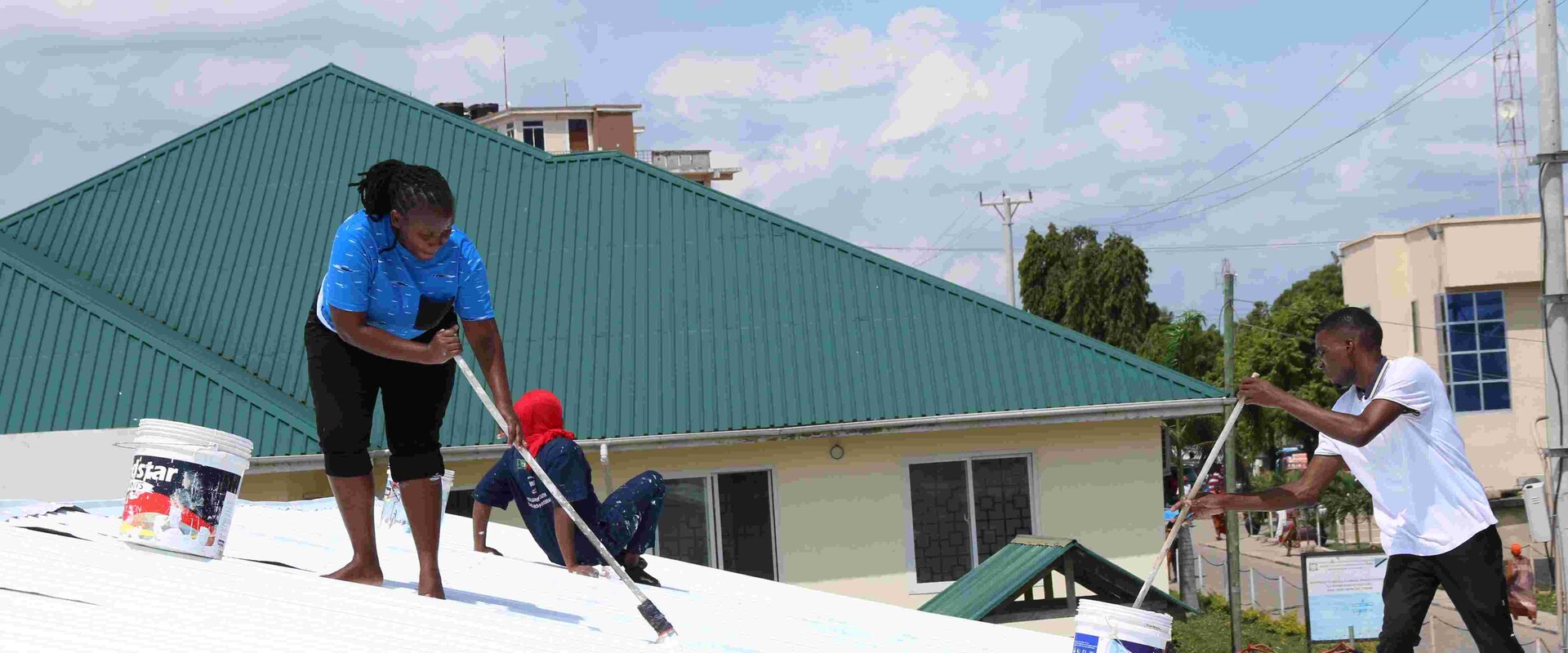
Cooling without air conditioning, even in direct sunlight
Challenge
2024 was the first year that average global temperature exceeded 1.5ºC above pre-industrial levels. Africa, in particular, was hard hit that year, with Zambia and Zimbabwe suffering the worst drought in two decades, reducing cereal yields by 42% and 50% respectively. As daytime temperatures in parts of the continent reached 45ºC, education also suffered, with many of the 242 million pupils who missed school because of the heat in 2024 located in sub-Saharan Africa.
As well as affecting food and education, excessive heat can cause the premature death of vulnerable people, degrade immunisation vaccines, spoil food and create water shortages. However, air conditioners are not widely available, or affordable, in poorer countries. Although greenhouse gases drive global warming, Africa as a whole only produces 4% of all emissions – less than the 10% produced by cooling units, mostly in the developed world.
Passive Daytime Radiative Cooling (PDRC) materials reflect most incoming sunlight while efficiently emitting thermal radiation through the atmospheric window (8–13 μm), allowing heat to escape towards the cold background of outer space (about -270ºC) rather than being trapped by greenhouse gases. However, these materials are hard to replicate in low-income countries, and metrological data needed to validate cheaper alternatives was missing.
Solution
During the PaRaMetriC project, the Emissivity Working Group at the Physikalisch Physikalisch-Technische Bundesanstalt (PTB), the national metrology institute of Germany, and its partners evaluated a range of state-of-the-art passive radiative cooling materials together with commercially available cool-roof coatings from Germany and locally produced coatings from Africa. The aim was to establish validated measurement techniques and benchmark data for state-of-the-art PDRC materials, enabling reliable comparison with commercially available and locally produced cool-roof coatings to identify affordable alternatives with comparable performance. PTB contributed metrologically traceable infrared characterisation of the materials, while complementary infrared, solar reflectance and other optical measurements were performed by project partners. The materials were characterised under different measurement conditions using metrologically traceable techniques. This included methods and facilities established and further refined through previous EURAMET projects, providing reliable and comparable data for selecting the most promising coatings for field demonstration.
Impact
Building on the metrological work carried out in PaRaMetriC, the Cool White project, initiated by the Federation of German Wholesale, Foreign Trade and Services (BGA) and supported by the German Society for International Cooperation (GIZ), translated validated measurement methods into practical demonstrations under real climatic conditions. Selected cool-roof coatings were applied to schools, hospitals and industrial buildings in Rwanda, Kenya, South Africa and Tanzania, allowing their performance to be evaluated under everyday operating conditions.
PTB developed a long-term monitoring methodology combining traceable temperature and humidity measurements with systematic evaluation of field data. Rather than relying on individual measurements, coating performance is assessed using comparable datasets collected over months and years under identical evaluation criteria. This enables direct comparison between coated and uncoated buildings across different seasons and weather conditions. Long-term monitoring has shown average roof-space temperature reductions of around 9ºC during the hottest hours of the day, substantially reduced indoor overheating, and demonstrated that the cooling performance remained nearly unchanged after one year of outdoor exposure despite visible ageing of the coating.
Beyond the technical results, the project strengthens cooperation with local metrology institutes through training, knowledge transfer and the establishment of harmonised measurement methodologies, creating the foundation for reliable long-term evaluation and wider deployment of passive cooling technologies.
- Category
- European Partnership on Metrology,
- Green Deal,
- Environment,