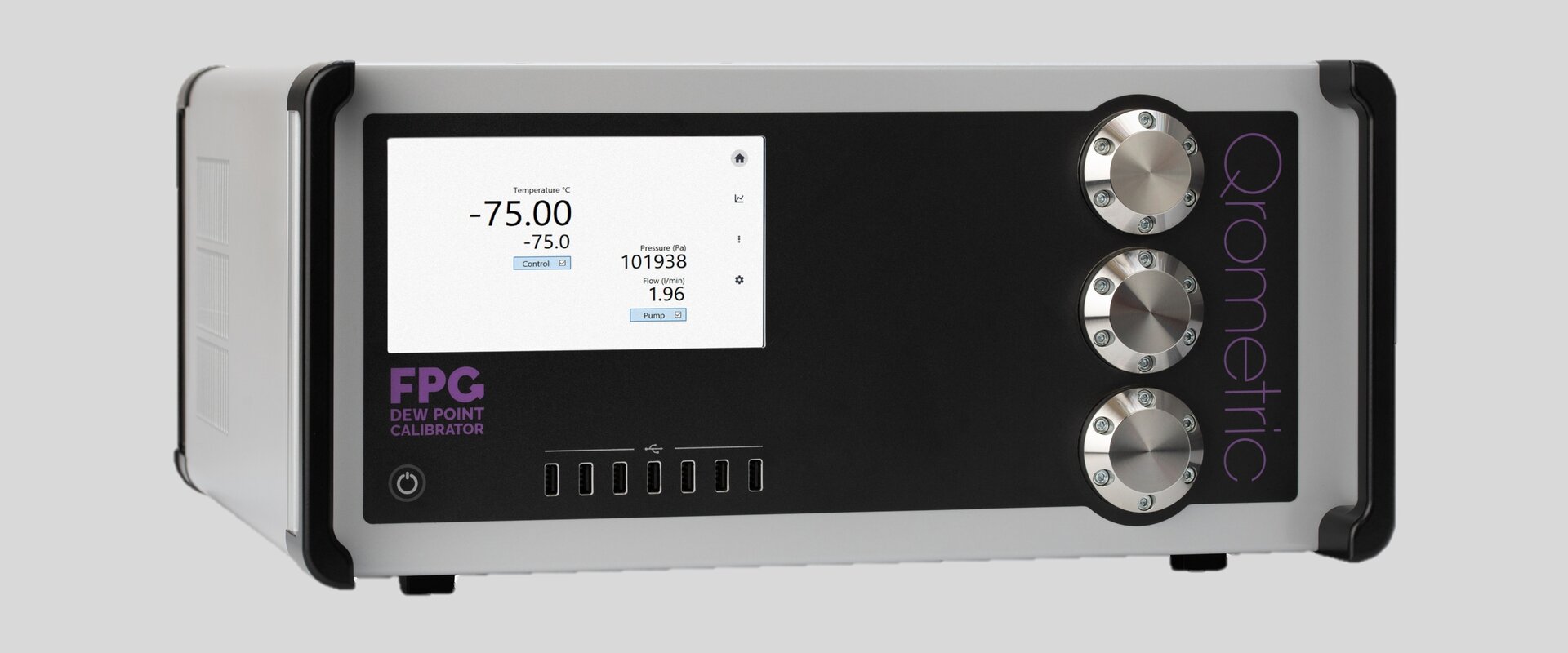
A world first portable instrument for in-situ humidity calibrations
Challenge
Humidity at unsuitable levels can cause unwanted effects in a range of industrial and commercial sectors. In food production, high humidity can stimulate the growth of bacteria, mould, and fungi, causing food spoilage. During semiconductor production, humidity in process gases even at trace level can compromise quality, production efficiency and reduce yield. In the pharmaceutical industry, production depends on dry gases for product safety and production efficiency. Water content impacts drug efficacy, stability in transport and storage, and increases drug costs by impacting shelf life. Extremely low temperatures can result in condensed water even from relatively dry air and many pharmaceuticals require cold temperatures for efficient synthesis.
To measure and control humidity levels, ‘dew point’ humidity sensors are commonly used. The dew point is the temperature to which a moist gas must be cooled for water vapour to reach the equilibrium with its condensed liquid phase – for air, this means the relative humidity becomes 100 %. Below 0 °C, this typically happens over ice and is termed the ‘frost-point temperature’. Trace water in process gases is measured either in terms of frost-point temperature with chilled-mirror hygrometers or water vapour amount fraction with spectroscopic analysers. Conversion from frost-point temperature to water vapour amount fraction requires the use of ‘water vapour enhancement factors’, which consider the non-ideal behaviour of the moist gas mixture.
As validated methods to calibrate humidity sensors in-situ are not available, they need to be removed for test and calibration. Enabling accurate, on-site calibration could save energy, reduce downtime, save costs and support optimised production in high-value manufacturing environments.
Solution
During the PROMETH2O project, Qrometric VCT supplied a prototype frost point generator (FPG) for in-situ calibration of dew/frost point temperature sensors. The performance of the FPG was extensively characterised for its water vapour generation capability across a range of matrix gases and pressure regimes in order to estimate its calibration uncertainty.
It then underwent two field trials, one at the University of Ljubljana in Slovenia, at frost point temperatures down to -90 °C, and one at INRIM, the Italian NMI, against its primary standard down to -100 °C. The FPG was also evaluated independently by NPL, the UK NMI, and showed excellent comparability down to -90 °C when compared to a MBW 373LX chilled-mirror hygrometer transfer standard calibrated against the NPL primary realisation.
Impact
Qrometric and VCT are UK partner companies who develop, manufacture and support specialised humidity measurement and calibration systems used across the global food, aerospace, pharmaceutical and manufacturing sectors. The FPG is now being commercialised by Qrometric, who were a partner in the PROMETH2O project and specialise in water vapour metrology.
The FPG is the world’s first self-contained portable dew/frost point calibrator capable of performing in-situ calibration of humidity sensors and moisture analysers. Qrometric VCT consider this innovation as an “industry disruptive” technology. With a validated temperature range from -100 °C to 0 °C and accuracy of 0.5 °C to 0.05 °C, this portable instrument is capable of dew/frost point generation at temperatures lower than most reference standards.
Qrometric VCT acknowledges the benefit of working with consortium members – not only for helping to confirm the FPG’s capabilities and performance, but also for the feedback received and the access to highest level metrological laboratories.
For the first time, instrumentation is available for accurate in-situ calibration of humidity sensors and moisture analysers. This advance will allow improved trace water measurements that will support waste reduction in European strategic sectors, such as the microelectronics industry, reduce waste of food, and provide better production environments for pharmaceuticals.