A new standard for accurate billing at hydrogen refuelling stations
Challenge
The European Union aims to become fully climate-neutral by 2050. Key to this ambition will be phasing out internal combustion engines in both light and heavy-duty vehicles. Electric vehicles based on hydrogen fuel cells are viable alternatives and it has been estimated by the European Commission that these cells could represent 32 % of fuel demand by 2050. For hydrogen to see wide-spread uptake, however, a robust infrastructure of hydrogen refuelling stations (HRS) must be established across Europe.
Previous EMPIR project 16ENG01 MetroHyVe identified key factors needing to be addressed to make this possible. In particular, the project highlighted that it was not possible to accurately measure the amount of hydrogen dispensed from an HRS at 700 bar, the pressure used for filling light-duty vehicles. This meant a certain level of uncertainty between the amount fueled and the amount charged ‘at the pump’. The project also highlighted that testing HRS compliance to regulation (in particular OIML R139) was slow and expensive. To improve HRS, reduce prices and ensure hydrogen’s uptake as an alternative fuel, traceable methods to calibrate HRS flow rates were needed.
Solution
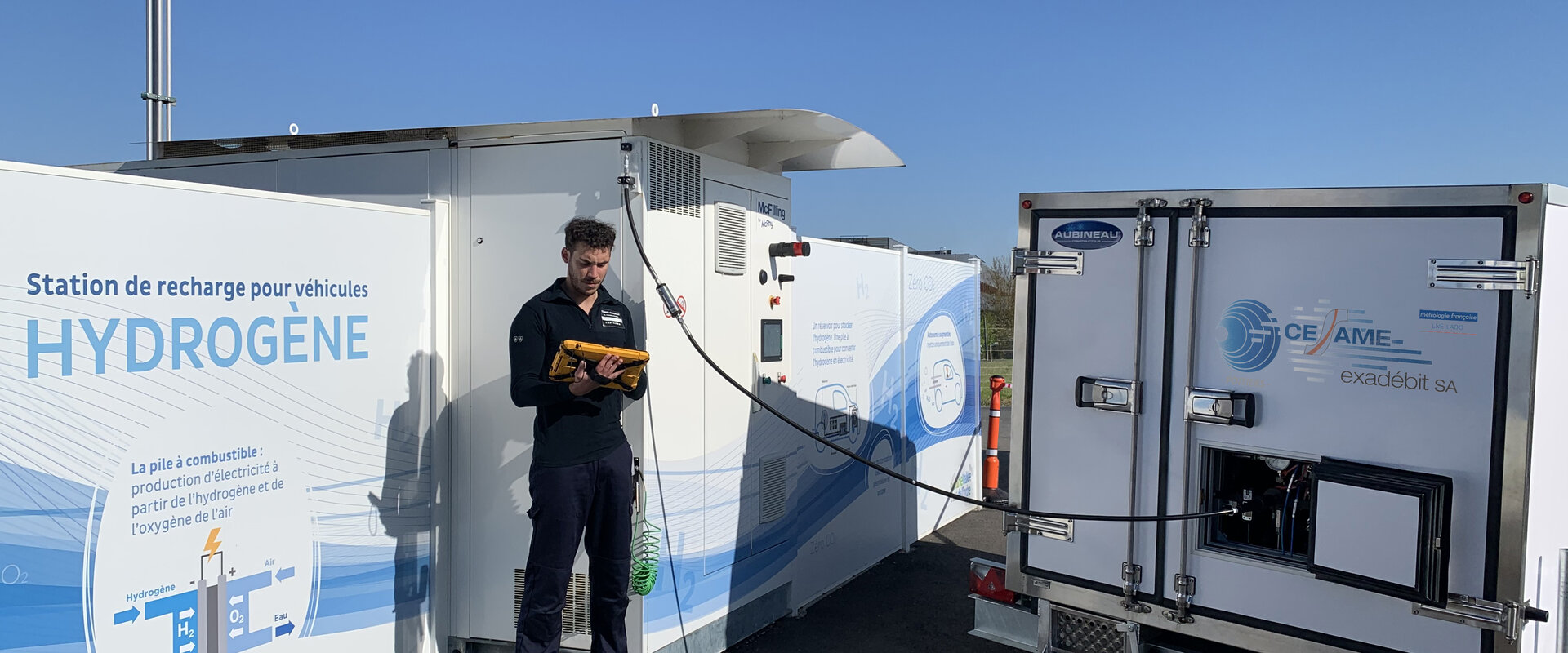
During the MetroHyVe 2 project, a mobile secondary measurement standard and method to verify HRS flow rates in the field were developed by Cesame-Exadebit s.a., a Designated Institute in France. Cesame has now integrated these into a new calibration service, able to calibrate HRS across a range of flow rates and temperatures at both 350 and 700 bar (for both heavy and light duty vehicles). The standard, based around a Coriolis mass flow meter, is traceable to primary standards developed during the MetroHyVe and MetroHyVe 2 projects. It has an uncertainty of better than 0.6 %, which is compliant with OIML R139, and allows HRS to be verified 50 % faster than before.
Impact
TotalEnergies is a global energy supplier with a 100-year history in the industry. More recently, the company has joined with French gas supplier AirLiquide to form TEAL Mobility, a European network of HRS. As well as standards related to safety and the environment, such as the EU Pressure Equipment Directive, these stations must conform to OIML R139. However, as highlighted by the MetroHyVe project, the certification process was both costly and time-consuming.
Following the development of the secondary standard during the MetroHyVe 2 project, TotalEnergies was able to use Cesame’s new service to calibrate HRS owned by TEAL Mobility. This has allowed the HRS to be OIML-certified in a timely and cost-effective way. Through this partnership, TotalEnergies has gained expertise and key knowledge about both the certification process and legal metrology for hydrogen.
The work of MetroHyVe 2 will continue bolstering consumer confidence in fair pricing at HRS, improving uptake of hydrogen as a fuel for all types of vehicles. This will help end reliance on petroleum, reducing carbon emissions and pollution. The Partnership project MetroHyVe3 builds on this work.
- Category
- EMPIR,
- Energy,
- EMN Energy Gases,