A new self-calibrating standard for the photonics industry
Challenge
Photonics – which deals with generating, using and detecting light – has been defined by the European Union as a Key Enabling Technology due to its applications in areas like health, manufacturing and efficient LED lighting.
To ensure photonics measurements are accurate, the optical power of sensor systems (which quantifies the ability of a lens within a sensor to refract and focus light at a point) must be known.
However, established calibration methods for optical power measurements have been unable to keep up with the development of photonics as a field. Technology in this area is trending towards miniaturisation, with many applications like climate monitoring requiring sensor systems to be integrated within other devices or to be used in remote locations, making existing methods unsuitable.
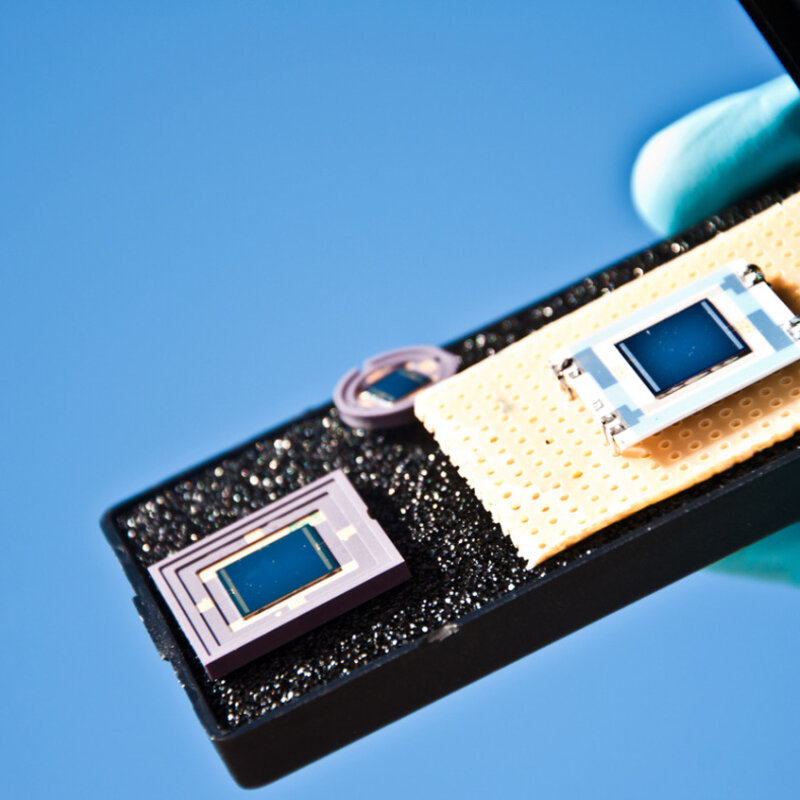
In response to this need, Predictable Quantum Efficient Detectors (PQEDs) emerged as a potential standard for self-calibration of optical power in sensor systems. However, their low availability and an inability to predict their internal and external quantum deficiencies (which quantify how well incident photons are converted to electrons within the PQED) prevented their uptake.
Solution
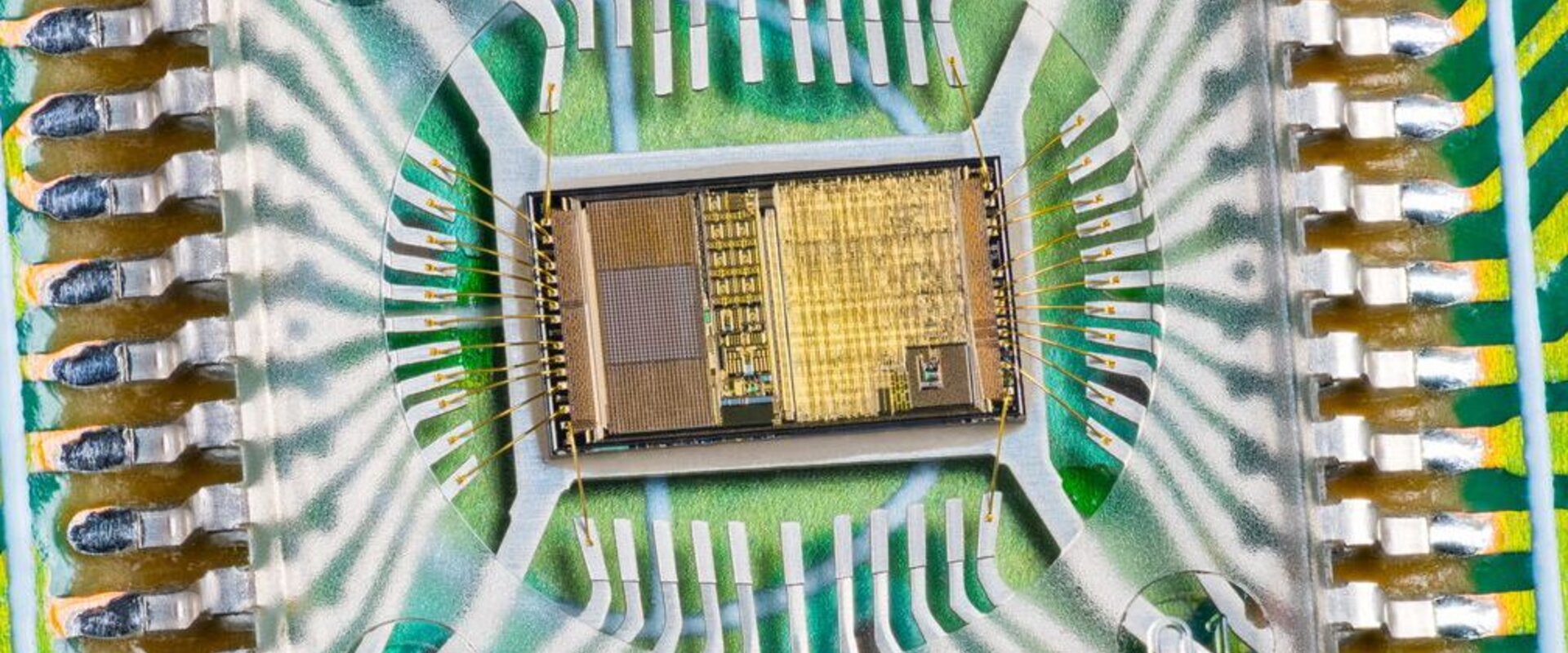
The chipS·CALe project investigated PQEDs to create an ‘NMI-ona-chip’ – a miniaturised primary standard which does not need external calibration – achieving record quantum efficiency and total losses of less than 10 ppm (an improvement of 100-1000 times over previous designs).
The project also majorly simplified traceability to the SI by creating the world’s first digital twin of a PQED to estimate spectral response over a broad range of wavelengths (400-850 nm).
The integration of digital tools and computer models into the development of the NMI-on-a-chip has allowed the project to achieve measurement accuracy at room temperature comparable to or better than existing standards at cryogenic temperatures.
This means the standard is suitable for use in integrated systems, or in remote locations far outside of a laboratory setting.
Impact
SINTEF, based in Norway, is one of Europe’s largest independent, non-profit research organisations, specialising across a wide range of fields including materials, microsystems and sensors. SINTEF run a micro- and nanofabrication facility which deals with development and small-scale production of high-tech silicon-based sensors, including radiation sensors, which are used in applications like material analysis, X-ray imaging and nuclear physics.
Before becoming a partner in the chipS·CALe project, SINTEF’s activities on radiation sensors were primarily focused on X-ray and particle detectors. chipS·CALe allowed the company to expand their activities to encompass photodetectors for detection of optical radiation, gaining substantial experience in designing and processing photodetectors. This has facilitated the development of other photodetector technologies with applications beyond metrology and the company now has a solid project portfolio, consisting of both new research projects and industrial projects. The record quantum efficiency of the PQEDs developed during the project has provided ultra-high sensitivity and predictability that far exceeds previously available commercial photodetectors.
The project’s work, which now allows for the reliable self-calibration of photodetectors, has been further developed in the follow-on Metrology Partnership project S-CALe Up.
- Category
- EMPIR,
- Standardisation,
- SI Broader Scope / Integrated European Metrology,