
A new instrument for large volume metrology and advanced manufacturing
Challenge
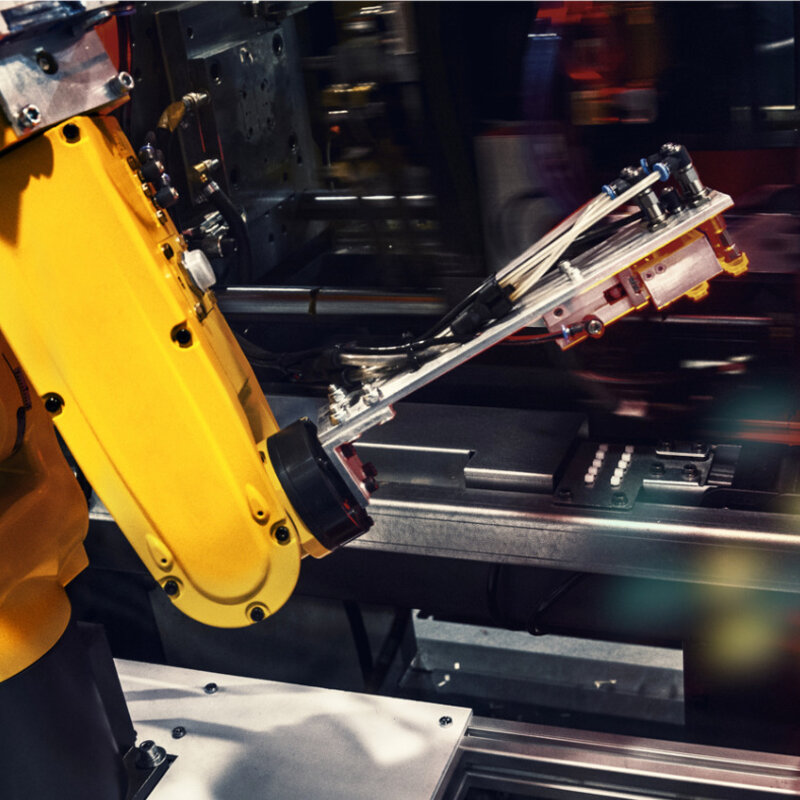
Many modern factories contain highly dynamic environments where robots work autonomously to assemble products. This presents a problem for those industries where individual components need to be tracked in real-time with high precision. Laser trackers can determine distance and position of single targets with sub-millimetre accuracy but can only handle multiple targets sequentially, and whilst multiple trackers could be used, this increases both time and comes at considerable expense.
In the project LUMINAR (2013-2016), the National Physical Laboratory (NPL), the National Metrology Institute of the UK, developed a prototype instrument based on divergent beam Frequency Scanning Interferometry (FSI). This utilised a single laser beam which was spread out over multiple targets equipped with retro-reflectors, allowing multiple measurements simultaneously. An internal hydrogen cyanide (HCN) gas absorption cell provided a spectral signal which could be probed by the laser, providing SI traceability. Although the initial instrument’s range was limited to a couple of metres, in the subsequent LaVA project (2018-2022) this was extended to over 10 m with a 50 μm accuracy using improved HCN spectroscopic data and task-specific measurement uncertainty evaluation for every measurement.
However, whilst a great improvement over commercial laser trackers, the prototype system was still limited to stationary or slowly moving targets.
Solution
During the DynaMITE project (2021-2024) NPL continued to develop the new FSI system to provide dynamic target capability. To achieve the faster scan rate, a commercial laser with multiple emitters was used, and Four Wave Mixing was employed to overcome the errors that can occur if the target changes position during measurements (termed a “Doppler shift”). To quickly identify targets for the laser and track them whilst moving, cameras were added as a photogrammetric solution. The multilateration algorithm used to precisely determine the position of the tracker heads was also updated, as was the patented beam steering mechanism which uses a holographic diffraction grating to steer individual laser beams to follow the motion of each target.
Impact
Following DynaMITE, the company K3 Metrology Ltd was formed in 2026 to commercialise the new Metralis instrument. It is the first system that can simultaneously track 6 or more targets with SI traceability at speeds encountered during precision robotic manufacturing operations, and coverage can be extended by adding more sensors to the network. Capable of real-time measurements in a 10 m x 10 m x 5 m volume, capturing both position and orientation (using multiple targets), it has an accuracy of 50 μm (0.05 mm) comparable to, or exceeding, current commercial systems. The new instrument also contains an automated calibration feature - eliminating the need for periodic checks or factory recalibration.
Aimed at advanced high-value manufacturing sectors it has demonstrated a robot control application at the Advanced Manufacturing Research Centre and in early trials during structural testing at an aerospace manufacturer. A timing study with a major manufacturing partner found that using Metralis can result in efficiency gains of 40%-60% over current processes and multiple aerospace primes are investigating its use for manufacturing next generation aircraft products.
Capability now exists in Europe to support Industry 4.0 automation and advanced manufacturing. In the long-term it will support advanced products such as lighter aircraft, efficiently manufactured vehicles, and the assembly of critical infrastructure such as next-generation power stations.
- Category
- EMPIR,
- Industry,
- New Technologies,
- EMN Advanced Manufacturing,