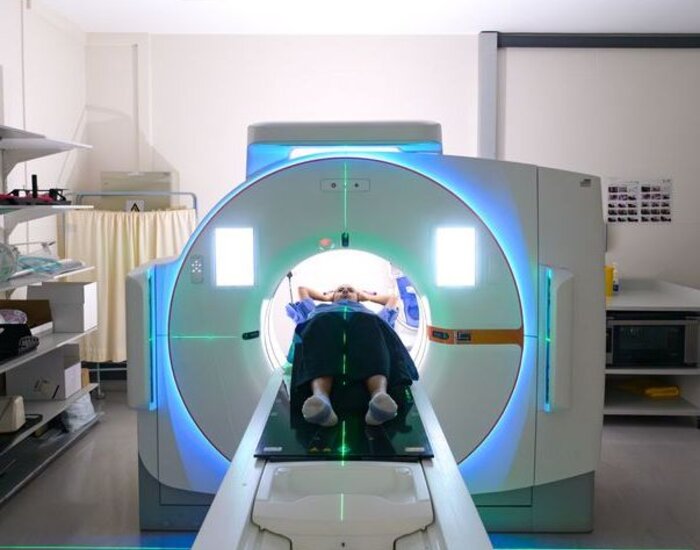
Image showing female in MRI scanner Female in MRI scanner
Date
Link
  • 21NRM05 STASIS project website
Tags
  • European Partnership on Metrology,
  • Standardisation,
  • EMN Mathematics and Statistics,

Standardisation improves safety of MRI scanning of patients with implants

<p>Higher‑quality diagnostic images for about 50 million EU citizens patients with implants</p>

Higher‑quality diagnostic images for about 50 million EU citizens patients with implants

Magnetic resonance imaging (MRI) is the gold standard for medical diagnostics with more than 40 million MRI scans performed in the European Union (EU) every year. While this number is increasing, scanning of patients with implants still poses a safety hazard. Implants can interact with the MRI scanner’s strong electromagnetic fields, resulting in dangerous tissue heating by radio frequency fields or gradient-induced heating of an implant. Even though international standards exist to address these risks, improvements are urgently needed and called for by implant manufacturers, equipment manufacturers and safety standards experts.

The completed Metrology Partnership project Standardisation for safe implant scanning in MRI (21NRM05 STASIS) created innovative technologies and updated and improved the relevant standards and methodologies, providing clinicians with more confidence when scanning their patients.

Benefits for manufacturers, testing laboratories and regulatory bodies  

Implant manufacturers are currently submitting applications for the approval of MRI safe or conditional safe implants when certain parameters are met, and the regulators are approving these applications according to existing standards, despite the recognised gaps. This project has closed many of these methodological gaps and contributed to updated, improved and new standards. This means that development costs for the implant industry will be reduced and overpriced costs for recalls or liability claims could be potentially avoided.

Benefits for the metrology and scientific communities

All measurement hardware and methodology are now easily accessible and reproducible through open-source publications. Several open-source software and open-source hardware repositories were created and are regularly being updated. This means that NMIs, measurement laboratories, scientific institutions and companies across Europe will be able to easily reproduce and apply these results to provide the traceability for measurements during MRI safety assessments. They will also be able to expand and extend them and translate them to future normative work.

Long term impact

The project will drive innovation and expand market opportunities for implant manufacturers, while strengthening MRI manufacturers’ position as technology leaders. It will deliver safer access to MRI for patients with implants by improving key standards and associated guidance. By avoiding overly conservative safety measures for both radio frequency and gradient‑induced heating, imaging performance can be improved, enabling higher‑quality diagnostic images in the presence of implants. Healthcare systems in the EU will benefit from cost reduction by the proposed smart implants approach, with quicker risk assessments and MR scan times due to improved imaging performance in the presence of implants.

Project co-ordinator, Lukas Winter from PTB, said:

”No more STASIS! We have advanced scientific innovation by integrating open-source technologies and methodologies. By supporting normative activities and contributing to the development of new standards for next-generation technologies, we are ensuring safety for patients.”

This Metrology Partnership project has received funding from the European Partnership on Metrology, co-financed by the European Union Horizon Europe Research and Innovation Programme and from the Participating States.


Want to hear more about EURAMET?

Sign up for EURAMET newsletters and other information

Follow us on LinkedIn and X