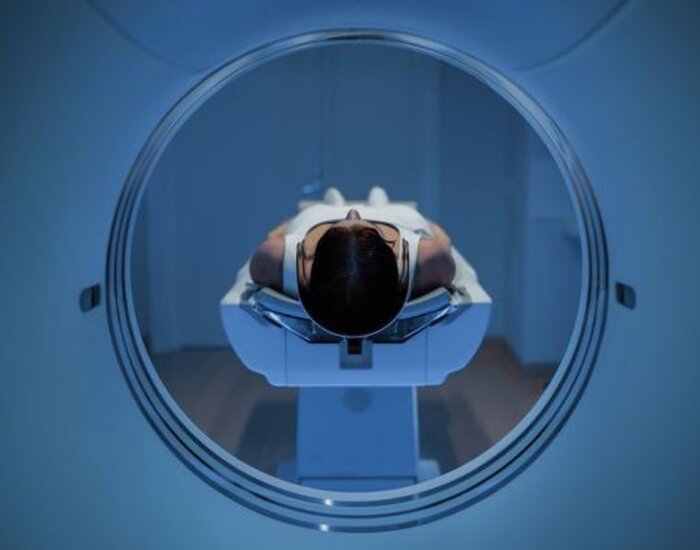
Image showing female patient lying on MRI scan bed Female patient lying on MRI scan bed
Date
Tags
  • European Partnership on Metrology,
  • Metrology for Digital Transformation,
  • EMN Mathematics and Statistics,

Partnership project contributes to new guidelines for quantitative magnetic resonance imaging

Developing the metrology framework to facilitate non-invasive ‘virtual’ biopsies

European Health policy supports the modernisation and digitalisation of health systems to protect and improve the health of EU citizens. Magnetic Resonance Imaging (MRI) uses magnetic fields and radio waves to produce detailed images of the inside of the body, and is a key part of this policy. However, ordinary MRI images are qualitative not quantitative and not always comparable between different MRI scanners or scans made at different locations.  

Recently, quantitative MRI (qMRI) techniques have emerged, such as Magnetic Resonance Fingerprinting (MRF) and Electric Properties Tomography (EPT). The reliability of these new approaches remains an issue due to the complexity of the measurement pipeline. A dedicated metrological framework is therefore needed to produce pixel-wise maps of parameters and their uncertainties, to make qMRI results trustworthy, objectively comparable and readable by a computer for assessments.

The Metrology Partnership project Trustworthy and quality-assured quantitative magnetic resonance imaging (24DIT01, APULEIO) is a three-year project which will run until 2028. During the first year it has contributed to three guidelines developed in the framework of the Study Group on Electro-magnetic tissue properties (EMTP) of the International Society for Magnetic Resonance in Medicine (ISMRM) and published in the Journal of Magnetic Resonance Imaging.

  1. Standardization of MR Electrical Properties Tomography aims to standardise the reporting of methods and results to support reproducibility and comparability of MR-EPT.
  2. Construction of Phantoms for MR Electrical Properties Tomography (From Structure to Composition) outlines the importance of MR-EPT phantom design and construction, focusing on structure, composition and reliability.
  3. MR Electrical Properties Tomography Acquisitions is about the acquisition of input data.

These guides will help make EPT results consistent and comparable, and mean they can be performed in different places. In the long term, the comparability of EPT and, more broadly, qMRI medical imaging will help decrease the number of scans needed and will allow the effective monitoring of the course of a pathology over time.

Project co-ordinator, Luca Zilberti, from INRiM said:

"Standardising EPT, as well as qMRI techniques, is a crucial step toward their widespread clinical adoption. Much like the Metre Convention established a common language for measurement, these guidelines aim to provide the MRI community with a shared framework that enables quantitative tomographic results to be interpreted consistently and unambiguously across institutions. Combined with rigorous estimates of measurement reliability, this approach will pave the way for qMRI to become a trustworthy, non-invasive alternative to conventional tissue biopsies."

 This Metrology Partnership project has received funding from the European Partnership on Metrology, co-financed by the European Union Horizon Europe Research and Innovation Programme and from the Participating States.


Want to hear more about EURAMET?

Sign up for EURAMET newsletters and other information

Follow us on LinkedIn and X