Building partnerships between measurement specialists and the climate & ocean observation communities to enhance metrological best practice across Europe and beyond.
Back from the depth of the ocean; image: courtesy of Rieke Schäfer/PTB
Analysis of ocean variable measurement practice finds measurement uncertainty often misunderstood
Snapshot survey of oceanographers highlights barriers of time and cost impeding efforts to improve observation data quality and equivalence
Introduction
A snapshot survey carried out by PTB and LNE for the Climate and Earth Observation European Metrology Network has revealed that concepts of measurement uncertainty are rarely, if at all, applied in practice and are often misunderstood by oceanographic researchers.
Responses to a survey of seven practitioners representing five oceanographic institutions, some onboard the GEOTRACES Sonne vessel as it traversed the Pacific Equator last year, highlighted that potential metrological means to improve data quality and equivalence of measurement results were considered overly time-consuming and costly.
Practical constraints to realising metrological concepts
It should be stressed that this initial survey and its analysis cannot be considered comprehensive or representative of global practice. It also carries no criticism of the current practice of these experts. Nonetheless, it does reveal some practical constraints with respect to the realisation of metrological concepts. It also suggests a systematic follow-up study could be worthwhile. Such a study might support efforts of the metrological community to implement metrological concepts in oceanography by highlighting the potential benefits and provide support for overcoming barriers to delivering best practice.
The preliminary study (which can be made available on request) was conducted last year, based on interviews of experts, including some operating onboard the same cruise mission described by Rieke Schäfer, a PhD student at the electrochemical laboratory of Physikalisch-Technische Bundesanstalt (PTB) and of GEOMAR Helmholtz Centre for Ocean Research Kiel, on a 16,000 km mission from Ecuador to Australia, completed on 2 June 2023. See: A metrologist at sea.
Practitioners were interviewed about typical practices for measuring fourteen ocean variables. While the sample of experts was small and so these views may not represent global practice, the findings confirm previous reviews, including the COO EMN (European Metrology Network) Stakeholder Needs Review, that metrological concepts of traceability, uncertainty, or official accreditation schemes to verify calibration and measurement capabilities according to harmonised standards, are rarely applied by the oceanographic community.
Lack of metrological principles to ensure quality of measurement data was also highlighted at the BIPM/WMO workshop on climate action in September 2022.
Gap analysis for ocean variable measurements
PTB, with the support of LNE, produced a gap analysis addressing the Climate and Ocean Observations EMN’s ocean theme, considering where there might be metrological deficiencies and needs.
The interviews addressed the following ocean variables:
pH
total alkalinity (TA)
pCO2
dissolved inorganic carbon (DIC)
temperature
salinity
chlorophyll
oxygen
ocean flow
ammonium
aluminium
trace metals
nutrients (silicate, nitrate, phosphate)
turbidity
The survey found adequate routes of traceability were realised for a few quantities like temperature and salinity, but rarely considered in many others — such as current measurements for biological quantities.
Measurement uncertainty was reported rarely used at all and often misunderstood. Accreditation of calibration labs and conducting comparison measurement as means to improve data quality and ensure equivalence of measurement results were seen only occasionally, mainly because such efforts were considered time-consuming and costly.
The Ocean Best Practice and Standardisation System is an effort by the community to improve measurement practice. However, these best practices are very diverse and focus on harmonising data processing and aligning procedures within specific projects rather than ensuring comparability of data within stated uncertainties in the metrological sense.
Support for implementing metrological concepts in oceanography
It must, however, be emphasised that the number of measurement quantities, i.e., the so-called essential ocean variables, and associated measurement methods and documents is large, so would require a comprehensive study to produce a fully representative picture.
Through initiatives such as Project MINKE, efforts are underway to support the oceanographic community, such as by communicating the importance of metrology and helping prepare communities to work together with the COO EMN.
At least, this study provides a baseline snapshot that substantiates the initial impression of metrologists. In fact, it would be worthwhile to initiate a more systemic study, which could provide sound support for efforts of the metrological community to implement metrological concepts in oceanography.
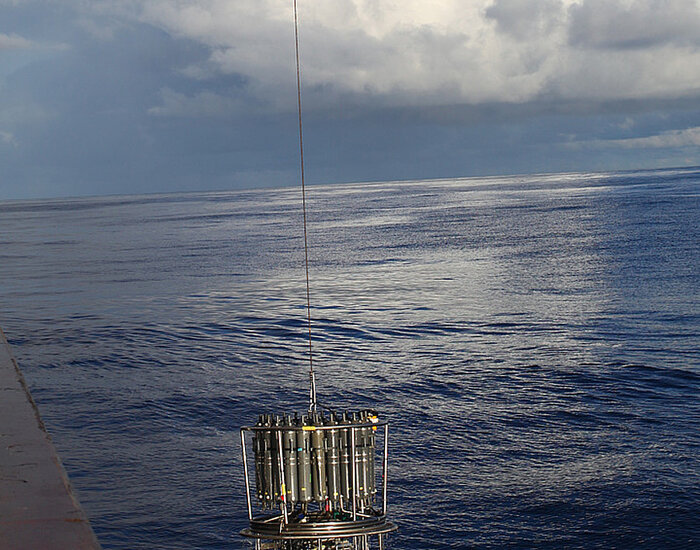 Back from the depth of the ocean; image: courtesy of Rieke Schäfer/PTB