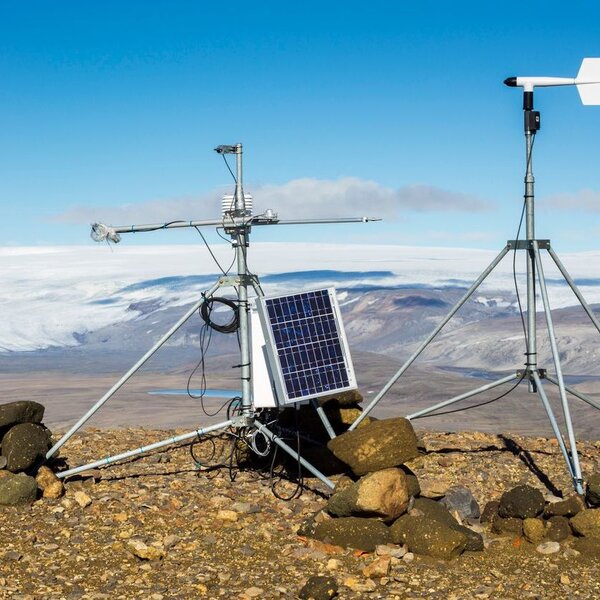
<p><em>An EMPIR project supported the European Metrology Network for Climate and Ocean Observation – focusing on reliable metrology in this important area</em></p>
An EMPIR project supported the European Metrology Network for Climate and Ocean Observation – focusing on reliable metrology in this important area
Monitoring the health of climate and ocean
Understanding climate change, supporting the sustainable use and protection of the oceans, and providing innovative climate services, all require reliable observations. Climate and Ocean observations, and the modelling efforts that build on them, provide policy makes with the information they need to make informed decisions.
The Global Climate Observing System (GCOS) has defined 55 Essential Climate Variables (ECVs) to be monitored with global, multi-decadal measurements. The Global Ocean Observation System (GOOS) supplements these with additional quantities that are more broadly important for oceanography in its Essential Ocean Variables (EOVs). For society to obtain the full benefit from these observations, it is important that they are robust and quality assured. Significantly, the World Meteorological Organization (WMO), the Committee on Earth Observation Satellites (CEOS), and GCOS itself all require the application of metrological (measurement science) techniques to achieve that robustness.
Launch of first European Metrology Network
In 2019 the EMPIR project Support for a European Metrology Network for climate and ocean observation (18NET04, ForClimateOcean) began establishing a focal point for metrologists and experts in the climate and ocean observation fields to support coordination amongst Europe’s metrology institutes in providing metrological expertise to meet those GCOS and GOOS requirements. That same year the project helped successfully launch of one of EURAMET’s first European Metrology Networks (EMN), the European Metrology Network for Climate and Ocean Observation (EMN COO), which has been used as a model for subsequent EMNs.
Building a common language
Prior to formation of the EMN, many measurement institutes in Europe were individually supporting the climate and ocean observation communities in bringing metrological principles into their observations. The ForClimateOcean project, and the EMN it established, brought these independent efforts together, and provided new opportunities for jointly connecting with the observation communities, to develop an understanding of observation community needs and to work towards common standards and approaches by sharing good practices.
The project consortium liaised with global and European stakeholders through workshops and surveys and carried out systematic reviews to identify gaps in metrology applied to climate and ocean observations. Based on these efforts, a Stakeholder Needs Report was developed for the EMN in 2021 and a Strategic Research Agenda in 2022. This work, along with the greater links forged, supported all the member metrology institutes in defining their research programmes and project activities, and in working more confidently with the observation communities.
Liaising with other communities – climate, space and ocean
The EMN also reached out and influenced communities in the environmental field. In 2022 it had a leading role in supporting the coordination of the workshop Metrology for Climate Action hosted by BIPM and WMO. The workshop’s aim was to identify the metrology needs in environmental observation for society, how to coordinate efforts, and how to make meaningful observations of a changing planet. The full report of this important event was published in 2023 and validated and extended the strategic direction that had been established by the EMN through the ForClimateOcean project. EMN members are also included in the WMO’s Expert Team on Measurement Uncertainly.
With direct and indirect support of the project, EMN members have been able to influence several international organisations coordinating observations. EMN members support the WMO’s Expert Team on Measurement Uncertainty, participated in the Working Group on Calibration & Validation (WGCV) of the Committee on Earth Observation Satellites and act as Central Calibration Laboratories (CCL) for the Global Atmosphere Watch (GAW) programme.
The EMN also reached out to the Aerosol, Clouds and Trace Gases Research Infrastructure (ACTRIS) which has led to this research infrastructure agreeing to become a partner of the EMN. EMN members have also been invited to join the International Association for the Physical Sciences of the Oceans (IAPSO) best practice study group on the Calibrating Measurements of Total Dissolved Inorganic Carbon in Seawater. This participation was supported by efforts within the project to understand the standardisation needs in oceanography.
Summary
At the end of the ForClimateOcean project in 2024, the EMN had nearly 30 participating member organisations, working closely together, and with stakeholder organisations, in establishing metrological approaches to support the climate and ocean observation community – fulfilling the initial ambitions of the EMPIR project.
The activities of ForClimateOcean have helped support EURAMET’s vision for EMNs: to be positioned to ensure a sustainable and world-leading metrology capability for Europe, based on high-quality scientific research, with effective and inclusive infrastructure, able to meet the rapidly advancing needs of end users.
In time, this work will help ensure a sustainable ocean and significantly improve climate models, reduce variance in forecasts, and enable more reliable decision making in the efforts to combat climate change.
The coordinator Emma Woolliams (NPL) said about the work:
“I am thrilled by how the EMN for Climate and Ocean Community grew from a concept to a thriving, international collaboration through the ForClimateOcean project. The project provided us with the opportunity to connect our individual efforts, becoming together far more than the sum of the parts of our earlier activities.”
This EMPIR project is co-funded by the European Union's Horizon 2020 research and innovation programme and the EMPIR Participating States
Want to hear more about EURAMET?
Sign up for EURAMET newsletters and other information
Follow us on LinkedIn and X/Twitter