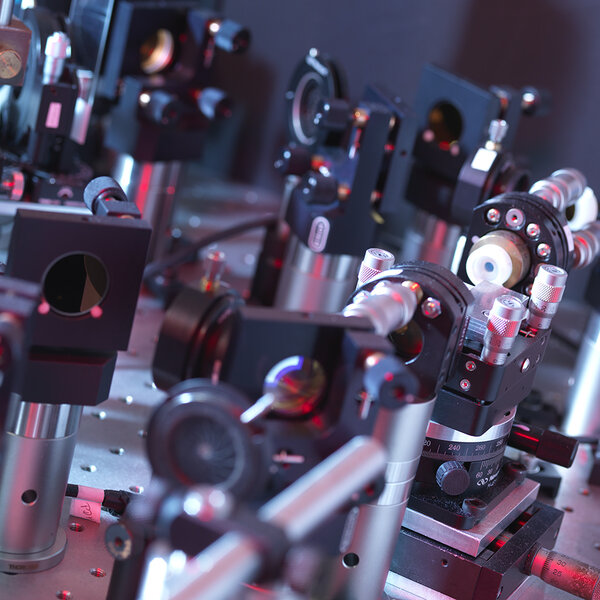
Four EMRP and EMPIR collaborative projects prepare for the photonics measurement challenges required by the ‘second quantum industrial revolution’.
Four EMRP and EMPIR collaborative projects prepare for the photonics measurement challenges required by the ‘second quantum industrial revolution’.
Co-authors: Christopher Chunnilall (NPL), Ivo Pietro Degiovanni (INRiM), Stefan Kück (PTB) and Marek Šmid (CMI)
Introduction
Many existing technologies such as microprocessors, solid state imaging devices and lasers are based on quantum physics. Just as classical physics underpinned the Industrial Revolution, these “quantum 1.0” technologies underpinned the Information Age. The emerging “quantum 2.0” technologies that rely on the creation, detection and manipulation of a single or a few quantum states and more subtle, less familiar aspects of quantum mechanics, such as superposition and entanglement, have the potential to create a “second quantum revolution”. Günther H. Oettinger, Commissioner Budget & Human Resources and former Commissioner for the Digital Economy and Society, outlined in the Commission’s plan that this second revolution “should lead to devices with far superior performance and capabilities for sensing, measuring and imaging; for communication, simulation and computing. Quantum technologies ultimately are expected to open new opportunities to address grand challenges in such fields as energy, health, security and the environment. Some are already starting to be commercially exploited. Others may still require years of careful research and development. Yet others we cannot even imagine today.” Over 2 billion euro funding has been provided by the EU Quantum Flagship and national programmes in the UK, Germany and the Netherlands to support the commercialisation of quantum 2.0 technologies.
The need
Quantum metrology (metrology is the science of measurement) aims to develop the new measurement capability needed for the commercial success of these quantum technologies and, also, to exploit quantum-enhanced techniques to surpass the sensitivity, precision and accuracy of conventional techniques. In photonics, a major challenge is to bridge the traceability gap from the International System of Units (SI) currently established in the classical regime to the single-photon level where quantum photonic devices operate. Calibrating the quantum features and behaviour of these devices requires not just translating traditional measures to the single-photon level, but the development of new metrics, methods and instrumentation for quantifying them.
Four EURAMET photonics projects have each brought together experts from different countries in order to tackle the measurement challenges in this highly technical area. Sharing their combined expertise and resources in these collaborations have enabled EURAMET and the National Metrology Institutes and Designated Institutes to make faster and more efficient progress than if the institutes worked in isolation.
The EURAMET Projects
Since 2010, EURAMET has significantly boosted efforts to develop a robust metrology infrastructure supporting emerging quantum photonic technologies. Major progress has been achieved through the following projects within the European Metrology Research Programmes, EMRP and EMPIR:
These have primarily focussed on the following topics: