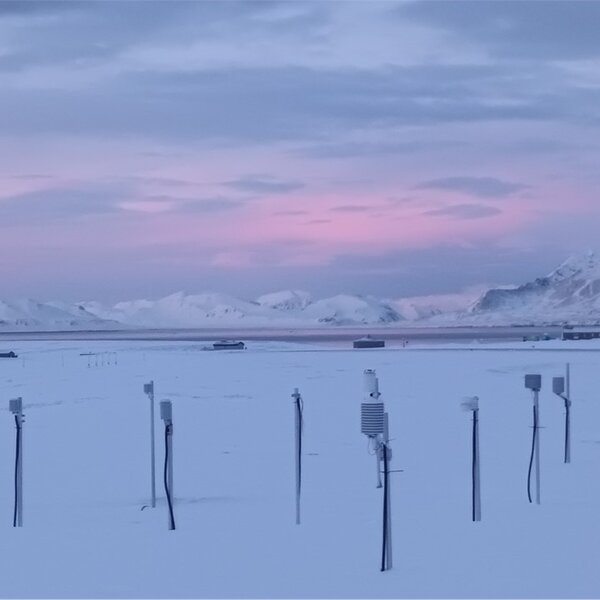
<p><em>Polar regions are very sensitive to climate change – and monitoring these regions provides early indications of potential climate trends</em></p>
Polar regions are very sensitive to climate change – and monitoring these regions provides early indications of potential climate trends
The temperatures in the Arctic continue to rise at three times the global annual average. Not only does the melting of ice and snow contribute to rising sea levels, but it could also contribute to extreme temperatures in other parts of the world. To help combat global warming it is essential that measurements, such as air temperature, are rigorously monitored. Air temperature measurements are mainly performed by resistance thermometers protected by shields with the aim of avoiding the influence of solar radiation and rain on thermometer’s readings.
Combinations of different models of thermometers and different models of radiation shields are used around the world since neither a specific thermometer, nor a radiation shield have been defined as a ‘reference system’ so far.
As each radiation shield creates a specific microclimate inside, air temperature measurements depend on the combination of both shield and thermometer – which makes comparability between different systems around the world limited and creates inconsistencies in climate measurements. The World Meteorological Organization (WMO) recognises the field intercomparison of instruments as the most powerful tool for increasing the comparability of measurements taken at different times and in different places. The WMO, aware of the importance of air temperature measurements in the evaluation of climate change and the strong influence of external factors on air temperature measurements, recommended the organisation of field comparisons of radiation shields in extreme climates. Comparisons of radiation shields have been performed in different climate conditions but an intercomparison of radiation shields in the polar climate was still required.
This problem has been addressed by the now completed EMPIR project Increasing the comparability of extreme air temperature measurements for meteorology and climate studies (19SIP06, COAT).
Building on the work performed in the earlier EMRP project MeteoMet2, members of the consortium, which included experts from metrology, meteorology and the artic environment, performed two measurement campaigns using 10 different models of radiation shields. The first campaign was laboratory based where all the instrumentation was calibrated just before and just after the second field campaign at the Arctic research station, in NY-Ålesund, Norway.
This second campaign was conducted at the Arctic station for over a year using 41 thermometers. As well as temperature, which was measured every 2 minutes, data was also recorded for wind speed and direction, solar radiation, humidity, and pressure. From the data, the consortium derived a reference shield that will allow more comparable measurements of temperatures in the polar climate.
The campaign results were published in a paper entitled COAT Project: Intercomparison of Thermometer Radiation Shields in the Arctic along with the data sets generated and the work has been shared with the primary supporter of the project, the WMO. The validated intercomparison protocol was submitted for consideration to WMO INFCOM/SC-MINT, WMO’s Standing Committee on Measurements, Instrumentation and Traceability, as a reference document.
The comparison protocol, the results of the field comparison and the guidance developed in the project, will support the harmonisation of future measurements and intercomparisons. In turn, the resulting, more accurate air temperature data will help guide climate policymakers to implement more appropriate climate policies.
The coordinator of the project Carmen Garcia Izquierdo (CEM) said about the work:
"With this project, we wanted to create solutions to increase the comparability of Air Temperature Measurements. In addition, building a metrological facility in field and under extreme climate conditions (in the Arctic) was challenging and highly appreciated by the WMO, which requests and encourages the development of field experiments with the aim of increasing the knowledge about metrology and climate.”
This EMPIR project was co-funded by the European Union's Horizon 2020 research and innovation programme and the EMPIR Participating States.
The EMRP joint research project was part of EURAMET’s European Metrology Research Programme. The EMRP was jointly funded by the EMRP participating countries within EURAMET and the European Union.
Want to hear more about EURAMET?
Sign up for EURAMET newsletters and other information
Follow us on LinkedIn and X/Twitter