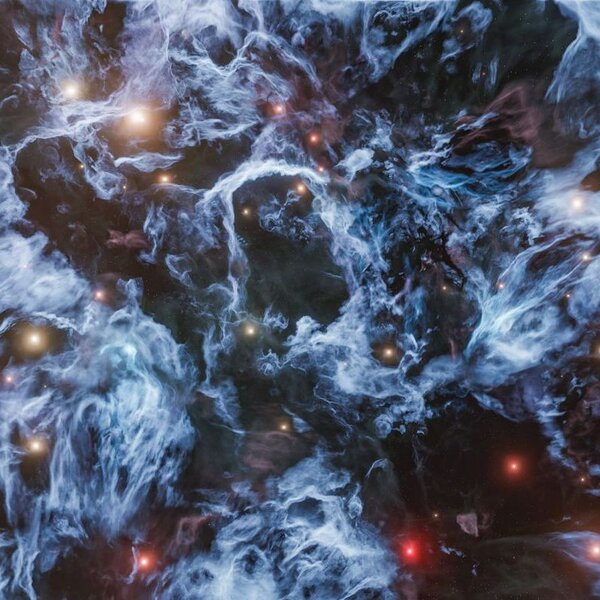
<p><em>Around 85% of the universe’s matter is ‘invisible’ and can only be detected by its gravitational effect</em></p>
Around 85% of the universe’s matter is ‘invisible’ and can only be detected by its gravitational effect
The missing mass of the Universe
In the early 20th century astronomers and physicists began to suspect there was a major anomaly in our understanding of the universe. In the 1980s this was confirmed when it was realised that - to keep the stars in their orbits - galaxies must contain around six times more matter that can only be detected by its gravitational effect. This ‘dark matter’ appears not to absorb, reflect, or emit electromagnetic radiation over its entire range – from radio waves to gamma rays. The only evidence of its existence so far is the effect of its gravity on normal matter.
Dark matter candidate
One possibility for dark matter is that it consists of extremely light particles termed ‘ultralight bosonic dark matter’ (UBDM). If this is the case then, when these ultralight particles interact photons, it would lead to oscillations or periodic changes within the interaction between charged particles, such as electrons and protons. As the strength of this interaction is described by a fundamental physical constant termed the ‘fine structure constant’ these oscillations can also be seen as oscillations of the constant.
Using optical clocks to hunt for dark matter
This is exactly what the EMPIR project Two-species composite atomic clocks (20FUN01, TSCAC) has examined using an ‘optical clock’ based on a reference transition of an ytterbium ion which is particularly sensitive to possible changes of the fine structure constant. Optical clocks have the potential to be the successors of caesium clocks, which have been used to realise the SI second since 1967.
This sensitive optical clock was compared with two other clocks over a measurement period of several months and the data enabled a search for oscillations of the fine structure constant on a magnified scale.
Whilst a detection of dark matter was not achieved, the absence of a signal allowed a determination of the upper limits of the possible interaction of photons with UBDM to be improved by an order of magnitude over a wide range.
The work has now been published in the journal PHYSICAL REVIEW LETTERS and featured in a Physics press release in June 2023. More information on this can be found on the website of PTB, the National Metrology Institute of Germany, where the work was performed.
Dr Nils Huntemann (PTB) who coordinated the EMPIR project, and who was also senior author on the article, said about the new data:
“Although our initial aim of the comparison was to verify the performance of the clocks, it is amazing to see how much information these comparisons contain, allowing us to test fundamental physical principles and even investigate curiosities such as dark matter.”
Although the nature of dark matter still remains a mystery, thanks to the work of this EMPIR project, the way these enigmatic particles interact with known-matter particles has been narrowed down.
This EMPIR project is co-funded by the European Union's Horizon 2020 research and innovation programme and the EMPIR Participating States.
Want to hear more about EURAMET?
Sign up for EURAMET newsletters and other information
Follow us on LinkedIn and X/Twitter