<p>Developing new standards to accelerate the use of microfluidic devices in medical and pharmaceutical applications</p>
Developing new standards to accelerate the use of microfluidic devices in medical and pharmaceutical applications
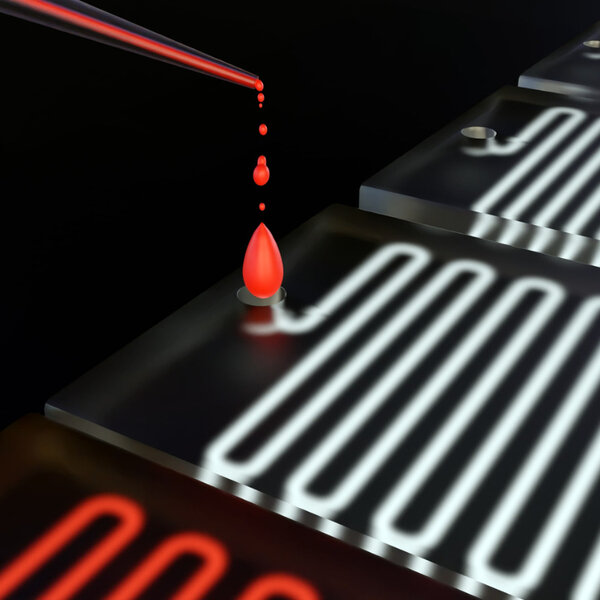
Microfluidics, concerned with fluid-handling in the nano-to-millilitre scale, is used in medical applications for on-the-spot diagnosis, including pregnancy, glucose, and pH tests. Although microfluidics is helping to boost innovation in medical diagnostics, until now drug development products on the market have not been traceable to reference standards and there is a lack of well-established metrology or calibration procedures. This is a huge obstacle for wider implementation of reliable microfluidics devices.
EMPIR project Establishing metrology standards in microfluidic devices (20NRM02, MFMET) is working to develop the metrology necessary to support standardisation for microfluids. Factors such as flow rate and liquid properties are being examined for microfluidics devices for pharmaceuticals, biomedical and mechanobiology applications. The most appropriate protocols will be incorporated into a EURAMET calibration guideline as well as ISO standards.
The project consortium has developed a set of videos that demonstrate best practice and technique in microfluidic measurements:
This video presents the MFMET project, and it introduces metrology and standardisation in the context of microfluidics.
This video presents optical methods for measurements of dimensions (for example width, height, and length) of microfluidic devices and microchannels. Among the presented methods are optical microscopy and confocal laser scanning microscopy.
All microfluidic devices need a connection to the outside macroscopic world, e.g. for samples or reagents. This video presents information of and requirements for connectors/interfaces in microfluidics.
This video presents flow in microfluidics. It shows measurements of flow and pressure, and a characterisation method for determining hydrodynamic resistance.
This video presents measurements of surface properties in microfluidics. The measured quantities are wettability, surface energy, and surface roughness.
This video is shows how leakage testing can be evaluated in microfluidic devices.
Project Coordinator Elsa Batista from IPQ said
‘The MFMET project achieved remarkable success by fostering collaboration among end users, manufacturers, academia, and metrologists. Together, they developed standardised documents and guidelines related to microfluidic technology. Notably, the consortium actively contributed to shaping the future roadmap of ISO/TC48/WG3 for microfluidic devices and participated in the Focus Group from CEN on Organ-on-Chip technology roadmap development. In terms of dissemination, the project produced over 30 documents, published four peer-reviewed papers, three articles in the popular press, and created several videos showcasing best practices and techniques in microfluidic measurement quantities. As the coordinator of the MFMET project, I am immensely proud to be part of its accomplishments.’
This EMPIR project is co-funded by the European Union's Horizon 2020 research and innovation programme and the EMPIR Participating States.
Want to hear more about EURAMET?
Sign up for EURAMET newsletters and other information
Follow us on LinkedIn and X/Twitter